Math Is Fun Forum
You are not logged in.
- Topics: Active | Unanswered
#1476 Re: Jokes » Why is six afraid of seven? » 2005-12-30 18:44:38
Or maybe 6 was afraid 7 would ask him the inevitable question: "why was 6 afraid of 7?" because he'd heard it 7 times. ;-)
#1477 Re: Jokes » Why is six afraid of seven? » 2005-12-30 18:42:07
Or maybe 7 threatened to differentiate 6, reducing him to zero! (runs screaming from the room)
#1478 Re: Jokes » Why is six afraid of seven? » 2005-12-30 18:40:02
Or maybe 6 was afraid of 7 simply because 7 is bigger then him.
Or perhaps 6 was afraid of 7 because the two of them together make 13, an unlucky number.
#1479 Re: Jokes » Why is six afraid of seven? » 2005-12-30 18:36:46
Actually it was because 7 is a prime number, and they are spooky!
BEWARE THE PRIME NUMBER!
#1480 Re: Dark Discussions at Cafe Infinity » obsessed with proofs » 2005-12-30 16:42:17
perhaps. But can you prove 2 + 2 will always equal 4? We obvserve it happens every time we try but technically can't prove it. Does that make it less true?
I agree proofs should be done most of the time, but sometimes proving an obvious concept feels redundant.
#1481 Dark Discussions at Cafe Infinity » obsessed with proofs » 2005-12-30 13:40:16
- mikau
- Replies: 6
I few weeks ago I learned about the critical number (closed interval) theorem. It stated that if f(x) is a function continious on an interval [a,b] the maximum and minimum values on the interval are either at f(a), f(x) or the critical numbers of the function f. I would not have realized this, but its quite obvious once its presented to you. But my mathbook said "the proof of this concept is beyond the scope of this book".
To me it seems obvious. Why would we have to prove it?
#1482 Re: Help Me ! » Inverse Functions!?? » 2005-12-29 12:54:24
Ah, I forgot. The graphs of an inverse function is the graph of the original function, reflected about the line y = x. So you could also draw a graph of the two functions and determine whether they appear to be relfections about the line y = x.
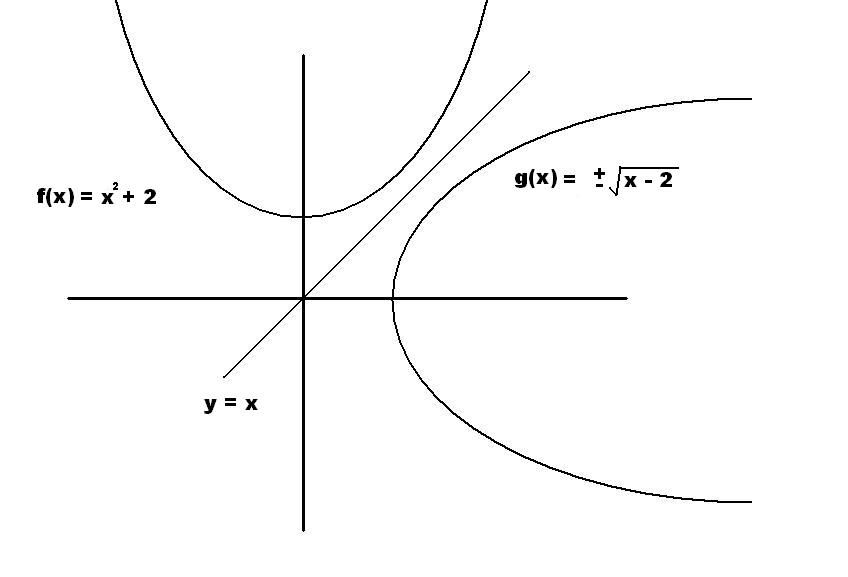
technically g(x) is not a function as a function only returns one value for a given input. It does not pass the vertical line test and does not qualify as a function. I just drew it that way to illustrate how the reflection works.
#1483 Re: Help Me ! » Inverse Functions!?? » 2005-12-29 12:43:22
Two ways you can prove it? The only way I know is this:
if g(x) is the inverse of f(x) then g(f(x)) = x I can't think of another way other then maybe doing it backwards: f(g(x)). Both will give you x if they are inverse functions.
I think I remember reading something about decomposing functions, I'll take a look.
#1484 Re: Help Me ! » I need help with these problems please.. » 2005-12-29 12:35:55
bery good? are you being funny?
#1485 Re: Help Me ! » I need help with these problems please.. » 2005-12-29 11:20:02
Not stupid. You just need practice. Math isn't hard. It just takes some getting used to.
#1486 Re: Help Me ! » I need help with these problems please.. » 2005-12-29 11:04:28
Nah we just pretend to be.
#1487 Re: Help Me ! » I need help with these problems please.. » 2005-12-29 08:35:32
2 real roots when the discriminant is positve. 2 imaginary roots when the discriminant is negative. Two equal roots when the discriminant is zero.
If you forget what the descriminant is:
You can find the roots of a quadratic equation of the form:
ax^2 + bx + c
using the quadratic formula:
(-b +- √ b^2 - 4ac)/2a
the part of the formula inside the radical side is the descriminant.
√ b^2 - 4ac
when the descriminant (b^2 - 4ac) is positive, it has two real roots. When it is negative, it will require the square root of a negative number and thus only has imaginary roots. When the discriminant is 0 the roots will be -b/2a + 0, and -b/2a - 0 which are obviously equal.
#1488 Re: Help Me ! » High School Student needs your help please... » 2005-12-28 14:47:38
thank you so much for taking your time to help me solve the problems....this is extremely helpful to me....:-)
No problem at all. I only wish high school chicks would ask for help with math in my neighborhood. ;-)
John E franklin, averaging the zero's, to find the axis of symetry. Why didn't I think of that? Just remember this is only ok to do when the parabolla is verticle. It cannot be solved for x instead and the xy coefficient must be zero. (remember the general conic equation)
#1489 Re: Jokes » identities » 2005-12-28 09:03:14
lol!
#1490 Re: Help Me ! » High School Student needs your help please... » 2005-12-28 07:57:27
Well basicly its the same problem presented in two different forms. When you graph an equation or a function on a cartesian coordinate grid, the horizontal location on the x axis represents the value of what they call the independant variable. The height on the y axis represents the value of the expression evaluated at that location.
Therefore if you have the eqaution:
L - S = 10
And
S * L = Product
We can rearrange the first equation to find L = 10 + S and subsitute this expression for L:
S * (10 + S) = Product
10S + S^2 = Product
if we graph were to replace S with x and Product with Y we would have:
x^2 + 10x = y
this is the eqaution of a parabolla. This graph represents the product of the two numbers who's difference is 10. Therefore we can look at the low point on the graph to find the minimum product, and note what value of x is required. We used x to represent S so we can use the x coordinate of the lowpoint on the graph for S, and the solve for L. The equation y = x^2 + 10x is a parabolla that opens upward, thus the vertex is the lowpoint on the graph. Using any of the various methods to find the vertex, we find the x coordinate of the vertex is x = -5. We used x to represent S so S = -5
Now lets use this value of S in the original equation to find L.
L - S = 10
L - (-5) = 10
L + 5 = 10
L = 5
So the two numbers are 5 and -5. :-)
#1491 Re: Jokes » identities » 2005-12-27 13:13:31
credit card = ∑(1, infinity) debt
#1492 Re: Help Me ! » derivative of an exponential function » 2005-12-27 12:54:44
lol. I just saw this yesterday and learned how to do it today. Yeah I suspected you could write it in tersm of e but wasn't sure. Very cool.
#1493 Re: Jokes » identities » 2005-12-27 08:30:03
Rather, Maths > fun
#1494 Re: Help Me ! » derivative of an exponential function » 2005-12-26 19:30:47
I'm not sure I've done differentiation of the form u^x yet. I think I know how to do it but I'm not sure so I'll let someone who knows tell you.
#1495 Re: This is Cool » Merry Christmas everyone!!! » 2005-12-26 19:11:41
Check this out! I wanted a book bag to carry my calculus book in. I got one and it looks so much like my calculus book, you'd think it was made for it!
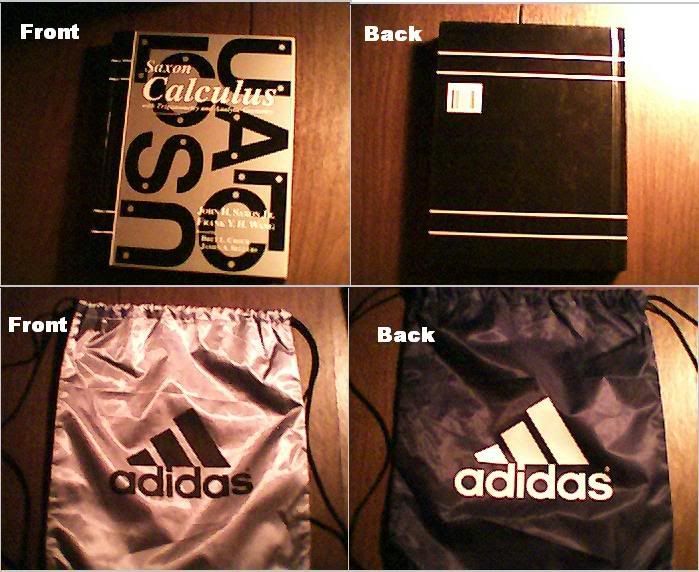
Is that awsome or what?
#1496 Re: Jokes » identities » 2005-12-26 18:33:51
Hahaha! This is great stuff! Keep it coming!
Math = anything and everything that ever was uber!
science = math + wiseguy
#1497 This is Cool » Merry Christmas everyone!!! » 2005-12-24 20:23:35
- mikau
- Replies: 6
Hope Santa got you all the mathbooks, graphing calculators and nerd clothes you asked for! ;-)
Merry Christmas everyone and God bless!
#1498 Re: Jokes » identities » 2005-12-24 19:52:02
Decaf = Coffee/infinity 
#1499 Jokes » identities » 2005-12-24 19:50:57
- mikau
- Replies: 14
sports identities:
soccer = 1/basketball
ping pong = tennis/10000
hockey = soccer + stick
baseball = basketball - hoop + bat - action.
skiing = 2(snowboarding)
football = soccer + wrestling
boxing = hockey - stick
Add your own identities!
#1500 Re: This is Cool » The TV show Numb3rs and probability » 2005-12-24 19:07:35
I find the description of the rules unclear.
The player chooses one [lets say #4] to hold. Then randomly opens all cases except the one they chose and another [let's say 23].
He "randomly" opens all the remaining cases? Why not just open all the remaining cases at once? I'm not following.
Maybe I should just stop asking questions and watch the show.