Math Is Fun Forum
You are not logged in.
- Topics: Active | Unanswered
#1376 Re: Help Me ! » limits » 2006-01-22 10:56:34
by convention √x means the positive square root of x. Not just the square root of x. The negative square root is simply represented by -√x.
We say √2^2 is 2, since by convention, the expression asked for the positive square root. If you ask for √(x^2), we want the positive square root, which will only be positive x. Not negative x. Its permissable to move a squared positive constant to the outside of the radical, but a squared variable could either have been a positive or negative number. Either way, its square would be positive, and the square root of a positive number is always positive, thus √x^2 = |x|
#1377 Re: Help Me ! » help me please.! » 2006-01-22 08:19:26
"For which set of data would 2 triangles be formed?"
The wording of this problem makes no sense at all to me. TWO trianges? What the heck?
The others are easy enough. #2 Just use the quadratic formula to find the roots, then add them and find "the sum of the roots".
3. Well the discriminant is the part of a quadratic formula inside the radical. If the discriminant is negative, the equation would have imaginary roots. So we can ellimante c and e. If it is 0 or 49, the square roots would be integers (7, and 0) and would be rational numbers. The square root of 15 is an irrational number (since it cannot be expressed as a fraction of integers), so a. is the answer.
#1378 Re: Help Me ! » limits » 2006-01-22 07:51:47
I guess your right.
#1379 Help Me ! » limits » 2006-01-22 07:34:28
- mikau
- Replies: 15
Find the limit of sqrt(x^2)/x as x approaches zero. I figured this is the same as x/x which is always 1, but according to the answer, the limit is undefined. Now sqrt(x^2) as is, is the same as |x|, and |x|/x does not have a limit as x approaches zero, since the right hand limit doesn not equal the left hand limit.
This worries me, how do you know when you can simplify and rearrange a limit, and when you can't?
#1380 Re: Help Me ! » Is there a definition of an integer? » 2006-01-21 11:57:35
irspow I think all you have to do is declare a variable
unsigned int x;
If you were to assign a float or decimal value to it, it would automaticly be converted to an int and change the sign if its negative I think.... But I believe, the drawback is it doesn't round. Thus if you assigned a value of 3.9999999999 to an int it would have a value of 3. A rounding function should be relativly easy to write, though.
#1381 Re: Help Me ! » Is there a definition of an integer? » 2006-01-21 08:21:10
Do you mean like could you write a computer program to convert to a positive integer? That would be pretty pointless since, for instance in C++, unsigned integer will do that auotomaticly. As far as a mathematical algorithm to follow, I think thats pretty pointless. A computer program needs a series of steps to follow, and its easy enough to write one, but people are smart enough not to need that. A general definition should do.
#1382 Re: Help Me ! » Need help with problem » 2006-01-21 08:04:01
My apologees!
Anyway, I was thinking about this problem a lot last night.
At any rate, maybe we should just keep cranking out rearragned forms and see if we find anything.
Pgj * Tgc = Pgc * Tgj = Rg
Pbj * Tbc = Pbc * Tbj = Rb
Pgj = 20 + Pbj
Tgj = Tbj + 10/3
hmm...
#1383 Re: Help Me ! » Need help with problem » 2006-01-20 14:35:20
Isrpower, as you can see I also got 10 relationships. Did you get one I didn't get?
#1384 Re: Help Me ! » Need help with problem » 2006-01-20 14:08:41
Oops. The position where the boy saw the cyclist on the graph I drew is obviously wrong. But fortunatly, that should have no effect on the truthfullness of the equations. (if I did them right in the first place)
#1385 Re: Introductions » Hi » 2006-01-20 13:51:45
Sure. I never went to school so I'm not too familair with the american system either. :-P But from what I've heard, you take algebra 1 in 9th grade, algebra 2 in 10th, 11th is trig and 12 is analytical geometry ( I think...). If you excell in math you can get calculus in 12th grade. My dad got calculus in 12th grade but he had to take a summer course in anylitical geometry to get in.
#1386 Re: Help Me ! » Need help with problem » 2006-01-20 13:32:58
Well I managed to crank 11 equations out of this problem. There are 11 variables to consider so it should just be a matter of rearranging now. But I'm too exhausted to do it at this point so I'll just post what I found for now.
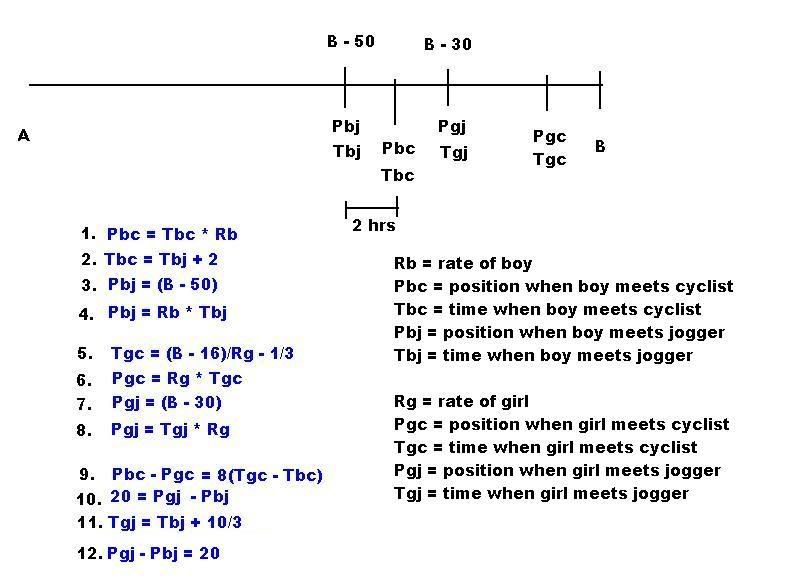
We'll let A = 0, and t = 0 be the time when they first begin. Also I changed jack and jill to boy and girl, so we can represent them with different letters.
1. The position (or distance traveled from A) when the boy saw the cyclist equals the time in hours from when he first started, times his rate. Thus Pbc = Tbc * Rb
2. Supposedly, the boy passed the cyclest two hours after he passed the jogger. So Tbc = Tbj + 2
3. When the boy saw the jogger, he was 50 miles from point b. So Pbj = B - 50
4. The position of the boy when he saw the jogger equals his rate times the time it took to get there. Thus Pbj = Tbj * Rb
5. Supposedly, the girl saw the cyclist 20 minutes before she got 16 miles from point B. How long would it take her to get 16 miles frome point B? Well, Rg * T = (B - 16) T = (B - 16)/Rg. But she saw the cyclest 20 minutes before this time. We're working the problem in hours so thats 1/3 hour before. Thus Tgc = (B - 16)/Rg -1/3
6. Position of the girl when she saw the cyclist equals her rate, times the time it took her to get there. Thus Pgc = Rg * Tgc
7. We are told the girl met the jogger when she was 30 miles from be, thus Pgj = B - 30.
8. Position when girl saw the jogger equals her rate times the time it took to get there. Thus Pgj = Rg * Tgj
9. The cyclist drove from the position where he passed the boy, to the position where he passed the girl. So the distance he traveled between the 2 was (Pgc - Pbc). He did this from the time he passed the boy, to the time he passed the girl, and was driving at 8 mph. Thus the distance between the two also 8 * (Tgc - Tbc). These two distances are equal so (Pgc - Pbc) = 8 * (Tgc - Tbc)
10. The boy met the jogger 50 miles from B and the girl met the jogger 30 miles from B. Thus the positions where they met the jogger were 20 miles apart. Thus Pgj - Pbj = 20. (this is provable using equations 3 and 7)
11. The jogger traveled 20 miles from the position where he met the boy to the position where he met the girl. We don't know how long this was but we do know his rate was 6. So 6 * T = 20. T = 10/3. Thus The time from when the boy saw him to when the girl saw him was 10/3 hours. So Tgj - Tbj = 10/3. Rearraned Tgj = 10/3 + Tbj
12. Oops! I wrote this already. My bad!
Ok so thats 10 equations then. Not 11. 10 is just a combination of equations 3 and 7 (ironicly) so it doesn't count. And 12 I wrote already (in a rearranged form)
The equation may still be solvable at this point, with a lot of rearranging. But I'm going to see if I can find one last equation.
#1387 Re: Help Me ! » Need help with problem » 2006-01-20 09:03:22
I hate when the wording is debatable!
#1388 Re: Introductions » Hi » 2006-01-20 09:02:20
nice! your doing calculus!
Wish I had discovered math earlier. I could have gone very far by now.
Does everyone in your school take calculus in 11 and 12th year? Here usually you only get calculus if your extra good.
#1389 Re: Help Me ! » Need help with problem » 2006-01-20 08:57:06
I'm confused about the wording of this problem:
Two walkers Jack and Jill walked by the same road and at the same time from point A to point B. When Jack was 50 miles from point B, he passed a jogger who was jogging towards point B at 6 miles per hour. Two hours later, Jack met a cyclist going in the opposite direction at 8 miles per hour.
When it says 2 hours later, does it mean two hours after they first started walking? Or two hours after he passed the jogger?
#1390 Re: This is Cool » Math *IS* Fun » 2006-01-20 08:46:03
Ah I see it now.
I saw that "zort in a mirror" episode in Pinky and The Brain. Brain roxxors! He should be a calculus teacher.
#1391 Re: Introductions » Hi » 2006-01-20 08:40:59
Well then answer me this. Have you learned anything about differentiation and integration? Area under a curve? That sort of thing?
I never went to school and learned everything I know by reading books. (It was about a year and a half ago that I discovered math).
Could you tell me the name of your text book? (The book where your getting these cool problems from)
#1392 Re: Introductions » Hi » 2006-01-20 08:21:49
darn! Clearly america's math education system is too slow. (not that I ever used it)
I bet your from athens greece.
So your in trig then? Or did you get AP and get calculus? I've rarely seen such tough geometry problems, and to think your getting them in highschool. Thats wierd...(98.6% of all americans are IDIOTS! at least mathwise...)
Whats the name of your current math/geometry book? I'd like to see if I can get my hands on it.
#1393 Re: Help Me ! » Circle And Square » 2006-01-20 08:09:02
I have to attribute this solution to my dad. I showed him this problem and he recalled a method I used to solve another problem which I had showed him and how it could be applied here. (Remember the circle with the four 20 degree inscirbed angles? Thats the one)
Anyways, all we're concerned about is the ratio, so we can assign values to either the circle or the square (but not both) and find the area of the other in terms of the first.
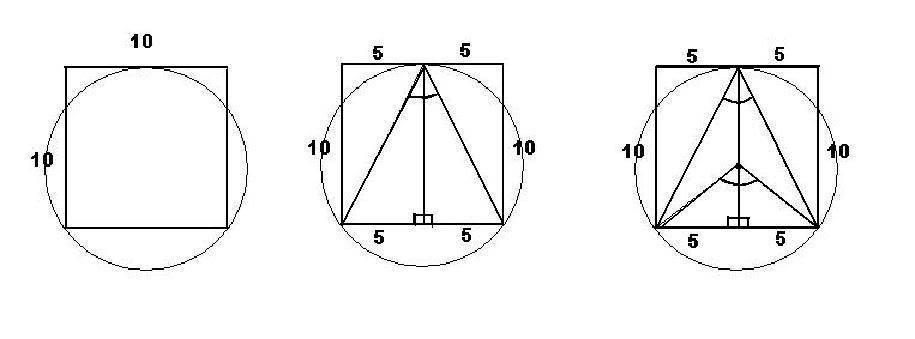
Lets start by letting the square be 10 by 10. If we divide it in two and draw diagonals, we have drawn an inscribed angle inside the circle. The length of this incribled angle is 2 arctan(5/10) thus the measure of the intersecpted arc will be 4 arctan(5/10). We can now draw an angle from the center of the circle to the edges of this arc to find the middle angle. Divide it by 2 to find the angle of a right triangle with a leg of 5. We can now find the radius using trig and solve the problem. :-)
#1394 Help Me ! » Graeme » 2006-01-20 07:35:16
- mikau
- Replies: 2
you seem to have some quite difficult geometry problems. I'm curious, what level math are you currently studying? Are you in college? What career are you studying for?
Why don't you go to the introductions forum and tell us a little about yourself? 
#1395 Re: This is Cool » Math *IS* Fun » 2006-01-19 20:22:56
... I don't get it...
#1396 Re: Help Me ! » it looks easy but ... » 2006-01-19 19:26:19
incase your not sure where I got the requirements from. If you have an expression such as |x + 1| if the value of x + 1 is less then zero, it will be negative. Therefore, if x + 1 is less then 1, the expression will haves its sign changed. Thus |x + 1| equals -(x + 1) when the expression is less then 1. To find when x + 1 is less then zero: x + 1 < 0 solved x < -1. Lets try a value less then -1 as a test. |-2 + 1| = 1. But -2 is less then 1 so instead of | x + 1| we can write -( x + 1) x = -2 so
-(-2 + 1)
-(-1)
1.
This gave us the same answer as the absolute value expression. Why? Because thats what the absolute value symbols mean. When the value is negative (less then 0) the sign is reversed to make if positve.
Thus if (x < 0) |x| = -x
#1397 Re: Help Me ! » it looks easy but ... » 2006-01-19 19:17:35
doesn't look easy at all. Absolute value algebra is a nightmare!
Lets see, if x < 1 then the expression |x -1| will be - (x-1). If x > 4, then |8 - x| will be -(8 - 2x). Fortunatly, x can never be both less then 1 and greater then 4 so its either one or the other. Not both. Of course, if x is neither less then 1, nor greater then 4, then both the abolute value symbols can be eliminated. So lets check all three situations.
if x < 1
-(x - 1) - ( 8 - 2x) = 3 solved x = 10. 10 is not less then 1 so we discard this solution.
if (x > 4)
(x - 1) + (8 - 2x) = 3 solved x = 4. 4 is not less then 4 so we discard this solution.
if (1 <= x <=4)
(x - 1) - (8 - 2x) = 3. solved x = 4. 4 is greater then 1 and less then 4 so this is an acceptable solution.
So if my thinking is correct, x = 4 should be the solution.
#1398 Re: Help Me ! » A sphere problem » 2006-01-19 16:03:30
Maybe. I'm not sure where you got that formula.
I think the reason I didn't see the obvious solution was I did not assume the line drawn from the small circle to the edge of the large, had the angle as the line from the center of the large circle to the point of tangency.
Lets see if I can prove it.
(edit) dang. It seems obvious enough but I can't seem to prove it. I'll keep working on it but maybe you guys can get it before me.
Prove this!
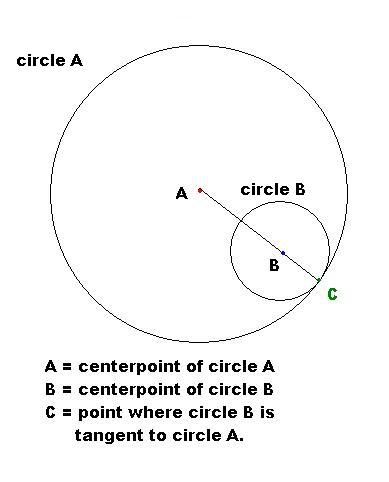
If a small circle B is inside a large circle A, and circle B is tangent to circle A at point C, prove the line drawn through point A to point B passes through the point C. (the point of tangency). Point A and point B are the centerpoints of circles A and B.
#1399 Re: Help Me ! » A sphere problem » 2006-01-19 15:13:18
I wonder if this problem would be more difficult if the bowl size was given, but not the ball size.
#1400 Re: Help Me ! » A sphere problem » 2006-01-19 15:12:08
heres a drawing of how graeme did it. I take it he found the center coordinates of the small circle same as I did. Then just used the pythagorean theorem plus the radius.