Math Is Fun Forum
You are not logged in.
- Topics: Active | Unanswered
- Index
- » Science HQ
- » Liver
Pages: 1
#1 2026-03-19 15:03:27
- Jai Ganesh
- Administrator

- Registered: 2005-06-28
- Posts: 53,865
Liver
Liver
Gist
The liver is a vital, large, reddish-brown organ located in the upper right abdominal cavity, performing over 500 essential tasks including detoxification, bile production for digestion, and energy storage. It serves as a metabolic powerhouse, converting nutrients from food into energy, clearing harmful substances from the blood, and regulating blood clotting.
The liver is a vital organ performing over 500 essential functions, primarily acting as the body's chemical factory and filter. Key functions include metabolizing macronutrients (carbs, fats, proteins), detoxifying harmful substances (drugs, alcohol), producing bile for fat digestion, storing energy (glycogen) and nutrients, and synthesizing blood clotting proteins.
Summary
The liver is a major metabolic organ exclusively found in vertebrates, which performs many essential biological functions such as detoxification of the organism, and the synthesis of various proteins and various other biochemicals necessary for digestion and growth. In humans, it is located in the right upper quadrant of the abdomen, below the diaphragm and mostly shielded by the lower right rib cage. Its other metabolic roles include carbohydrate metabolism, the production of a number of hormones, conversion and storage of nutrients such as glucose and glycogen, and the decomposition of red blood cells. Anatomical and medical terminology often use the prefix hepat- from ἡπατο-, from the Greek word for liver, such as hepatology, and hepatitis.
The liver is also an accessory digestive organ that produces bile, an alkaline fluid containing cholesterol and bile acids, which emulsifies and aids the breakdown of dietary fat. The gallbladder, a small hollow pouch that sits just under the right lobe of liver, stores and concentrates the bile produced by the liver, which is later excreted to the duodenum to help with digestion. The liver's highly specialized tissue, consisting mostly of hepatocytes, regulates a wide variety of high-volume biochemical reactions, including the synthesis and breakdown of small and complex organic molecules, many of which are necessary for normal vital functions. Estimates regarding the organ's total number of functions vary, but is generally cited as being around 500. For this reason, the liver has sometimes been described as the body's chemical factory.
It is not known how to compensate for the absence of liver function in the long term, although liver dialysis techniques can be used in the short term. Artificial livers have not been developed to promote long-term replacement in the absence of the liver. As of 2018, liver transplantation is the only option for complete liver failure.
Details
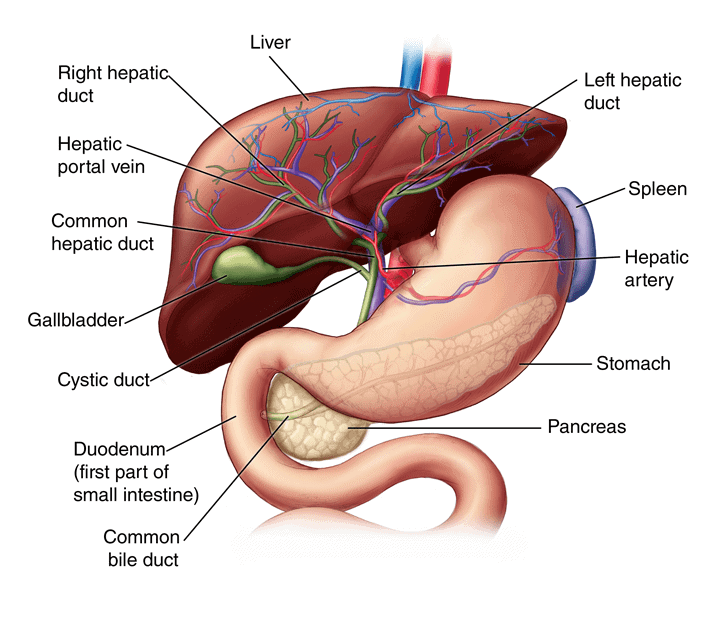
The liver is located in the upper right-hand portion of the abdominal cavity, beneath the diaphragm, and on top of the stomach, right kidney, and intestines.
Shaped like a cone, the liver is a dark reddish-brown organ that weighs about 3 pounds.
There are 2 distinct sources that supply blood to the liver, including the following:
* Oxygenated blood flows in from the hepatic artery
* Nutrient-rich blood flows in from the hepatic portal vein
The liver holds about one pint (13%) of the body's blood supply at any given moment. The liver consists of 2 main lobes. Both are made up of 8 segments that consist of 1,000 lobules (small lobes). These lobules are connected to small ducts (tubes) that connect with larger ducts to form the common hepatic duct. The common hepatic duct transports the bile made by the liver cells to the gallbladder and duodenum (the first part of the small intestine) via the common bile duct.
Functions of the liver
The liver regulates most chemical levels in the blood and excretes a product called bile. This helps carry away waste products from the liver. All the blood leaving the stomach and intestines passes through the liver. The liver processes this blood and breaks down, balances, and creates the nutrients and also metabolizes drugs into forms that are easier to use for the rest of the body or that are nontoxic. More than 500 vital functions have been identified with the liver. Some of the more well-known functions include the following:
* Production of bile, which helps carry away waste and break down fats in the small intestine during digestion
* Production of certain proteins for blood plasma
* Production of cholesterol and special proteins to help carry fats through the body
* Conversion of excess glucose into glycogen for storage (glycogen can later be converted back to glucose for energy) and to balance and make glucose as needed
* Regulation of blood levels of amino acids, which form the building blocks of proteins
* Processing of hemoglobin for use of its iron content (the liver stores iron)
* Conversion of poisonous ammonia to urea (urea is an end product of protein metabolism and is excreted in the urine)
* Clearing the blood of drugs and other poisonous substances
* Regulating blood clotting
* Resisting infections by making immune factors and removing bacteria from the bloodstream
* Clearance of bilirubin, also from red blood cells. If there is an accumulation of bilirubin, the skin and eyes turn yellow.
When the liver has broken down harmful substances, its by-products are excreted into the bile or blood. Bile by-products enter the intestine and leave the body in the form of feces. Blood by-products are filtered out by the kidneys, and leave the body in the form of urine.
Additional Information
Your liver performs more than 500 important functions, from filtering blood and processing nutrients to fighting infections. It creates bile and important proteins your body needs. You can’t live without a liver: If your liver fails, you’ll need an organ transplant to survive.
Overview:
What is my liver?
Your liver is the largest internal organ in your body and one of the only organs that can regenerate itself. The liver plays a crucial role in filtering blood, storing energy and producing bile for digestion.
Unfortunately, hundreds of diseases and conditions can damage your liver so it can’t work. Some of these can be life-threatening. Hepatologists, medical specialists who diagnose and treat liver disease, can treat and sometimes cure these diseases. And there are many things that you can do to keep your liver well and working as it should.
Function
Your liver is the biggest organ in your body, and it performs hundreds of functions every day.
What is the liver’s function?
Your liver’s biggest job is filtering harmful substances and waste from your blood. Every day, your liver filters more than 250 gallons of blood. If that wasn’t enough, and among many other duties, your liver also:
* Makes cholesterol that your body uses in different ways
* Helps produce certain hormones, protects your cells and is a key ingredient in bile production
* Makes proteins — like clotting factors that manage bleeding and albumin, which manages fluid pressure in your bloodstream
* Helps keep your blood glucose levels steady by storing glycogen (glucose) and releasing it into your bloodstream to keep your blood sugar levels on an even keel
* Breaks down toxins and germs so they safely leave your body in your pee and poop
* Works by breaking down fats in your blood to produce energy, and if there are too many, they may get stored as extra fat
Anatomy:
Where is my liver located?
Your liver is on the right side of your upper body. It’s located under your ribs, just next to your stomach.
What does my liver look like?
Your liver looks like a spongy, reddish-brown wedge of tissue. The wedge, which may be about the size and shape of a football, may weigh between 3 and 5 pounds.
The liver has two lobes (sections). The lobe on the right is slightly larger than the lobe on the left. Both lobes contain many blood vessels and thousands of smaller lobes (lobules) that are tiny clusters of liver cells (hepatocytes).
Some of the important parts of your liver anatomy include:
* Lobules: These are tiny clusters of liver cells that connect with your bile ducts, the tubes that transport bile from your liver to your small intestine.
* Hepatic veins: These are blood vessels in your liver’s lobes that carry blood through your liver so it can remove waste and toxins that eventually leave your body through your pee and poop.
* Bile ducts: Bile ducts carry the bile that your liver produces out to the rest of your body.
Conditions and Disorders:
What common conditions and disorders can affect my liver?
There are over 100 types of liver diseases, but they fall into a handful of subtypes. Examples include:
* Alcohol-induced hepatitis: Heavy alcohol use can cause acute or chronic hepatitis (inflammation in your liver). If it’s frequent or lasts a long time, it can lead to cirrhosis and liver failure.
* Bile duct obstruction: Conditions that block the flow of bile through your bile ducts can cause it to build up and injure your liver. Gallstones and biliary stricture (narrowing) are some common causes.
* Inherited metabolic disorders: Some of these disorders can cause toxic products to build up in your blood. Hemochromatosis is one example.
* Liver lesions: These are abnormal growths in your liver. Most are benign (noncancerous), including liver cysts and liver hemangiomas. But some abnormal growths are liver cancer, including hepatocellular carcinoma, intrahepatic cholangiocarcinoma (bile duct cancer in your liver) and hepatoblastoma.
* Steatotic (fatty) liver disease: These are conditions that involve fat buildup in your liver. Condition types include alcohol-related liver disease, metabolic dysfunction-associated steatotic liver disease (MASLD) and non-alcohol-related steatohepatitis.
* Toxic hepatitis: Chronic overexposure to toxins, like industrial chemicals or drugs, can cause acute or chronic hepatitis.
* Viral hepatitis: Viral hepatitis infections can become chronic infections that cause chronic liver disease, including hepatitis B and hepatitis C. Hepatitis A is an acute (short-term) infection.
What are common signs and symptoms of liver problems?
Common early symptoms of liver problems include:
* Upper abdominal pain
* Nausea
* Your skin and eyes turning yellow (jaundice)
When liver disease is more advanced and your liver function declines, you may develop many other symptoms, like:
* Confusion or mild cognitive impairment
* Dark-colored pee and light-colored poop
* Fatigue
* Musty-smelling breath
* Swollen belly or legs
What tests can check my liver health?
Healthcare providers may use a combination of tests to check on your liver or to diagnose liver diseases, like:
* Blood tests: Liver function tests measure substances in your blood that your liver produces, like liver enzymes, proteins and bilirubin. High or low levels may indicate liver disease.
* Imaging tests: Imaging tests of your liver can show signs of inflammation, lesions or scarring. Examples include liver ultrasound, CT scan, nuclear liver scan and elastography.
* Liver biopsy: To diagnose some conditions, your healthcare provider might need to take a small tissue sample from your liver to examine in a lab. They can usually do this with a hollow needle.
What are common treatments for liver conditions?
Different treatments are available to treat different liver diseases, including medications and surgery. The most common — and important — treatment for liver disease is reducing stress on your liver through diet and lifestyle changes. If liver disease reaches the end stages, you’ll need a liver transplant.
Care:
How can I take care of my liver?
To keep your liver healthy and functioning well, you can:
* Avoid infections: Washing your hands, being vaccinated against hepatitis and practicing safe sex all help reduce your risk of infections that can harm your liver.
* Avoid excess toxins: If you drink beverages with alcohol, limit your drinks to one or two a day. If you use tobacco, try to quit and ask your healthcare provider for helpful resources. And be sure to use medications as directed. Avoid unnecessary herbal supplements.
* Eat well: Consider the Mediterranean diet, which focuses on whole foods and healthy fats. Maintaining a weight that’s healthy for you can also help to prevent metabolic liver disease.
When should I contact a healthcare provider?
Liver disease symptoms can be vague and may feel like many other diseases. Belly aches and nausea might mean stomach flu rather than liver disease. But stomach pain that doesn’t go away, unintended weight loss and jaundice (yellow eyes and skin) are reasons to contact a healthcare provider.
It appears to me that if one wants to make progress in mathematics, one should study the masters and not the pupils. - Niels Henrik Abel.
Nothing is better than reading and gaining more and more knowledge - Stephen William Hawking.
Offline
Pages: 1
- Index
- » Science HQ
- » Liver