Math Is Fun Forum
You are not logged in.
- Topics: Active | Unanswered
Pages: 1
#1 2026-02-26 16:29:52
- Jai Ganesh
- Administrator

- Registered: 2005-06-28
- Posts: 53,832
Latent Heat
Latent Heat
Gist
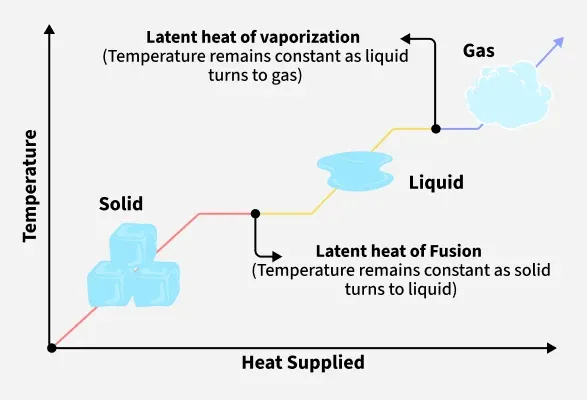
Latent heat is the energy absorbed or released by a substance during a change in its physical state (solid, liquid, or gas) that occurs without changing its temperature. This "hidden" energy breaks or forms molecular bonds, with primary types being latent heat of fusion (melting/freezing) and vaporization (boiling/condensation).
Latent heat is the energy absorbed or released by a substance during a change of state (like melting, freezing, boiling, or condensing) without changing its temperature, acting as "hidden" energy to break or form molecular bonds. This energy is measured per unit mass (e.g., Joules/kg) and involves two main types: the latent heat of fusion (solid to liquid/liquid to solid) and the latent heat of vaporization (liquid to gas/gas to liquid).
Summary
Latent heat is energy absorbed or released by a substance during a change in its physical state (phase) that occurs without changing its temperature. The latent heat associated with melting a solid or freezing a liquid is called the heat of fusion; that associated with vaporizing a liquid or a solid or condensing a vapour is called the heat of vaporization. The latent heat is normally expressed as the amount of heat (in units of joules or calories) per mole or unit mass of the substance undergoing a change of state.
For example, when a pot of water is kept boiling, the temperature remains at 100 °C (212 °F) until the last drop evaporates, because all the heat being added to the liquid is absorbed as latent heat of vaporization and carried away by the escaping vapour molecules. Similarly, while ice melts, it remains at 0 °C (32 °F), and the liquid water that is formed with the latent heat of fusion is also at 0 °C. The heat of fusion for water at 0 °C is approximately 334 joules (79.7 calories) per gram, and the heat of vaporization at 100 °C is about 2,230 joules (533 calories) per gram. Because the heat of vaporization is so large, steam carries a great deal of thermal energy that is released when it condenses, making water an excellent working fluid for heat engines.
Latent heat arises from the work required to overcome the forces that hold together atoms or molecules in a material. The regular structure of a crystalline solid is maintained by forces of attraction among its individual atoms, which oscillate slightly about their average positions in the crystal lattice. As the temperature increases, these motions become increasingly violent until, at the melting point, the attractive forces are no longer sufficient to maintain the stability of the crystal lattice. However, additional heat (the latent heat of fusion) must be added (at constant temperature) in order to accomplish the transition to the even more-disordered liquid state, in which the individual particles are no longer held in fixed lattice positions but are free to move about through the liquid. A liquid differs from a gas in that the forces of attraction between the particles are still sufficient to maintain a long-range order that endows the liquid with a degree of cohesion. As the temperature further increases, a second transition point (the boiling point) is reached where the long-range order becomes unstable relative to the largely independent motions of the particles in the much larger volume occupied by a vapour or gas. Once again, additional heat (the latent heat of vaporization) must be added to break the long-range order of the liquid and accomplish the transition to the largely disordered gaseous state.
Latent heat is associated with processes other than changes among the solid, liquid, and vapour phases of a single substance. Many solids exist in different crystalline modifications, and the transitions between these generally involve absorption or evolution of latent heat. The process of dissolving one substance in another often involves heat; if the solution process is a strictly physical change, the heat is a latent heat. Sometimes, however, the process is accompanied by a chemical change, and part of the heat is that associated with the chemical reaction.
Details
Latent heat (also known as latent energy or heat of transformation) is energy released or absorbed, by a body or a thermodynamic system, during a constant-temperature process—usually a first-order phase transition, like melting or condensation.
Latent heat can be understood as hidden energy which is supplied or extracted to change the state of a substance without changing its temperature or pressure. This includes the latent heat of fusion (solid to liquid), the latent heat of vaporization (liquid to gas) and the latent heat of sublimation (solid to gas).
The term was introduced around 1762 by Scottish chemist Joseph Black. Black used the term in the context of calorimetry where a heat transfer caused a volume change in a body while its temperature was constant.
In contrast to latent heat, sensible heat is energy transferred as heat, with a resultant temperature change in a body.
Usage
The terms sensible heat and latent heat refer to energy transferred between a body and its surroundings, defined by the occurrence or non-occurrence of temperature change; they depend on the properties of the body. Sensible heat is sensed or felt in a process as a change in the body's temperature. Latent heat is energy transferred in a process without change of the body's temperature, for example, in a phase change (solid/liquid/gas).
Both sensible and latent heats are observed in many processes of transfer of energy in nature. Latent heat is associated with the change of phase of atmospheric or ocean water, vaporization, condensation, freezing or melting, whereas sensible heat is energy transferred that is evident in change of the temperature of the atmosphere or ocean, or ice, without those phase changes, though it is associated with changes of pressure and volume.
The original usage of the term, as introduced by Black, was applied to systems that were intentionally held at constant temperature. Such usage referred to latent heat of expansion and several other related latent heats. These latent heats are defined independently of the conceptual framework of thermodynamics.
When a body is heated at constant temperature by thermal radiation in a microwave field for example, it may expand by an amount described by its latent heat with respect to volume or latent heat of expansion, or increase its pressure by an amount described by its latent heat with respect to pressure.
Latent heat is energy released or absorbed by a body or a thermodynamic system during a constant-temperature process. Two common forms of latent heat are latent heat of fusion (melting) and latent heat of vaporization (boiling). These names describe the direction of energy flow when changing from one phase to the next: from solid to liquid, and liquid to gas.
In both cases the change is endothermic, meaning that the system absorbs energy. For example, when water evaporates, an input of energy is required for the water molecules to overcome the forces of attraction between them and make the transition from water to vapor.
If the vapor then condenses to a liquid on a surface, then the vapor's latent energy absorbed during evaporation is released as the liquid's sensible heat onto the surface.
The large value of the enthalpy of condensation of water vapor is the reason that steam is a far more effective heating medium than boiling water, and is more hazardous.
Meteorology
In meteorology, latent heat flux is the flux of energy from the Earth's surface to the atmosphere that is associated with evaporation or transpiration of water at the surface and subsequent condensation of water vapor in the troposphere. It is an important component of Earth's surface energy budget. Latent heat flux has been commonly measured with the Bowen ratio technique, or more recently since the mid-1900s by the eddy covariance method.
Additional Information
Latent heat is defined as the heat or energy that is absorbed or released during a phase change of a substance. It could either be from a gas to a liquid or liquid to a solid and vice versa. Latent heat is related to a heat property called enthalpy.
However, an important point that we should consider regarding latent heat is that the temperature of the substance remains constant. As far as the mechanism is concerned, latent heat is the work that is needed to overcome the attractive forces that hold molecules and atoms together in a substance.
Let’s take an example. Suppose a solid substance is changing to a liquid; it needs to absorb energy to push the molecules into a wider, more fluid volume. Similarly, when a substance changes from a gas phase to a liquid, its density levels also need to go from a lower to a higher level, wherein the substance then needs to release or lose energy so that the molecules come closer together. In essence, this energy that is required by a substance to either freeze, melt or boil is said to be latent heat.
Early Developments of the Concept
The Scottish scientific expert, Joseph Black, presented the idea of latent heat somewhere close to the period 1750 and 1762. Scotch bourbon producers had employed Black to decide the best blend of fuel and water for refining and to examine changes in volume and weight at a steady temperature. Dark applied calorimetry for his investigation and recorded latent heat esteems.
British physicist James Prescott Joule portrayed latent heat as a type of potential vitality. Joule accepted that vitality relied upon the specific design of particles in a substance. Actually, it is the direction of particles inside an atom, their substance holding, and their extremity that influence latent heat.
Types of Latent Heat Transfer
Lets us discuss some of the different types of latent heat that can occur.
Latent Heat of Fusion
The latent heat of fusion is the heat consumed or discharged when matter melts, changing state from solid to fluid structure at a consistent temperature.
The ‘enthalpy’ of fusion is a latent heat, in light of the fact that during softening, the heat energy expected to change the substance from solid to fluid at air pressure is the latent heat of fusion, as the temperature stays steady during the procedure. The latent heat of fusion is the enthalpy change of any measure of substance when it dissolves.
At the point when the heat of fusion is referenced to a unit of mass, it is typically called the specific heat of fusion, while the molar heat of fusion alludes to the enthalpy change per measure of substance in moles.
The fluid state has higher inward energy than the solid state. This implies that energy must be provided to the solid so as to dissolve it, and energy is discharged from a fluid when it solidifies on the grounds that the particles in the fluid experience more fragile intermolecular force, and thus have higher potential energy (a sort of bond-separation energy for intermolecular powers).
At the point when fluid water is cooled, its temperature falls relentlessly until it drops just underneath the line of the point of solidification at 0 °C. The temperature at that point stays consistent at the point of solidification while the water takes shape. When the water is totally solidified, its temperature keeps on falling.
The enthalpy of fusion is quite often a positive amount; helium is the main known exception. Helium-3 has a negative enthalpy of fusion at temperatures beneath 0.3 K. Helium-4 additionally has a marginally negative enthalpy of fusion underneath 0.77 K (−272.380 °C). This implies that at suitable steady weights, these substances solidify with the expansion of heat. For the situation of 4He, this weight territory is somewhere in the range of 24.992 and 25.00 atm (2,533 kPa).
Latent Heat of Vaporization
Latent heat of vaporization is the heat consumed or discharged when matter disintegrates, changing state from fluid to gas state at a consistent temperature.
The heat of vaporization of water is the highest known. The heat of vaporization is characterised as the measure of heat expected to transform 1 g of a fluid into a fume without a change in the temperature of the fluid. This term isn’t in the rundown of definitions given by Weast (1964), so the definition originates from Webster’s New World Dictionary of the American Language (1959). The units are cal/gram. The heat of vaporization is latent heat. The word latent originates from the Latin word latere, which intends to lie covered up or hidden. Latent heat is the extra heat required to change the condition of a substance from solid to fluid at its softening point, or from fluid to gas at its breaking point after the temperature of the substance has come to both of these focuses.
Note that latent heat is related to no adjustment in temperature, yet a difference in the state. As a result of the high heat of vaporization, the vanishing of water has an articulated cooling impact, and buildup has a warming impact.
Similar to the case for ‘Heat of Fusion/Melting,’ the heat of vaporization/buildup additionally speaks to the measure of heat traded during a stage move. For vaporization, it is the amount of heat (540 cal g^{-1}) expected to change over 1 g of water to 1 g of water fume. A similar measure of heat is traded or discharged in the stage move during the buildup of 1 g water fume to 1 g of water.
Amphibian researchers might be normally intrigued with the enormous measure of heat traded (80 cal g−1) in the stage move from water to ice or from ice to water, yet the measure of heat traded (540 cal g^{-1}) in the stage move from water to water fume, or water fume to water is 6.75 times bigger (540/80 = 6.75). Despite the fact that the significance of this enormous measure of heat trade through vaporization or buildup might be undervalued by people, it is immense. On a little yet basic scale forever, water dissipating off sweating warm-blooded creatures, including people, keeps up internal heat levels inside thin survivable points of confinement. On a worldwide scale, the apparently perpetual stage moves between fluid water and water fume in the climate are the key determinants in the redistribution of water and heat inside the hydrological cycle far and wide.
The enthalpy of vaporization, ΔHv, is additionally named the “latent heat of vaporization.” And ΔHv is the distinction between the enthalpy of the soaked fume and that of the immersed fluid at a similar temperature. The enthalpy of vaporization information is utilised in process estimations, for example, the plan of alleviation frameworks, including unpredictable mixes. In refining, the heat of vaporization esteems are expected to discover the heat loads for the reboiler and condenser, and information on the enthalpy of vaporization is required in the structure of heat exchangers for disintegrating fluids.
Reasonable Heat
Although reasonable heat is frequently called latent heat, it is anything but a steady temperature circumstance or is a stage change included. Reasonable heat reflects heat move among an item and its environment. The heat can be “detected” as an adjustment in an item’s temperature.
Reasonable Heat and Meteorology
While latent heat of combination and vaporization are utilised in material science and science, meteorologists also consider reasonable heat. At the point when latent heat is ingested or discharged, it produces insecurity in the climate, conceivably delivering an extreme climate. The change in latent heat adjusts the temperature into contact with hotter or cooler air. Both latent and reasonable heat cause air to move, creating wind and vertical movement of air masses.
Instances of Latent and Sensible Heat
Everyday life is loaded up with instances of latent and reasonable heat:
Bubbling water on a stove happens when warm vitality from the heating component is moved to the pot, and thus to the water. At the point when enough vitality is provided, fluid water grows from the water fume and the water bubbles. A gigantic measure of vitality is discharged when water bubbles are formed. Since water has such a high heat of vaporization, it’s anything but difficult to get scorched by steam.
Correspondingly, significant energy must be assimilated to change over fluid water to ice in a cooler. The cooler expels heat energy to permit the stage progress to happen. Water has a high latent heat of combination, so transforming water into ice requires the expulsion of more energy than solidifying fluid oxygen into solid oxygen per unit gram.
Specific Latent Heat
Specific latent heat is characterised as the measure of heat energy (heat, Q) that is consumed or discharged when a body experiences a steady temperature process.
The formula for specific latent heat is:
L = Q/m
Where:
L is the specific latent heat
Q is the heat retained or discharged
m is the mass of a substance.
The most widely recognised kinds of consistent temperature forms are stage changes, for example, liquefying, solidifying, vaporization, or buildup. The energy is viewed as “latent” on the grounds that it is basically covered up inside the atoms until the stage change happens. The most well-known units of specific latent heat are joules per gram (J/g) and kilojoules per kilogram (kJ/kg).
Specific latent heat is an escalated property of the issue.
It appears to me that if one wants to make progress in mathematics, one should study the masters and not the pupils. - Niels Henrik Abel.
Nothing is better than reading and gaining more and more knowledge - Stephen William Hawking.
Offline
Pages: 1