Math Is Fun Forum
You are not logged in.
- Topics: Active | Unanswered
Pages: 1
#1 2026-02-16 16:47:08
- Jai Ganesh
- Administrator

- Registered: 2005-06-28
- Posts: 53,832
Hypermetropia
Hypermetropia
Gist
Hypermetropia, or farsightedness, is a common refractive error where distant objects are clear, but near objects appear blurry because light focuses behind the retina. It is caused by a short eyeball or flat cornea, often hereditary. Symptoms include eye strain, headaches, and reading difficulty. Treatment includes convex lenses (glasses/contacts) or refractive surgery.
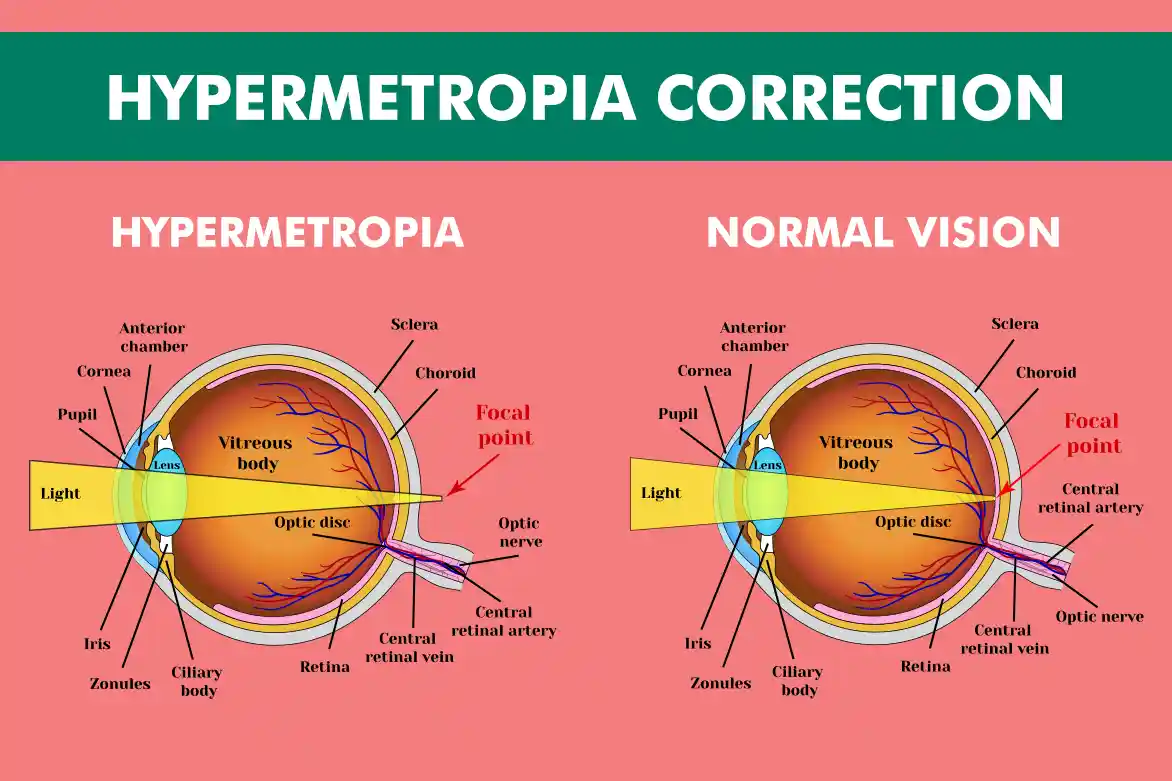
Hypermetropia (or farsightedness/hyperopia) is a common vision condition where distant objects are seen clearly, but nearby objects appear blurry because light focuses behind the retina instead of on it, often due to the eyeball being too short or the cornea having too little curvature. This condition is corrected with convex lenses (glasses or contacts) that help converge light onto the retina, restoring clear vision, especially for close work.
Summary
Far-sightedness, also known as long-sightedness, hypermetropia, and hyperopia, is a condition of the eye where distant objects are seen clearly but near objects appear blurred. This blur is due to incoming light being focused behind, instead of on, the retina due to insufficient accommodation by the lens. Minor hypermetropia in young patients is usually corrected by their accommodation, without any defects in vision. But, due to this accommodative effort for distant vision, people may complain of eye strain during prolonged reading. If the hypermetropia is high, there will be defective vision for both distance and near. People may also experience accommodative dysfunction, binocular dysfunction, amblyopia, and strabismus. Newborns are almost invariably hypermetropic, but it gradually decreases as the newborn gets older.
There are many causes for this condition. It may occur when the axial length of eyeball is too short or if the lens or cornea is flatter than normal. Changes in refractive index of lens, alterations in position of the lens or absence of lens are the other main causes. Risk factors include a family history of the condition, diabetes, certain medications, and tumors around the eye. It is a type of refractive error. Diagnosis is based on an eye exam.
Management can occur with eyeglasses, contact lenses, or refractive corneal surgeries. Glasses are easiest while contact lenses can provide a wider field of vision. Surgery works by changing the shape of the cornea. Far-sightedness primarily affects young children, with rates of 8% at 6 years old and 1% at 15 years old. It then becomes more common again after the age of 40, known as presbyopia, affecting about half of people. The best treatment option to correct hypermetropia due to aphakia is IOL implantation. (IOL: Intraocular lens).
Other common types of refractive errors are near-sightedness, astigmatism, and presbyopia.
Details
Hypermetropia, also called hyperopia, is a common condition that can also be hereditary. If you suspect you have hypermetropia, it is not something that should cause you great worry. You can visit one of our optometrists in our stores to learn more about your treatment options. If you are farsighted, glasses or contact lenses provide a straightforward solution.
Light rays enter your eye through the cornea – the front part of your eye. Then, the light goes through the pupil to the eye lens. The light rays are redirected by the cornea and the lens, so that they land exactly on the retina.
When a person is farsighted, the light that enters the eye falls behind their retina, resulting in blurred vision when viewing objects nearby.
There are two different hypermetropia (hyperopia) causes:
Axial hypermetropia
The distance between the front of your eye (cornea) and the back of your eye (retina) is too small, causing the light rays to fall behind the retina.
Refractive hypermetropia
The cornea or eye lens is too flat, so the light rays do not ‘break’ enough, causing the light to fall behind the retina.
Hypermetropia symptoms
People with hypermetropia can usually see objects in the distance clearly, but struggle as they get closer to an object. Depending on how high the refractive error is, even an object a few metres away may appear blurred.
Risk factors for hypermetropia can include a family history of the condition, certain medicines and diabetes.
Symptoms of hypermetropia include eye strain, blurry vision and headaches, with eye strain often being the first and most noticeable symptom. Some people with hypermetropia can experience difficulty with depth perception, or seeing with both eyes, and some children may experience double vision as a result of trying to focus. Sometimes symptoms can include squinting or eye-watering.
Some of the first signs in children may be complaining about not being able to read textbooks in school, having difficulty drawing or putting beads on a string, having tired eyes when looking at a screen, or possibly learning difficulties.
Hypermetropia treatment: what are your options?
For some people it may be a relief to learn what has been causing their headaches and eye strain, and that there are several effective treatment options available.
Hypermetropia, or long-sightedness, is caused by the light rays falling behind the retina, causing nearby objects to appear blurred or unfocused. this condition can be present from birth, but more commonly, it occurs later in life. Many people can correct their vision themselves, by squinting or adjusting their eye muscles. this is called accommodation. Accommodation may make your vision clear, but you may still experience symptoms relating to hypermetropia, such as eye strain and headaches.
When looking at hypermetropia treatments, there are various options. Your optometrist can explain to you about hypermetropia causes, symptoms and treatment, and can advise you which treatment will be best for you, based on your lifestyle, budget and overall health.
Here are some hypermetropia treatment options:
Glasses
One of the most common forms of hypermetropia treatment is glasses. After an eye examination the optometrist will give you your prescription. The dioptres are the numbers used to measure the power of the refractive error. With hypermetropia the dioptres are positive. A plus lens will redirect the light rays so that they fall exactly on the retina, allowing you to see clearly.
The benefits of glasses are that they are a quick solution, with no downtime for recovery, and that they are easy to adjust, as your prescription naturally changes over time. For most people, adapting to wearing glasses is just a matter of wearing them for a few days.
Contacts
For some people, contact lenses are a good option for hypermetropia treatment, especially if they experience high levels of farsightedness. The main benefits of contact lenses are that they can be worn during sports and that they are virtually invisible. There are several options when it comes to contact lenses. Based on your ocular health and your personal preferences, an optometrist will give you advice tailored to your needs. Some examples of different contact lenses are daily disposable or reusable lenses. The latter can be worn for either two weeks or a month (depending on the type), but require daily cleaning of the lenses.
Contact lenses can also be worn by children, depending on their age and maturity. It is important for contact lens wearers to always have at least one pair of glasses.
Laser surgery for hypermetropia treatment
Another optional treatment is laser surgery although it is not a hypermetropia cure. As with any procedure, recovery times vary, and it may not be suitable for everyone. Common types of laser surgery include PRK, LASIK and LASEK, all of which can be effective for long-sightedness.
Additional Information
Hypermetropia (long-sightedness) is a common eye condition where nearby objects appear blurred, but your vision is clearer when looking at things further away.
If you feel your eyes are often tired and you have problems focusing on objects close to your eyes, you may have hypermetropia.
Causes
Your eye is like a camera. It focuses light on the back of your eye (on a place called the retina), which provides you with clear vision. Long-sight is caused by light not being correctly focused, with light travelling behind the retina.
* One cause may be that your eyeballs are shorter than usual. This means that the retina is closer to the pupil, causing light to travel past the retina. A normal eye is usually around 23mm in length, so an eye that is hypermetropic will be shorter than 23mm.
* Alternatively you can also have hypermetropia if your cornea is flat. The cornea should be curved to direct light onto the retina.
Both of these factors cause long-sightedness, as they cause light to travel past the retina. This results in blurry vision, and can affect your daily life.
Hypermetropia in children.
Hypermetropia is usually genetic. Babies and young children may suffer from hypermetropia, but this should eventually correct itself. This happens as the eyeballs lengthen as they grow. However, a lazy eye may develop as a result. This is because the eye with the weakest vision is ignored by the brain, and does not learn the correct way to see. If this is not corrected in young children, there is a risk that the weaker eye will never see as well as the other eye.
Treatments for hypermetropia
If you think you may be longsighted, let your optician know. They will be able to diagnose this in an eye examination and provide you with a prescription if you need one.
If you have been diagnosed with hypermetropia by an optician, there are three solutions:
Glasses
If you have long-sighted vision, it can be corrected by wearing plus powered lenses. This helps focus light entering the eye on the correct area of the retina, making your vision clearer.
Contact Lenses
Contact lenses are another alternative, although you will still need a pair of glasses as backup in case you are unable to wear your lenses. Again, they will be plus powered to refract the light to the retina. The prescription is likely to differ from a glasses prescription. There are different types of contact lenses available, including daily or monthly disposables. Talk to your optician about the best option to suit your lifestyle.
Laser Surgery
Laser surgery provides the opportunity to correct your vision. Although it corrects existing visual impairments, it does not prevent further changes to eyesight afterwards.
FAQs About Hypermetropia:
Can children outgrow hypermetropia?
Yes, many children are born farsighted and gradually develop normal vision as their eyes grow, but regular check-ups are necessary.
Is hypermetropia hereditary?
Genetics can play a role, but environmental factors also contribute.
Can hypermetropia cause headaches?
Yes, eye strain from focusing efforts often leads to headaches, especially after close work.
Does hypermetropia worsen with age?
In some cases, it can worsen, especially if presbyopia develops.
Can hypermetropia be cured?
While it cannot be “cured,” it can be effectively managed with glasses, contact lenses, or surgery.
Conclusion
Hypermetropia is a common and manageable eye condition that affects the ability to see nearby objects clearly. Recognizing the symptoms early and seeking professional diagnosis can prevent discomfort and improve quality of life. Whether through corrective lenses or surgical options, effective treatments exist to restore clear vision and reduce eye strain.
Regular eye examinations and adopting good eye care habits are essential steps toward maintaining healthy vision. If you experience blurred near vision, headaches, or eye fatigue, consult an eye care specialist to discuss appropriate evaluation and treatment.
It appears to me that if one wants to make progress in mathematics, one should study the masters and not the pupils. - Niels Henrik Abel.
Nothing is better than reading and gaining more and more knowledge - Stephen William Hawking.
Offline
Pages: 1