Math Is Fun Forum
You are not logged in.
- Topics: Active | Unanswered
Pages: 1
#1 2026-02-09 16:37:22
- Jai Ganesh
- Administrator

- Registered: 2005-06-28
- Posts: 53,832
Wavelength
Wavelength
Gist
Wavelength is the spatial distance over which a wave's shape repeats, measured from one peak to the next (or trough to trough), represented by the Greek letter lambda. It's a fundamental property of waves (like light, sound, water) and is inversely related to frequency (higher frequency means shorter wavelength, like blue light). In common language, being "on the same wavelength" means sharing understanding, while in technology, AWS Wavelength provides edge computing for low-latency applications.
Wavelength is the distance between two corresponding points on consecutive waves, like from one crest to the next or one trough to the next, representing the spatial period of a wave. Denoted by the Greek letter lambda, it's a fundamental property of waves (light, sound, etc.) and is inversely proportional to frequency; longer wavelengths have lower frequencies, and shorter wavelengths have higher frequencies, measured in meters (m) or nanometers (nm).
Summary
Wavelength is the distance between corresponding points of two consecutive waves. “Corresponding points” refers to two points or particles in the same phase—i.e., points that have completed identical fractions of their periodic motion. Usually, in transverse waves (waves with points oscillating at right angles to the direction of their advance), wavelength is measured from crest to crest or from trough to trough; in longitudinal waves (waves with points vibrating in the same direction as their advance), it is measured from compression to compression or from rarefaction to rarefaction. Wavelength is usually denoted by the Greek letter lambda (λ); it is equal to the speed (v) of a wave train in a medium divided by its frequency (f): λ = v/f.
Details
In physics and mathematics, wavelength or spatial period of a wave or periodic function is the distance over which the wave's shape repeats. In other words, it is the distance between consecutive corresponding points of the same phase on the wave, such as two adjacent crests, troughs, or zero crossings. Wavelength is a characteristic of both traveling waves and standing waves, as well as other spatial wave patterns. The inverse of the wavelength is called the spatial frequency. Wavelength is commonly designated by the Greek letter lambda (λ). For a modulated wave, wavelength may refer to the carrier wavelength of the signal. The term wavelength may also apply to the repeating envelope of modulated waves or waves formed by interference of several sinusoids.
Assuming a sinusoidal wave moving at a fixed wave speed, wavelength is inversely proportional to the frequency of the wave: waves with higher frequencies have shorter wavelengths, and lower frequencies have longer wavelengths.
Wavelength depends on the medium (for example, vacuum, air, or water) that a wave travels through. Examples of waves are sound waves, light, water waves, and periodic electrical signals in a conductor. A sound wave is a variation in air pressure, while in light and other electromagnetic radiation the strength of the electric and the magnetic field vary. Water waves are variations in the height of a body of water. In a crystal lattice vibration, atomic positions vary.
The range of wavelengths or frequencies for wave phenomena is called a spectrum. The name originated with the visible light spectrum but now can be applied to the entire electromagnetic spectrum as well as to a sound spectrum or vibration spectrum.
Additional Information
There are many kinds of waves all around us. There are waves in the ocean and in lakes. Did you also know that there are also waves in the air? Sound travels through the air in waves and light is made up of waves of electromagnetic energy.
The wavelength of a wave describes how long the wave is. The distance from the "crest" (top) of one wave to the crest of the next wave is the wavelength. Alternately, we can measure from the "trough" (bottom) of one wave to the trough of the next wave and get the same value for the wavelength.
The frequency of a wave is inversely proportional to its wavelength. That means that waves with a high frequency have a short wavelength, while waves with a low frequency have a longer wavelength.
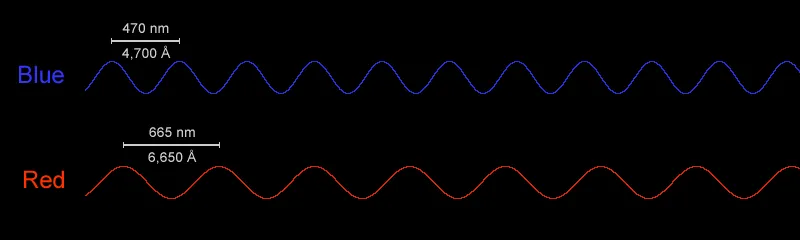
Light waves have very, very short wavelengths. Red light waves have wavelengths around 700 nanometers (nm), while blue and purple light have even shorter waves with wavelengths around 400 or 500 nm. Some radio waves, another type of electromagnetic radiation, have much longer waves than light, with wavelengths ranging from millimeters to kilometers.
Sound waves traveling through air have wavelengths from millimeters to meters. Low-pitch bass notes that humans can barely hear have huge wavelengths around 17 meters and frequencies around 20 hertz (Hz). Extremely high-pitched sounds that are on the other edge of the range that humans can hear have smaller wavelengths around 17 mm and frequencies around 20 kHz (kilohertz, or thousands of Hertz).
It appears to me that if one wants to make progress in mathematics, one should study the masters and not the pupils. - Niels Henrik Abel.
Nothing is better than reading and gaining more and more knowledge - Stephen William Hawking.
Offline
Pages: 1