Math Is Fun Forum
You are not logged in.
- Topics: Active | Unanswered
#1426 Re: Puzzles and Games » Real life architectual problem » 2006-01-13 11:04:45
(long low whistle) That is utterly genius! And may be an entirely different way of solving the problem!
#1427 Re: Puzzles and Games » Real life architectual problem » 2006-01-13 03:20:54
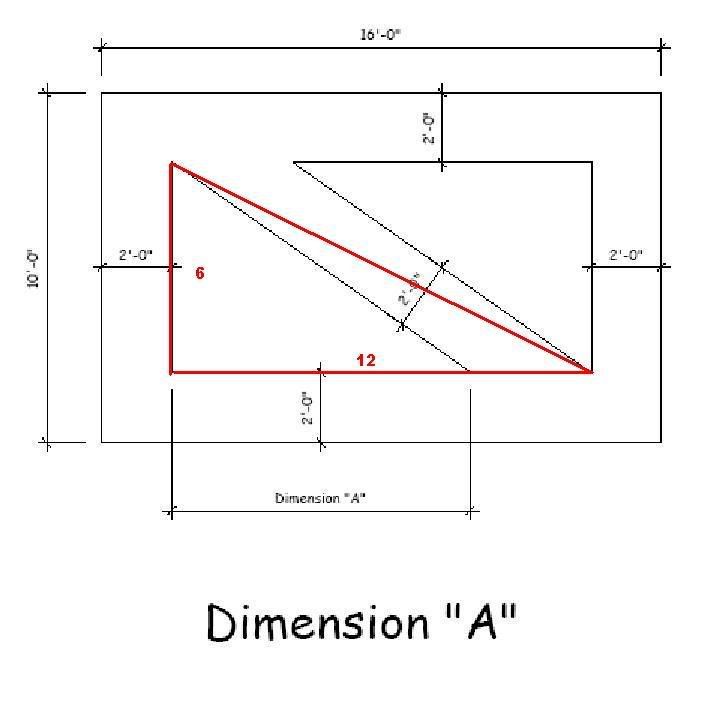
The two triangles are congruent to eachother. But they are obviously not congruent to the red triangle I drew. Ricky incorrectly scaled from this triangle.
#1428 Re: Puzzles and Games » Real life architectual problem » 2006-01-12 19:09:28
This is achictecture, you can't measure it untill its either built or drawn, which requires you know the dimensions. (evil laughter)
#1429 Re: Puzzles and Games » Real life architectual problem » 2006-01-12 18:54:59
Lol. Theres actually a trick to it. And a hint.
The hint is litterally this: "think outside the box".
#1430 Re: Puzzles and Games » Real life architectual problem » 2006-01-12 18:44:52
Forgive me if I'm wrong but I think you messed up. It apppears you scalled the inside triangle to a 12 by 6 triangle. You can't, they are not congruent:
#1431 Re: Help Me ! » trouble with trig » 2006-01-12 18:31:06
hehehaha!!!!
#1432 Re: Help Me ! » trouble with trig » 2006-01-12 18:25:50
Uh... isn't this a math website?
Got a question? Post it here! We can help!
#1433 Re: Puzzles and Games » Real life architectual problem » 2006-01-12 17:24:59
Step 2. Eat a banana, and think what to do in step 3.
#1434 Re: Jokes » Optimism vs pessimism » 2006-01-12 13:28:01
Yeah, sadly pessimests always end up being right about something.
#1435 Re: This is Cool » Fun problem » 2006-01-12 13:25:56
Correct! Boy you guys are smart.
My dad told me about this problem. He got it in highschool. Everyone got it wrong because everyone assumed the balls initial velocity was 0 at the instant it is let go, but actually, at that instant, the balls velocity equals the velocity of the balloon! Usually people miss this but neither of you did. Well done!
I love calculus....
#1436 Re: Help Me ! » logarithmic differentiation » 2006-01-12 13:18:49
Seems to arrive at the same place. But I'm not familar with that method.
Anyway, do you think I got the poblem right?
#1437 Re: Puzzles and Games » Real life architectual problem » 2006-01-12 12:15:25
I don't even remember how to solve it. :-P
#1438 Re: Jokes » Optimism vs pessimism » 2006-01-12 09:56:50
Yeah first comes birth, then school, then marriage, then death. Thus if you don't marry, you'll never die! ;-) marriage will kill you! 
#1439 Puzzles and Games » Real life architectual problem » 2006-01-12 08:24:20
- mikau
- Replies: 18
This was a real architectual problem my dad encountered, and it took him forever to solve. Lets see if anyone can get it:
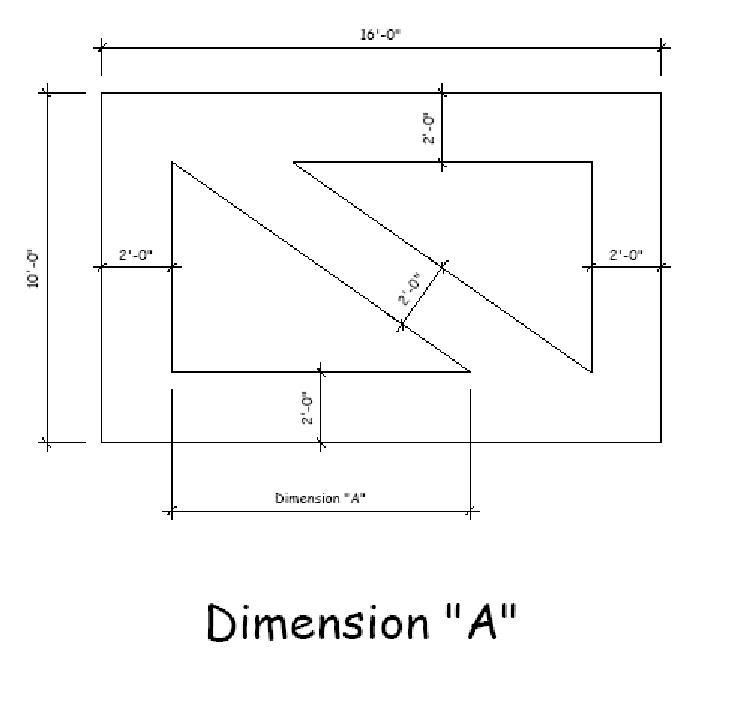
Find A.
#1440 Re: Help Me ! » logarithmic differentiation » 2006-01-12 07:45:56
So you think maybe its a misprint?
#1441 Re: This is Cool » Fun problem » 2006-01-12 07:37:16
Correct! Nice job mathsy! But you can display the answer so long as you don't show how you worked it.
Dang. You got it first try. Lets me rewrite the problem to make it less obvious. (edit) okie doke. Lets see if anyone else can get it. (note, the answer has changed, mathsy's answer was correct for the original problem)
#1442 This is Cool » Fundamental theorem of calculus explanation » 2006-01-11 21:39:24
- mikau
- Replies: 2
The direct connection between the integral of a function and its area, I find mystifying. It seems more like a made up rule for a wierd game, but its true! How could it be that the graph of the function who's slope is represented by the current function at a given point, give us the area? How could the line tangent to a graph and area, two seemingly unrelated topics be so directly connected?
There are proofs but most of them usually involve manipulations and application of other theorems which in the end, proves it mathematicly, but doesn't really help us to see WHY it is so.
Pondering over the relations between velocity and position, I've noticed theres an easy way to demonstrate why it is so, which is relativly easy to understand. (but bear in mind you cannot be mathematical idiot to understand this demonstration)
Refer to the following diagram:
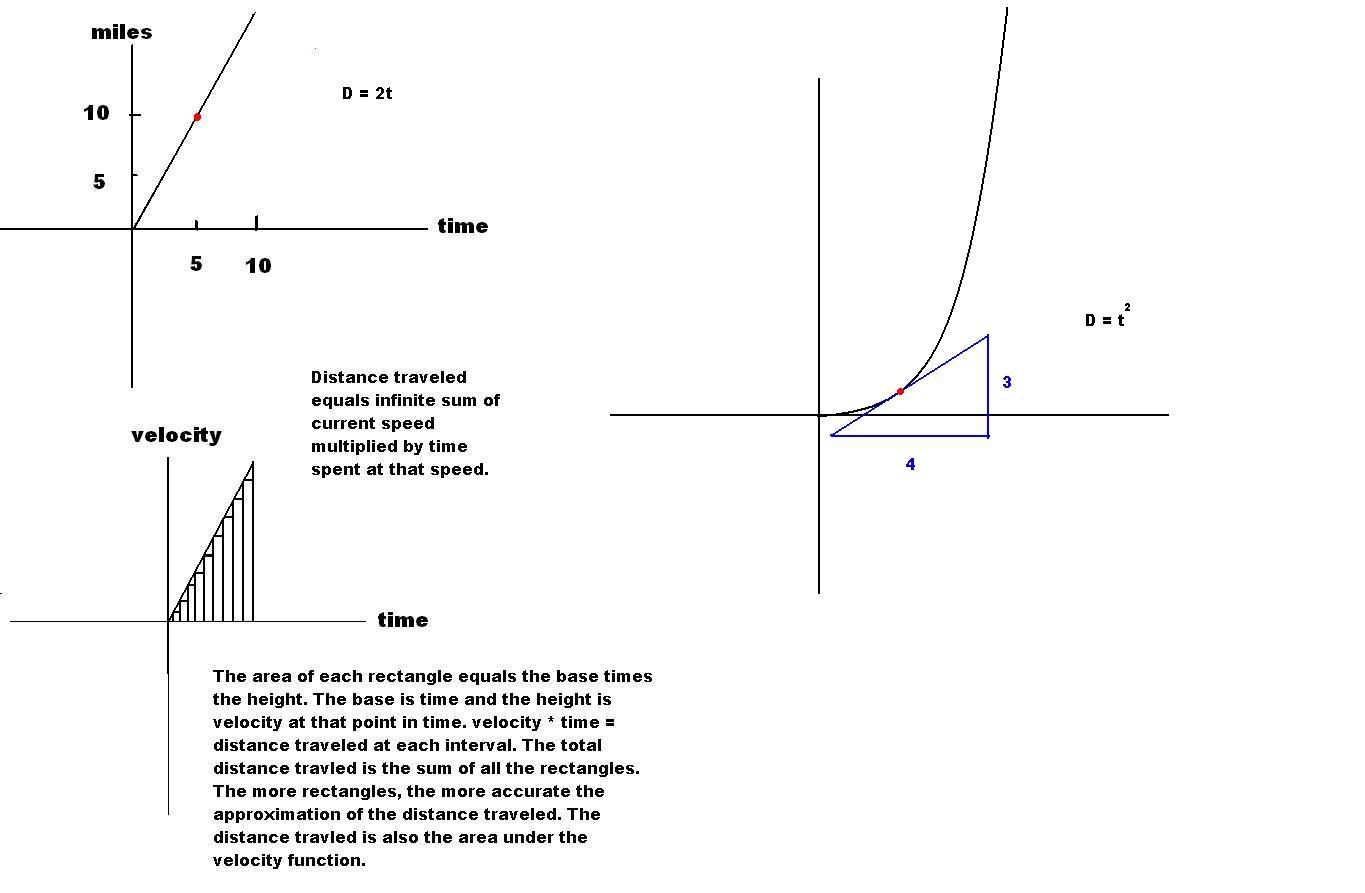
Lets say a car is traveling such that its position is defined by the straight line on the top left. The miles traveled is graphed vertically, and the hours driving is graphed horizontally. It appears the car drove 10 miles in 5 hours. rate * time = distance so rate = distance/time. He traveled 10 miles in 5 hours so his rate was 2 miles per hour. (Now thats a slow car!) Notice how 2 appears to be the slope of the graph!
Now take the graph on the right. In this graph, the distance traveled begins to accelerate upward, so it looks like the car is getting faster. So how fast is the car going at a certain point? Well the speed is constantly changing, but the speed at an individual point can be found, by observing the slope of the line at that particular point. Say for instance the car is at the location of the red dot. The distance he travels (the vertical height) divided by the time it took (the horizontal distance) is his speed at that point, because speed is distance traveled divided by the time it took. At this exact point his speed appears to be about 3 miles per 4 hours. Or if you reduce it, 0.75 miles per hour. NOTE! This does not mean he travled 0.75 miles in one hour, or 3 miles in 4 hours, it simply means his SPEED at that PRECISE location is 0.75 miles an hour, for a SPLIT second.
Hence, if you have a function describing how far you've traveled at a given time, the slope of the function at a given point in time, represents your speed at that point. The derivative of a function is the slope of the line at a given point, and thus, the derivative of a position function of time, is the speed at that given point in time.
Take a moment to be sure you understand why this is.
Now that we have demonstrated the derivative of position equals speed, we can work backwards.
If you are traveling 5 miles an hour, for 10 hours, you will travel 50 miles. Rate * time = distance. If you travel 3 miles an hour for 2 hours, 5 miles an hour for 2 hours, and 6 miles an hour for 2 hours, you will have travelled (3*2 + 5*2 + 6*2) miles, for a total of 28 miles. We see that if the speed is not kept at a constant, the distance traveled equals the sum of the the speed traveled at a particular time, multiplied by the time spent traveling at that speed.
Likewise, if your speed is smoothly increasing, how far you travel is an infinite sum of the speed at a given point multiplied by the time spent traveling at that speed. If you add up all the products of the rate at each infinitly short portion of time, multiplied by the time spent at that speed, at each infinitly small point in time, we will get the total distance traveled. Take a look at the bottom left diagram with the little rectangles. The area of each of these rectangles is the time spent on each short interval, times the height at that particular point in time. The sum of these rectangles approximates the distance traveled. The more rectangles we make, the more accurate the approximation. Notice that this also approximates the area under the velocity function, which also gets more accurate the more rectangles we use. Thus the distance traveled (on a given interval) equals the area under the velocity function. (on that interval)
The point I just made is not easy to explain in words (for me at least) hopefully this is easy for you to comprehend. If you simply can't understand this, then this explanation will not help you.
But we don't need to sum up an infinite number of rectangles who's heights are the current velocity at a given time, and who's bases are infinitly small portions of time. If we already have the position function, and we wanted to know how far the car will go in 5 hours, if the distance traveled by the car is given by D(t) = t^2 the car will travel 25 miles. (in 5 hours).
But what if we didn't have the position function? We have demonstrated that the derivative of a position function (where distance traveled is a function of time) gives us the speed at a given point in time. If speed is the derivative of the distance traveled function, then integrating the velocity (or speed) function, will give us the position, or distance traveled function.
So if we are given the velocity of a car equals 2t, this is the speed of the car at a given point in time. The velocity is the derivative of the position, (or "distance traveled") function. If we integrate we get position = t^2. At t = 5 the car will have traveled 25 miles.
But again recall, how the distance traveled equals the area under the curve of the velocity function (on a given interval). Thus if we wanted to know the area under the curve of the velocity function, we can integrate to find the position function. The distance traveled on a given interval equals an infinite sum of rectangles who's base is an infitly thin portion of time and who's height is the velocity at that point in time. This infinite number of rectangles is exactly the same as the area beneath the velocity function!
If we wanted to find the distance traveled between two points, for instance, how much distance you drove between the second and 5th hour, you always subtract initial position from final position to find the distance from one point to another, if you'd driven a total distance of 4 after two hours, and 25 after five hours, you drove a total of (25 - 4) or 21 miles between the 2nd and 5th hour. Again, distance traveled equals area under velocity function. So the area under the velocity function from a to b, equals the distance traveled at b minus the distance traveled at a. Distance traveled can be found by integrating velocity and the area under the velocity function (on a given interval) equals the distance traveled. So:
area under the velocity function on the interval [a, b] equals the integral of v(t) at t = b minus the integral of v(t) at t = a.
Those of you who see errors or innacuracies in this demonstration please point them out so I can correct them.
#1443 This is Cool » Fun problem » 2006-01-11 19:06:57
- mikau
- Replies: 4
A balloon takes off the ground and rises at a rate of 20 ft per second. after 10 seconds a ball is dropped out of the balloon, how many seconds after the ball is dropped will it hit the ground?
For the sake of the problem, assume the balloons initial height is zero. The height of the ball equals the height of the balloon untill it is let go, and the acceleration of gravity is exactly -32 ft/sec
Please do not display how you worked out the problem as not to spoil it for others. Just provide your answer. Remember, the answer is not how many seconds after the balloon is released, but how many seconds from when the ball is let go, untill it hits the ground.
Good luck! 
#1444 Re: Help Me ! » logarithmic differentiation » 2006-01-11 17:06:21
"The only way I know how to solve this is implicit differentiation:"
Yeah but you took the natural log of both sides to simplify, so you did use logarithmic differentiation.
But man, you did something wierd. You took the derivative of ln y, and wrote 1/y * y' in accordance with the chain rule. I suppose this is the same as 1/y dy but you didn't do it on the other side. (dx)
Anyways, I'll attempt to do it using your method.
u = 2x
y = u^u
ln y = u ln u
1/y dy = u/u du + ln u du
1/y dy = du + ln u du
1/y dy = (1 + ln u) du
Now u = 2x so du = 2 dx
Inserting these values we get:
1/y dy = (1 + ln 2x)2 dx
dy/dx = y(1 + ln 2x) 2
Once again, I arrive at the same conclusion.
#1445 Re: Help Me ! » logarithmic differentiation » 2006-01-11 16:03:56
I keep getting dy/dx = y2(1 + ln 2x)
My book gives an answer of y2(1 + ln x)
#1446 Help Me ! » logarithmic differentiation » 2006-01-11 15:21:11
- mikau
- Replies: 17
Differentiate y = 2x^(2x) using logarithmic differentiation.
I've done it several times, in different ways, but I can't seem to get the correct answer. 
#1447 Re: Dark Discussions at Cafe Infinity » Chess » 2006-01-11 06:46:14
Yeah, like forgetting to add + C to the answer of an integration problem. x_x
#1448 Re: Help Me ! » inflection points » 2006-01-11 06:41:51
What defines an inflection point? Generally I think its when the slope briefly decreases and the increases again, and maybe vice versa as well.
#1449 Help Me ! » inflection points » 2006-01-10 18:28:08
- mikau
- Replies: 12
The graph of f(x) = ax^3 + bx^2 + cx + d has a relative maximum at (0,0) and a point of inflection at (1, -2). Find the equation of f by determining a,b,c and d.
This short sentance is absolutely loaded with clues.
First lets find the first and second derivative of f(x)
f(x) = ax^3 + bx^2 + cx + d
f'(x) = 3ax^2 + 2bx + c
f''(x) = 6ax + 2b
Now the problem stated the function has a relative maximum at (0,0), this tells us two things at once. First it tells us that f(0) = 0 and also that f'(x) = 0
f(0) = a(0^3) + b(0^2) + 0c + d = 0 so d must equal 0.
f'(0) = 3a(0^2) + 2b(0) + c = 0 so c must also equal
We are then told it has an inflection point at (1,-2), this means f(1) = -2 and if I remember correctly, the second derivative equals 0 at an inflection point, so f''(1) = 0
f(1) = a + b + c + d = -2 we know c and d are zero so: a + b = -2
f''(1) = 6a + 2b = 0 so -3a = b
-3a = b and a + b = -2
a = 1
b = -3
so f(x) = x^3 - 3x^2
Cool problem huh?
Now down to the main question, the problem stated there was an inflection point at (1,-2) this means the second derivative will be 0 at 1, but doesn't this also mean the first derivative will be 0 as well?
Take for instance the function f(x) = x^3
f'(x) = 3x^2
f''(x) = 6x
f''(0) is 0 since it is an inflection point, but also f'(0) = 0. When first trying to solve the problem, I thought the fact that f had an inflection point at (1,-2) also suggested that f'(1) = 0. But it isn't, and it screwed the problem up.
Thats wierd. I really would have thought an inflection point would have a derivative of 0 at that point. Or do I faintly remember reading that the derivative of a function does not exist at an inflection point?
Agh... so much to remember.. I'm forgeting what I read about inflection points. I think I remember reading that the second derivative of an inflection point is always 0, but the reverse is not always true. There is not always an inflection point for values of x for which the second derivative equals zero.
#1450 Re: Dark Discussions at Cafe Infinity » Chess » 2006-01-10 12:59:15
Mathematicians are supposed to be chess wizards. I'd say its a myth.
I always loose chess games by making one little mistake and blowing the game. Same as I do when I mess up a math problem. Only takes one tiny mistake to get a problem wrong.