Math Is Fun Forum
You are not logged in.
- Topics: Active | Unanswered
#1401 Re: Help Me ! » A sphere problem » 2006-01-19 14:55:51
Come to think of it, my not noticing I could use graeme's method was so idiotic its unreal. My equation and graph skill is much higher then my geometry. In my oppinion the simplest solution is the best and graeme's was the simplest. Hats off to you graeme!
Great problem!
#1402 Re: Help Me ! » A sphere problem » 2006-01-19 14:50:18
Just read greame's solution and its much simpler. Pretty much the same as mine only uses geometry rather then equations. Works just as well only its faster, so I'd say his is the best way to do it. Still I'm proud of my equal slopes observation. :-)
#1403 Re: Help Me ! » A sphere problem » 2006-01-19 14:05:54
This one was pretty tough being that it really needs to be done in three dimensions.
Thats what I thought irspower, but with a little care and a nifty observation, it can be solved in 2d.
Take a look at my pic. Its pretty much self explanatory.
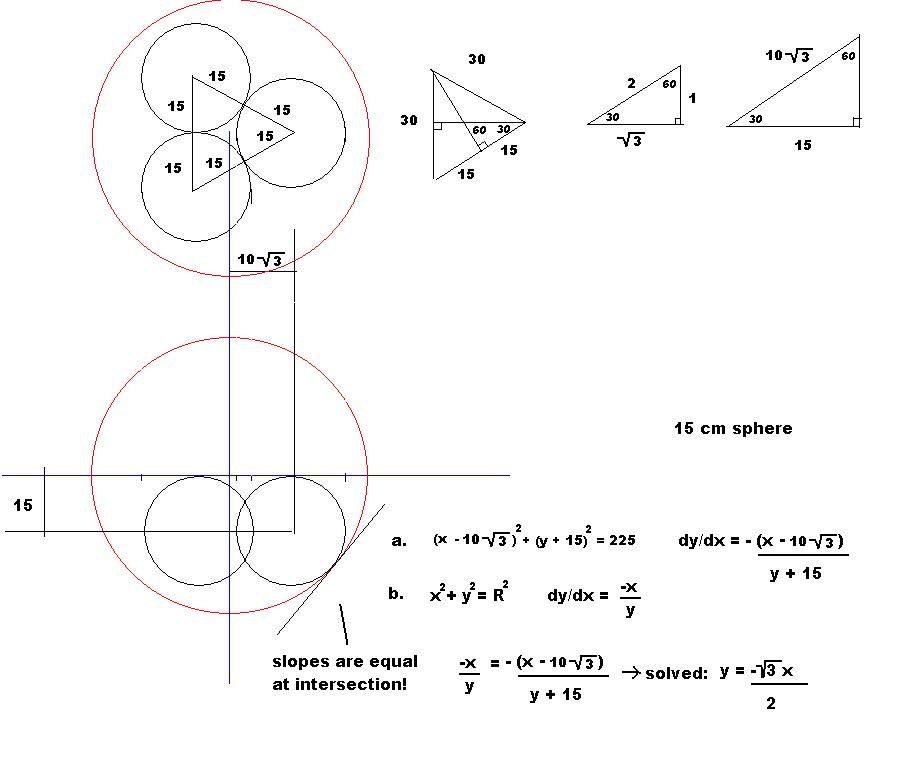
The key to this problem is the slopes of the two cirlces are equal at the intersection. This gives us an extra equation that does not contain R. Then we have two equations for x and y that do not contain R. We can then solved for y in terms of x. Substitute this value of x in equation a to solve for x, then solve for y. Once we have the values of x and y we can use equation b to find the radius.
In the end I got the same answer Greame did, so I guess thats the correct answer.
The slope observation I think is an interesting one that I never made before. Its very usefull in finding the intersection of tangent circles and the size of tangent circles (as in this case). A circle of an unkown radius, with a given centerpoint, can intersect a given circle, at an infinite number of points. But there are only two points for which they intersect, and are tangent, the points of intersection where the slopes are equal. That gives us an extra equation to find the intersection. :-)
#1404 Re: Dark Discussions at Cafe Infinity » what the heck is Zach Week? » 2006-01-19 08:39:19
We know how to spell it, great one. We were attempting to entertain thee. Forgive us if we offended thee.
#1405 Re: This is Cool » Implicit Graphs » 2006-01-19 06:39:43
Neat! Thanks for the explanation, MathsIsFun! Fractals were mentioned in num3rs the other week but I'd never heard of them. Now I have!
#1406 Re: Dark Discussions at Cafe Infinity » what the heck is Zach Week? » 2006-01-18 17:05:34
hahahaha!
I'm saint mikau the arc angle! You shall be punished for your sines and cosines!
#1407 Re: Help Me ! » A sphere problem » 2006-01-18 12:36:22
It is an interesting problem. I think I could solve it but not in a formal way. (naming the postulates and axioms, etc.)
I really need to review geometry. Did algebra 2 so fast it was like a fleeting dream...
#1408 Re: Help Me ! » Seriously need help! x_x » 2006-01-17 16:11:06
Yeal well never underestimate the value of substitution. :-)
#1409 Re: Help Me ! » Help... » 2006-01-16 19:20:22
"What am I talking about? I failed at that so dramatically that I'm not even sure if it's possible." lol. Thats pretty cool you dropped out and taught yourself.
A lot of people who are serious about learning seem to prefer college to highschool. In college, kids are there because they chose to go there. In high school, they're there because they're required by law. Of course theres always the idiot who goes to college to party it up and all but they usually don't last long since there grades are bad. At least thats what I heard.
"High school will force you to learn how some crock-brained educational theorist thinks you should learn."
Eek! Crock brained teachers? Sometimes I'm really glad I was homeschooled....
#1410 Re: Help Me ! » Help... » 2006-01-16 17:16:59
Hey, dude! I was homeschooled too! But I had to teach myself highschool math. So I guess that also makes me self schooled.
I know the feeling. I'm probably going to go into a college this fall and I've never set foot in a classroom. Scary stuff! x_x
#1411 Re: Help Me ! » Seriously need help! x_x » 2006-01-16 15:28:22
.....
Okay..lol. I come here asking you guys to help me do this problem, and I end up helping you do it.
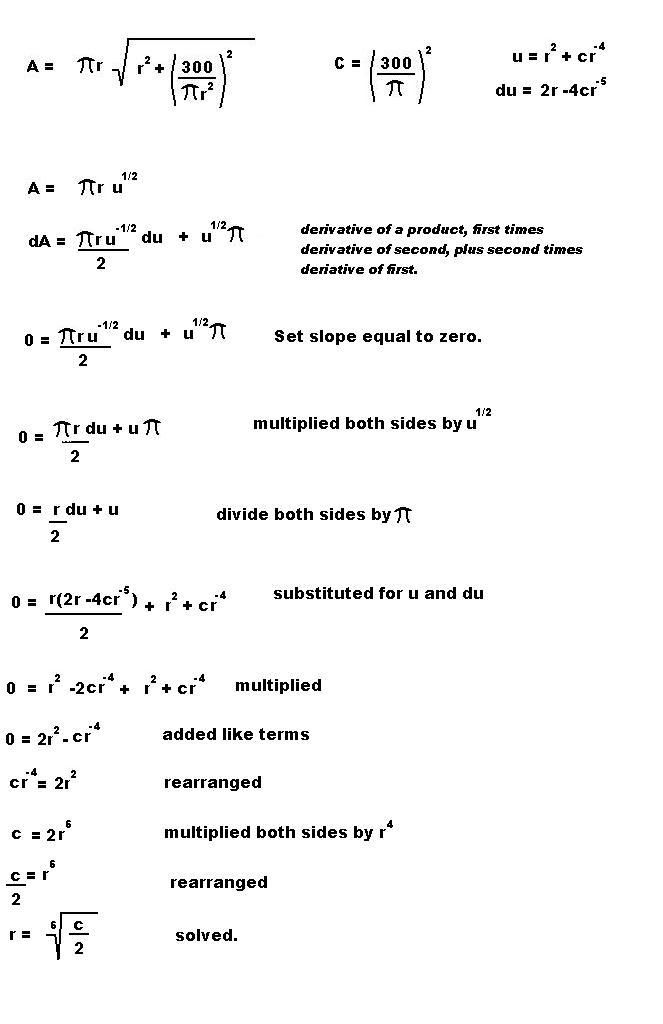
In this problem it helps to substitute the constant (300/pi)^2 with C and the expression inside the radical with u.
Here we are:
#1412 Re: Help Me ! » Seriously need help! x_x » 2006-01-16 13:31:39
WHEW! Nevermind I just got it. I think what helped is I created a constant C to equal (300/pi r^2)^2 and just kept the fact that it was a constant in mind. Then the problem becomes:
pi r sqrt(r^2 + c r^-4)
Which is much easier to work with. Give it a shot, its a fun problem!
#1413 Help Me ! » Seriously need help! x_x » 2006-01-16 13:07:39
- mikau
- Replies: 5
Ok, I'm supposed to find the value of R for which dA/Dr is zero. (a turning point on the graph)
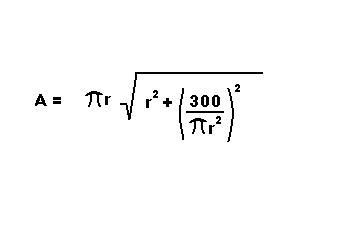
I've differentiated this several times but it always ends up producing nightmarish 5, 6, or 7 degree polynomials which I have no clue how to solve.
Some problems in my book are supposed to be solved with a graphing calculator but usually it tells you when to use it. Anyway this can be solved without a graphing calculator?
#1414 Dark Discussions at Cafe Infinity » what the heck is Zach Week? » 2006-01-16 10:09:32
- mikau
- Replies: 27
Not so obvious to me....
#1415 Re: Jokes » "Classic" Joke » 2006-01-15 17:38:01
Phi huh? Is that pronounced fie? (ryhmes with pi) or fee? (ryhmes with tea)
phi pi, pho phum!
#1416 Re: Jokes » "Classic" Joke » 2006-01-15 13:15:16
what does that little circle with a slash through it stand for, mathsy?
#1417 Re: Jokes » "Classic" Joke » 2006-01-15 11:02:11
I'd give it a √60 out of 10
#1418 Re: Help Me ! » logarithmic differentiation » 2006-01-15 09:48:57
In case no one noticed, this still has not been solved. I'm pretty confident I'm doing it right but my book always end up right in the end.
Differentiate y = 2x^(2x) using logarithmic differentiation.
Anyone want a shot at it?
#1419 Re: This is Cool » Implicit Graphs » 2006-01-15 06:43:59
Totally "rad"! ;-)
#1420 Re: Puzzles and Games » Real life architectual problem » 2006-01-14 11:10:26
Thats a good way to do it. :-)
#1421 Re: Jokes » "Classic" Joke » 2006-01-14 10:39:34
lol! Great joke!
#1422 Re: Jokes » Optimism vs pessimism » 2006-01-14 07:58:42
Optimist: la-de-da, lovely day isn't it? CRUNCH
LOL! Thats hilarious. What was it that crunched him? A giant bug seeking revenge?
#1423 Re: Puzzles and Games » Real life architectual problem » 2006-01-13 18:06:45
Here we are! The solution to this nightmare of a problem is really quite simple, it just requires a little trick.
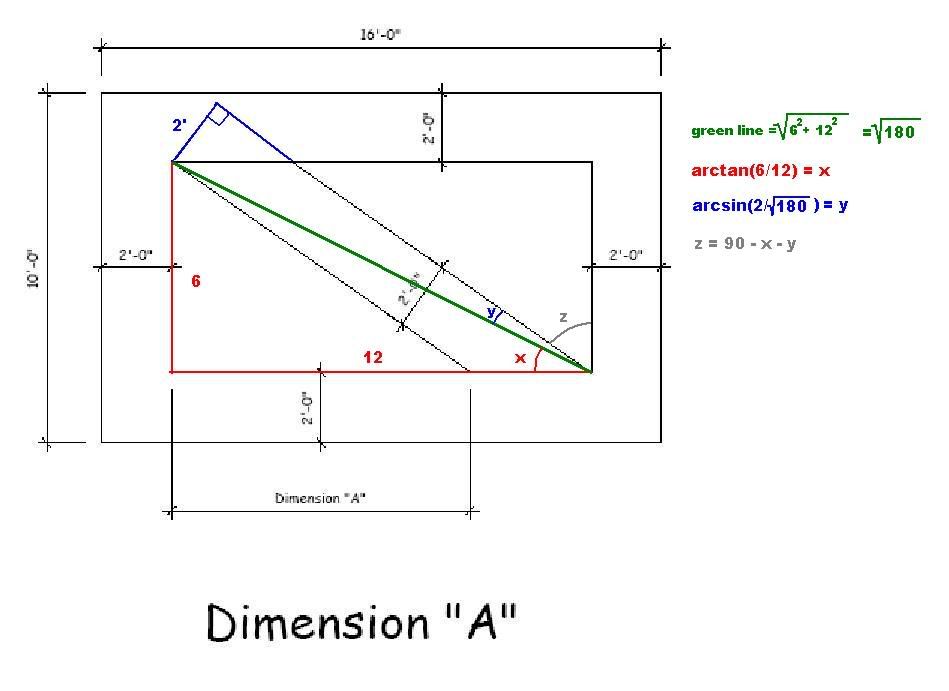
As you can see, the trick is to extend the beam out just enough till it touches the uper left corner and the required lengths and angles can be found as shown. Once you have these, the solution to the problem is easily attainable.
#1424 Re: This is Cool » Fundamental theorem of calculus explanation » 2006-01-13 18:01:41
WHEW! Someone made a comment! Thanks John E. Franklin. When no one says anything I think everyone hated it but is too polite to say so.
#1425 Re: Puzzles and Games » Real life architectual problem » 2006-01-13 17:32:12
Well I"ve been thinking about it, but unless I'm mistaken, it appears that only produces another unknown dimension, so that doesn't help.
I shall reveal the solution to the problem momentarily.