Math Is Fun Forum
You are not logged in.
- Topics: Active | Unanswered
#101 Re: Puzzles and Games » [ASK] Exact Measure Using 2 Bottles » 2018-07-04 20:35:26
By the way, this thread is better in the Puzzles and Games section.
#102 Re: Help Me ! » Division » 2018-07-04 20:28:34
Do that division, given in https://www.mathsisfun.com/long_division.html
I’m not doing your homework for you. You do it yourself.
#103 Re: Help Me ! » Division » 2018-07-03 10:14:23
In problems like this, the first thing to is to reduce the fraction to its lowest terms:
[list=*]
[*]
[/list]
so you’ll be doing the following long division:
[list=*]
[*]
[/list]
If the denominator ends with one or more 0, you can shift the decimal point in the numerator to get rid of the 0:
[list=*]
[*]
[/list]
giving
[list=*]
[*]
[/list]
#104 Re: Help Me ! » Division » 2018-07-02 08:55:25
I’m not doing your homework for you. You do it yourself.
#105 Re: Help Me ! » Division » 2018-07-02 05:19:07
Go on, then. Use long division.
#106 Re: Help Me ! » Finally back! Need help on this advanced algebra problem. » 2018-07-02 05:17:48
#107 Re: Help Me ! » Division » 2018-07-01 23:44:50
In that case …
#108 Re: Help Me ! » Division » 2018-07-01 20:42:00
#109 Re: Jokes » Country jokes » 2018-06-17 17:30:58
Q: Why is the Northeast of England is so old and broken down?
A: Because it has aged with Tyne and is now the worse for Wear!
#110 Re: Help Me ! » Sequences » 2018-06-16 23:11:58
Bob, I think r=0 is also possible for (a).
For (b), I think the answer is all nonnegative integers. Clearly there are infinite geometric sequences with no integers, e.g.
[list=*]
[*]
[/list]
If r = 1, add 1 as the first term to the above sequence.
If r > 1, then
[list=*]
[*]
[/list]
is an infinite geometric sequence (common ratio 1/r) with exactly r integer terms (the first r of them).
#111 Re: Exercises » highest position » 2018-06-02 23:20:53
Let the insect’s speed along the minute hand be v. After time t, the insect has moved a distance vt from the base of the hand and so its height h above the horizontal through the centre of the clock face is given by
[list=*]
[*]
[/list]
(note that the angular velocity of the minute hand is 2π/(60×60) radians per second). Differentiate:
[list=*]
[*]
[/list]
Set to to 0:
[list=*]
[*]
[/list]
This equation can’t be solved analytically; using Wolfram|Alpha, I get t ≈ 493 seconds = 8 minutes 13 seconds, i.e. the insect is at its highest position at 12:08:13.
Check that d²h/dt² < 0 so that this is indeed a maximum value.
#112 Re: Help Me ! » Conditional Statements and Venn Diagrams » 2018-06-01 08:09:20
3. The statement is: “If something is a dog, then it is a mammal.” This is of the form p ⇒q where p is the statement “something is a dog” and q is the statement “it is a mammal”. So what do you think the statement “if something is not a dog, then it is not a mammal” should be? (Hint: It is not A or D.)
7. Did you make a typo in the following?
"If x2>10, then x>0."
As it stands, that question doesn’t make sense.
13. Hint: What is the inverse of the given statement? Write it down and think about it.
#113 Re: Help Me ! » Number series » 2018-05-30 04:25:17
Sorry, I made some typos in my formula. I’ve edited my post and fixed it now.
#114 Re: Jokes » Bird Jokes : Questions and Answers » 2018-05-29 08:26:34
Q: What is the favourite sitcom of ducks?
A: You Rang, Mallard?!
#115 Re: Help Me ! » Number series » 2018-05-29 08:24:28
I actually used Wolfram to simplify the following expression (which I had to do in two stages as it was too long for the software to process in one go):
#116 Re: Help Me ! » Number series » 2018-05-28 12:13:56
No doubt there's a solution much closer to the surface that is simply staring me in the face, but which I'm blind to!

#117 Re: Help Me ! » Long division on these polynomials? » 2018-05-27 00:13:19
That’s because the degree of the numerator polynomial is less than that of the denominator polynomial. Maybe you want to divide the latter by the former?
#118 Re: This is Cool » Interesting facts » 2018-05-25 23:58:10
#120 Re: Jokes » Money Matters » 2018-05-22 21:28:55
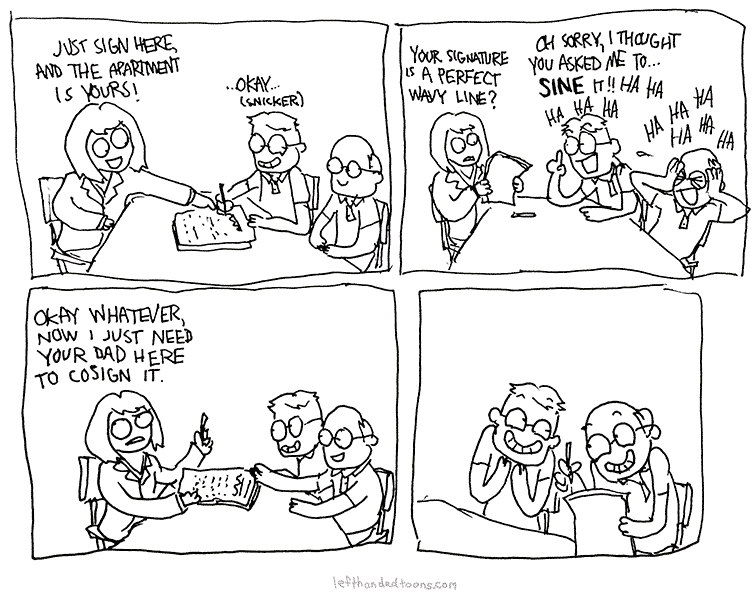
#122 Re: Help Me ! » Find number in the series » 2018-05-18 00:11:36
The quartic(degree-4) polynomial in n satisfying the series for n = 1, 2, 3, 4, 6 is:
[list=*]
[*]
[/list]
Just plug in n = 5 to find the missing number.
#123 Re: Help Me ! » Algebra » 2018-05-08 07:43:56
Hi Grantigriver.
Your proof is correct, provided that the polynomial f(x) does not have multiple roots (i.e. all its roots have multiplicity 1). If f(x) has a multiple root, then, as zetafunc’s counterexample shows, the result no longer holds.
When I first saw this problem, I also thought like you that f(x) must be a divisor. I had forgotten all about multiplicities.
PS: IMHO the question itself is not very well worded as there is no mention of multiplicities. It would be better if we were more clear on whether there are repeated roots.
#124 Re: Help Me ! » Been stuck on this. » 2018-05-04 10:23:16
#125 Re: Maths Is Fun - Suggestions and Comments » What is wrong again? » 2018-05-04 09:54:27
Thank you, MathsIsFun. 