Math Is Fun Forum
You are not logged in.
- Topics: Active | Unanswered
Pages: 1
#1 2026-03-28 00:04:56
- Jai Ganesh
- Administrator

- Registered: 2005-06-28
- Posts: 53,920
Mount Elbrus
Mount Elbrus
Gist
Mount Elbrus is the highest peak in Europe, rising 5,642 meters (18,510 feet) above sea level in the Caucasus Mountains of Southwest Russia, near the Georgian border. It is a dormant twin-coned stratovolcano with 22 glaciers and is one of the world's prominent Seven Summits, popular with climbers, especially from June to September.
Mount Elbrus is located in Russia. It is situated in the southern part of the country, within the Caucasus Mountains in the Kabardino-Balkaria and Karachay-Cherkessia republics, near the border with Georgia. As the highest mountain in Europe at 5,642 meters (18,510 feet), it is a dormant volcano.
Summary
Mount Elbrus[a] is the highest mountain in Russia and Europe. It is a dormant stratovolcano rising 5,642 m (18,510 ft) above sea level, and is the highest volcano in Eurasia, as well as the tenth-most prominent peak in the world. It is situated in the southern Russian republic of Kabardino-Balkaria in the western extension of Ciscaucasia, and is the highest peak of the Caucasus Mountains.
Elbrus has two summits, both of which are dormant volcanic domes. The taller, western summit is 5,642 metres (18,510 ft); the eastern summit is 5,621 metres (18,442 ft). The earliest recorded ascent of the eastern summit was on 10 July 1829 by a Circassian man named Khillar Khashirov, and the western summit in 1874 by a British expedition led by F. Crauford Grove and including Frederick Gardiner, Horace Walker and the Swiss guide Peter Knubel.
Details
Mount El’brus is located in southwest Russia and is part of the Caucasus Mountains. It is the highest point in Russia as well as the highest point in all of Europe. It makes up part of the Prielbrusye National Park. El’brus is one of the Seven Summits of the world, which are the tallest mountains on each of the seven continents.
El’brus is an extinct volcano that is around 2.5 million years old. Its last known eruption was in 50 C.E. Ancient peoples called the mountain Strobilus, which in Latin means “pine cone,” due to the mountain’s twisted shape.
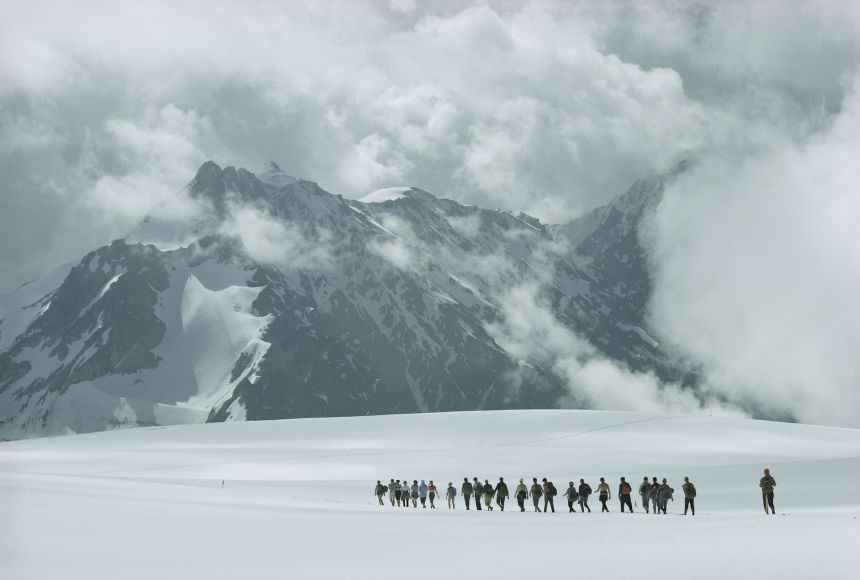
It has two peaks, each of which rises over 5,590 meters (18,000 feet). The climate of El’brus is generally cold. Even during summer, nighttime temperatures are around -8°C (18°F). It is even colder above the snow line. Much of El’brus is covered by ice, and 22 glaciers can be found on the mountain. Water from glacier melt feeds surrounding rivers. The east summit of the mountain was first reached by the Russian army on a scientific expedition in 1829. In 1874, climbers reached the west summit, the highest point of the mountain.
Today, El’brus is a major tourism center. People mainly travel to the mountain for skiing and hiking. Reaching the summit of El’brus is highly challenging and should only be attempted at certain times of year. However, out of the Seven Summits, El’brus is considered one of the easiest to climb thanks to a cable car system that carries climbers up to an elevation of 3,658 meters (12,500 feet). Most climbers reach the peak in less than a week, but El’brus still has a high amount of deaths—around 30 annually—relative to the number of climbers who attempt to summit each year.
Additional Information
Mount Elbrus is the highest peak of the Caucasus mountains, southwestern Russia. It is an extinct volcano with twin cones reaching 18,510 feet (5,642 metres) and 18,356 feet (5,595 metres). The volcano was formed more than 2.5 million years ago. Sulfurous gases are still emitted on its eastern slopes, and there are many mineral springs along its descending streams. A total area of 53 square miles (138 square km) of Elbrus is covered by 22 glaciers, which feed the Kuban River and some of the headwaters of the Terek. Elbrus is a major centre for mountaineering and tourism in the Caucasus region. In 1964 an extensive tourist and mountaineering base was opened, with large-scale sporting facilities.
It appears to me that if one wants to make progress in mathematics, one should study the masters and not the pupils. - Niels Henrik Abel.
Nothing is better than reading and gaining more and more knowledge - Stephen William Hawking.
Offline
Pages: 1