Math Is Fun Forum
You are not logged in.
- Topics: Active | Unanswered
#226 2018-09-22 03:00:33
- Jai Ganesh
- Administrator

- Registered: 2005-06-28
- Posts: 53,929
Re: Miscellany
207) Camel
Camels are mammals with long legs, a big-lipped snout and a humped back. There are two types of camels: dromedary camels, which have one hump, and Bactrian camels, which have two humps. Camels' humps consist of stored fat, which they can metabolize when food and water is scarce.
In addition to their humps, camels have other ways to adapt to their environment. They have a third, clear eyelid that protects their eyes from blowing sand. Two rows of long lashes also protect their eyes. Sand up the nose can be a problem, but not for camels. They can shut their nostrils during sand storms.
Humans have used camels as a means of transport for thousands of years. They can carry about 375 to 600 lbs. (170 to 270 kilograms) on their backs, according to National Geographic. This earned these beasts of burden a nickname, "ships of the desert." Domestic camels are often the main source of meat, milk and even leather or wool products.
Size
Most camels tower above humans. A Bactrian camel, according to the San Diego Zoo, grows to a shoulder height of 6 feet (1.8 meters) and a body length of 10 feet (3 m). They normally weigh 1,320 to 2,200 lbs. (600 to 1,000 kg) when they are fully grown.
Dromedary camels get up to about 6.5 feet (2 m) tall at the shoulder and weigh 880 to 1,325 lbs. (400 to 600 kg).
Diet
Camels aren't picky about what they eat. Their thick lips allow them to eat things that most other animals couldn't, such as thorny plants. Camels are herbivores, though, so you won't find them eating meat.
Filling up on water, when it's available, is very important for camels. They can drink 30 gallons (113 liters) of water in just 13 minutes. Their bodies rehydrate faster than any other mammal.
When there is little food and water, the camel's hump fat releases water; 9.3 grams of fat releases 1.13 grams of water, according to research by the University of Singapore. Camels can survive up to six months without food or water.
Habitat
The two types of camel are found in different parts of the world. The dromedary camel, also called an Arabian camel, can be found in North Africa and the Middle East. The Bactrian camel lives in Central Asia. No matter the type, camels are usually found in the desert, prairie or steppe. Though many people think that camels only live in hot climates, they do well in temperature ranges from 20 degrees F (minus 29 degrees C) to 120 degrees F (49 degrees C).
Habits
Camels like to stay together in groups called herds. The herds are led by a dominant male, while many of the other males form their own herd called a bachelor herd. Camels are very social and like to greet each other by blowing in each other's faces.
Offspring
After a gestation of 12 to 14 months, a mother camel will find a private spot to have her young. Female camels usually only have one baby, but sometimes camels have twins.
Baby camels are called calves. The newborn calf is able to walk within 30 minutes, though the two won't rejoin the herd until around two weeks later. Camels become fully mature when they are 7 years old. Camels live around 17 years.
Classification/Taxonomy
Dromedary camels (Camelus dromedarius) and the domestic Bactrian camel (Camelus bactrianus) were named in 1758 by Swedish zoologist Carl Linnaeus, who only knew of the domestic variety. Wild Bactrian camels (Camelus ferus) were discovered in 1878 by Nikolai Prejevalsky, a Russian geographer who explored Mongolia and Tibet.
For many years, the wild Bactrian was thought to be a subspecies of the domestic Bactrian. However, in recent years, DNA analysis confirmed that C. ferus was a separate species, according to the San Diego Zoo. The main difference between the two species is that the wild Bactrian has three more chromosome pairs than the domestic Bactrian.
Here is the classification of camels, according to Integrated Taxonomic Information System:
Kingdom: Animalia
Subkingdom: Bilateria
Infrakingdom: Deuterostomia
Phylum: Chordata
Subphylum: Vertebrata
Infraphylum: Gnathostomata
Superclass: Tetrapoda
Class: Mammalia
Subclass: Theria
Infraclass: Eutheria
Order: Artiodactyla
Family: Camelidae
Genus: Camelus
Species:
Camelus bactrianus (Bactrian camel)
Camelus dromedarius (one-humped camel)
Subspecies:
Camelus bactrianus bactrianus
Camelus bactrianus ferus (wild Bactrian camel)
The wild Bactrian camel is considered critically endangered by the International Union for Conservation of Nature and has a population that is decreasing. In fact, wild camels are one of the most endangered large mammals. According to the Wild Camel Protection Foundation, there are fewer than 1,000 wild camels alive.
Other facts
Camels can run at 25 mph (40 kph) for long periods. If their owner is in a hurry, they can kick their speed up to 40 mph (67 kph).
The camel's hump is like a storage container. When camels use their stored fat, their hump will diminish. When they eat and drink again the hump will refill with fat.
Camels have oval-shaped red blood cells that help continue blood flow during times when water is scarce.
Camels are known for spitting on people. In fact, the animals are throwing up the contents of their stomach along with spit. This is a defense tactic when the animals feel threatened.
The large beasts make a variety of moans, groans and deep, throaty bellows. One of the camel's noises was even used to voice the character Chewbacca in the Star Wars movies.

It appears to me that if one wants to make progress in mathematics, one should study the masters and not the pupils. - Niels Henrik Abel.
Nothing is better than reading and gaining more and more knowledge - Stephen William Hawking.
Offline
#227 2018-09-23 00:00:03
- Jai Ganesh
- Administrator
- Registered: 2005-06-28
- Posts: 53,929
Re: Miscellany
208) Cotopaxi
Cotopaxi, volcanic peak, in the Cordillera Central of the Andes, central Ecuador. Rising to 19,393 feet (5,911 metres), it is among the world’s highest volcanoes. Cotopaxi has an almost perfectly symmetrical cone, interrupted only by one minor cone—the Cabeza del Inca (“Inca’s Head”). The mountain has a long record of violent eruption. The largest historical eruptions took place in 1744, 1768, 1877, and 1904. The eruption of 1877 was known for its lahars (volcanic mudflows) that traveled more than 60 miles (100 km) to meet the Pacific Ocean to the west and the Amazon River basin to the east. After the most-recent significant eruption, which occurred in 1904, minor eruptions took place in 1940 and 2015.
The terrain around the mountain’s base has many times been devastated by earthquakes or been buried in pumice and ash blown out of the crater. The mountain itself is built up of alternating flows of dark-coloured trachytic lava and falls of lighter-coloured ash. The crater at the top is 2,300 feet (700 metres) in diameter from north to south and 1,650 feet (500 metres) from east to west. Its depth is 1,200 feet (366 metres). The base of the volcano stands on open mountain grassland, but the whole upper part of the mountain is covered with permanent snow.
The first European to attempt an ascent of Cotopaxi was Alexander von Humboldt in 1802. He failed to reach the top and pronounced the mountain unclimbable. Other failures in 1831 and 1858 seemed to confirm this verdict. But in 1872 the German scientist and traveler Wilhelm Reiss succeeded in reaching the top on November 28, and in May of the following year A. Stübel was also successful. Cotopaxi and its surrounding grasslands are protected in Cotopaxi National Park, a major tourist attraction.

It appears to me that if one wants to make progress in mathematics, one should study the masters and not the pupils. - Niels Henrik Abel.
Nothing is better than reading and gaining more and more knowledge - Stephen William Hawking.
Offline
#228 2018-09-24 00:05:48
- Jai Ganesh
- Administrator
- Registered: 2005-06-28
- Posts: 53,929
Re: Miscellany
209) Victoria Falls
The Victoria Falls, one of the world's "natural wonders," are situated on the Zambezi River, on the border between Zambia and Zimbabwe. Vastly larger than North America's Niagara Falls, the Victoria Falls are rivaled only by South America's Iguazu Falls in volume. While Iguazu is divided into over 270 relatively "small" falls and cataracts, Victoria Falls is 1.06 miles wide, making it the largest curtain of water in the world. It drops between 295 feet and 355 feet into the Zambezi Gorge and an average of 1.804 million cubic feet of water plummeting over the edge every minute.
First seen by a European, Scottish missionary-explorer David Livingstone, in 1885, they are also a UNESCO World Heritage Site. The falls are considered a remarkable spectacle because of the peculiar, narrow, slot-like chasm into which the water falls, so one can view the falls face-on. The falls are part of two national parks, Mosi-oa-Tunya National Park in Zambia and Victoria Falls National Park in Zimbabwe. The Falls are one of Southern Africa's major tourist attractions.
History
The earliest known inhabitants of the area around Victoria Falls were Khoisan hunter-gatherers (bushmen). They were followed by Tokaleya people, who called the falls Shongwe. Later, the Ndebele named them aManza Thunqayo, and the Makololo called them Mosi-oa-Tunya, meaning "The smoke that thunders."
The first European to see the falls was David Livingstone on November 17, 1855, during his 1852-1856 journey from the upper Zambezi to the mouth of the river. Livingstone reached the Falls from upriver and rowed across to a small island that now bears the name Livingstone Island. Livingstone had previously been impressed by the Ngonye Falls further upstream, but found the new falls much more impressive, and named them after Queen Victoria. He wrote of the falls "No one can imagine the beauty of the view from anything witnessed in England. It had never been seen before by European eyes; but scenes so lovely must have been gazed upon by angels in their flight."
In 1860, Livingstone returned to the area and made a detailed study of the falls with the explorer John Kirk. Other early European visitors included Portuguese explorer Serpa Pinto; Czech explorer Emil Holub, who made the first detailed plan of the falls and its surroundings in 1875 (published in 1880); and British artist Thomas Baines, who executed some of the earliest paintings of the falls. Until the area was opened up by the building of the railway in 1905, however, the falls were seldom visited by other Europeans.
The falls
The falls lie about midway down the course of the Zambezi. For a considerable distance above the falls, the Zambezi flows over a level sheet of basalt, in a valley bounded by low and distant sandstone hills. The river's course is dotted with numerous, tree-clad islands, which increase in number as the river approaches the falls.
The falls are formed as the Zambezi plummets into a narrow chasm about 400 feet wide, carved by its waters along a fracture zone in the earth's crust. Numerous islets at the crest of the falls divide the water to form a series of falls.
The falls are extremely broad at about 1.06 miles across, and the height of the cascade varies from 263 feet at the right bank to 354 feet in the center. This makes Victoria roughly twice the height of Niagara Falls, and well over twice the width of the horseshoe falls (Niagara's main portion). The falling water generates spray and mist that rises typically to a height of over 1312 feet (and sometimes even twice as high), and is visible from up to over 30 miles away. At full moon, a "moonbow" can be seen in the spray instead of the daylight rainbow.
During the wet season, the falls have over 19-million cubic feet of water falling over its crestline each minute, and spray from this rises several hundreds of feet into the air because of the incredible force of the falling water. The 1958 flood of the Zambezi saw the falls reach record volumes of over 27-million cubic feet per minute. This compares to the Niagara Falls which has about six million cubic feet of water passing its crestline per minute in peak flow. This compares also to the Iguazu Falls of South America in terms of of size with peak volume.
The fall is broken into four parts by islands on the lip of the precipice. Close to the right bank is a sloping cataract 35 miles wide called the Leaping Water. Then beyond the 984-foot-wide Boaruka Island is the main fall, about 1509 feet across. Livingstone Island divides the main fall from another broad channel about 1739 feet wide, while on the left bank of the river is the Eastern Cataract.
Below the falls
The only outlet to the chasm into which the river falls is a narrow channel, cut in the barrier wall at a point about two thirds of the distance along from the western end. This channel is about 100 feet wide, and the whole volume of the river pours through it for 394 feet before emerging into a zigzagging series of gorges about 50 miles long which conduct the river past the basalt plateau.
At the end of its first gorge, the river has hollowed out a deep pool called the Boiling Pot. About 492 feet across, its surface is smooth at low water, but at high water is marked by slow, enormous swirls and heavy boilings. As the river exits the Boiling Pot, the channel turns sharply westward and enters the next of the zigzagging gorges. The walls of the gorges are over 394 feet high.
In the wet season (typically October through April), the river discharges as much as 320,000 cubic feet of water per second. At this time, the water rolls over the main falls in an unbroken expanse. The dry season may see the falls diminish to just a few narrow cascades, with the spray and mist almost absent and the flow reduced to as little as 12,500 cubic feet per second. At this time it is possible to look into the normally obscured depths of the gorge. The level of the river in the gorge varies by up to 66 feet between maximum flow in April and the end of the dry season in October.
Just below the Boiling Pot, and almost at right angles to the falls, the gorge is spanned by a bridge, one of only five over the Zambezi river, which was completed in April 1905 and was initially intended as a link in Cecil Rhodes' Cape-Cairo railway plan. The bridge is 820 feet long, with a main arch spanning 492 feet, and the top of the bridge is 410 feet above the low-water level of the river. The bridge carries a road and railway linking the towns of Victoria Falls and Livingstone and the road and rail networks of Zambia and Zimbabwe.
Tourism
Before the railway link to Bulawayo was completed in 1905, the falls were not often visited. They were an increasingly popular attraction during British colonial rule of the area and the tourist town of Victoria Falls grew up on the Zimbabwe side. From the late 1960s onwards visitor numbers dropped due to Zimbabwe's "2nd Chimurenga" also known as the Rhodesian Bush War, which sometimes resulted in military incursions into Zambia. The hostilities caused the latter to impose travel restrictions, such as border closures and other security measures, including the stationing of soldiers to restrict access to the gorges and some parts of the falls.
Zimbabwean independence in 1980 brought comparative peace, and the 1980s saw a renewed surge in tourism, and the development of the region as a center for extreme sports played a large role in this. By the end of the 1990s, almost 300,000 people were visiting the falls annually, and this was expected to rise to over a million in the next decade.
The numbers of people visiting the Zimbabwe side of the falls has historically been much higher than the number visiting the Zambia side, due to the greater development of the visitor facilities there. However, the number of tourists visiting Zimbabwe began to decline in the early 2000s as civil unrest brewed surrounding the continuing rule of Robert Mugabe. In 2006, hotel occupancy on the Zimbabwean side hovered at around 30 percent, while the Zambian side was at near-capacity, with rates reaching US $630 per night. The rapid development has prompted the United Nations to consider revoking the Falls' status as a World Heritage Site. The two countries permit tourists to make day trips from one side to the other without the necessity of obtaining a visa in advance, but visas issued at the border are expensive.
National parks
The falls are part of two, small, national parks, Mosi-oa-Tunya National Park in Zambia and Victoria Falls National Park in Zimbabwe, which contain abundant wildlife including sizable populations of elephants, buffalo, and giraffes. The river at this point also contains a large population of hippos.
Mosi-oa-Tunya national park provides a habitat for two white rhinos. The rhinos are the only white rhinos in Zambia, but are not indigenous, having been imported from South Africa. Within the park is a small cemetery at the site of the original British settlement in the area, Old Drift.

It appears to me that if one wants to make progress in mathematics, one should study the masters and not the pupils. - Niels Henrik Abel.
Nothing is better than reading and gaining more and more knowledge - Stephen William Hawking.
Offline
#229 2018-09-24 18:45:37
- Jai Ganesh
- Administrator
- Registered: 2005-06-28
- Posts: 53,929
Re: Miscellany
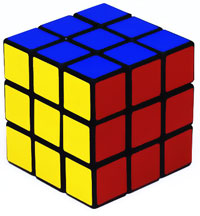
210) Rubik's Cube
Background
Rubik's cube is a toy puzzle designed by Erno Rubik during the mid-1970s. It is a cube-shaped device made up of smaller cube pieces with six faces having differing colors. The primary method of manufacture involves injection molding of the various component pieces, then subsequent assembly, labeling, and packaging. The cube was extremely popular during the 1980s, and at its peak between 1980 and 1983, 200 million cubes were sold world wide. Today sales continue to be over 500,000 cubes sold world wide each year.
The Rubik's cube appears to be made up of 26 smaller cubes. In its solved state, it has six faces, each made up of nine small square faces of the same color. While it appears that all of the small faces can be moved, only the corners and edges can actually move. The center cubes are each fixed and only rotate in place. When the cube is taken apart it can be seen that the center cubes are each connected by axles to an inner core. The corners and edges are not fixed to anything. This allows them to move around the center cubes. The cube maintains its shape because the corners and edges hold each other in place and are retained by the center cubes. Each piece has an internal tab that is retained by the center cubes and trapped by the surrounding pieces. These tabs are shaped to fit along a curved track that is created by the backs of the other pieces. The central cubes are fixed with a spring and rivet and retain all the surrounding pieces. The spring exerts just the right pressure to hold all the pieces in place while giving enough flexibility for a smooth and forgiving function.
History
Puzzle makers have been creating problems for people to solve for centuries. Some of the earliest puzzles date back to the time of the ancient Greeks and Romans. The Chinese have a ring puzzle that is thought to have been developed during the second century a.d. This was first described by Italian mathematician Girolamo Carolano (Cardan) in 1550. When the printing press was invented, complete books of mathematical and mechanical problems designed specifically for recreation were circulated.
From these early riddles and word problems, toy puzzles were naturally developed. In 1857, the Irish mathematician Sir William Hamilton invented the Icosian puzzle. Sometime around 1870, the famous 15 Puzzle was introduced, reportedly by Sam Lloyd. This puzzle involved numerical tiles that had to be placed in order and became extremely popular in the early twentieth century. In 1883, French mathematician Edouard Lucas created the Tower of Hanoi puzzle. This puzzle was made up of three pegs and a number of discs with different sizes. The goal was to place the discs on the pegs in the correct order.
There are various puzzles that involve colored square tiles and colored cubes. Some early precursors to the Rubik's cube include devices such as the Katzenjammer and the Mayblox puzzle. The Mayblox puzzle was created by British mathematician Percy MacMahon in the early 1920s. In the 1960s, Parker Bothers introduced another cube puzzle type toy called Instant Insanity. This toy achieved a moderate level of popularity in the United States. The early 1970s brought with it a device called the Pyraminx, which was invented by Uwe Meffert. This toy was a pyramid that had movable pieces that were to be lined up according to color.
Erno Rubik, an architect and professor at the University of Budapest developed the first working prototype of the Rubik's cube in 1974. He received a Hungarian patent in 1975. Apparently, it was also independently designed by Terutoshi Ishige, an engineer from Japan, who received a Japanese patent in 1976. Professor Rubik created the cube as a teaching aid for his students to help them recognize three-dimensional spatial relationships. When he showed the working prototype to his students, it was an immediate hit.
Over the next few years, Rubik worked with a manufacturer to allow production of the cube on a mass scale. After three years of development, the first cubes were available on toy store shelves in Budapest. While the cube remained popular in Hungry, the political atmosphere of the time made it difficult for it to be introduced in the United States. The two men who were most responsible for making the cube an international success were Dr. Laczi Tibor and Tom Kremer of Seven Towns Ltd., London. Seven Towns licensed the Rubik Cube invention from Professor Rubik for worldwide distribution. Dr. Tibor worked within Hungry to convince bureaucrats to allow the technology out of the country. Kremer found a United States toy maker, the Ideal Toy company, who was willing to help market the product. The product was an immediate hit, and during the 1980s, over 200 million cubes were sold. Around 1983, the frenzied popularity of the cube began to wane and sales slowed drastically. It remained in small scale production until Seven Towns took over the marketing, and licensed the Rubik Cube to the Oddzon Company for the United States market in 1995. Since that time sales have steadily increased to over 500,000 units a year.
Design
The most important part in the manufacture of a Rubik's cube is designing the mold for the various pieces. A mold is a cavity carved into steel that has the inverse shape of the part that it will produce. When liquid plastic is put into the mold, it takes on the mold's shape when it cools. The creation of the mold is extremely precise. The cavity is highly polished to remove any flaws on the surface. Any flaw would be reproduced on each of the millions of pieces that the mold will produce. In the manufacture of the cube parts, a two piece mold is typically employed. During production, the two mold pieces are brought together to form the plastic part and then opened to release it. The tool includes ejector pins that release the molded parts from the tools as it opens. All the parts are molded with auto gating tools that automatically remove the parts from the sprue as it is ejected. The molds are also produced with a slight taper, called release angle, which aids in removal. Finally, when molds are designed, they are slightly bigger than the pieces that they ultimately will produce. This is because as the plastics cool, they shrink. Different plastics will have a different shrink rate, and each tool must be specifically designed for the material that will be used.
The commercial cube is composed of six fixed cubes, eight movable cubes on the corners and 12 movable cubes on the edges. Each cube is one of six colors. The Rubik's cube has red, yellow, blue, green, white, and orange colors. In its solved state, each color is on only one face. When the cube is rotated, the edges and corners move and the cube becomes scrambled. The challenge of the puzzle is to restore each cube to its original position. The cube is extremely challenging because there are slightly more than 43 quintillion (4.3 × {10}^{19}) possible arrangements, and only one solution.
The standard Rubik's cube has sides of about 2.2 in (5.7 cm) per square. Various other sizes have also been produced such as a 1.5 in (3.8 cm) mini cube, a 0.8 in (2 cm) key chain micro cube, and a 3.5 in (9 cm) giant cube. While the standard cube is a 3 × 3 × 3 segmentation other types have also been introduced. Some of the more interesting ones include the 2 × 2 × 2 cube, the 4 × 4 × 4 cube (called Rubik's Revenge) and the 5 × 5 × 5 cube. The shape has also been varied and puzzles in the form of a tetrahedral, a pyramid, and an octahedral are among types that were produced. The Rubik's cube also led to the development of game derivatives like the Rubik's cube puzzle and the Rub it cube eraser.
Raw Materials
The individual pieces that make up the Rubik's cube are typically produced from plastic. Plastics are high molecular weight materials that can be produced through various chemical reactions called polymerization. Most of the plastics used in a Rubik's cube are thermoplastics. These compounds are rigid, durable, and can be permanently molded into various shapes. The plastics used in the Rubik's cube are acrylonitrile butadiene styrene (ABS) and nylon. Other plastics that might be used include polypropylene (PP), high impact polystyrene (HIPS), and high density polyethylene (HDPE).
For decorative purposes, a colorant is typically added to the plastic. The pieces of a Rubik's cube are typically black. During production, colored stickers are put on the outside of the cube to denote the color of a side. The plastics that are used during production are supplied to the manufacturer in a pellet form complete with the filler and colorants. These pellets can then be loaded into the molding machines directly.
The Manufacturing
Process
The manufacture of the first Rubik's cube prototypes was by hand. During the late 1970s, methods for mass production were developed and continue to be used today. Typically, production is a step by step process that involves injection molding of the pieces, fitting the pieces together, decorating the Rubik's cube, and putting the finished product in packaging.
Molding
(1) When production is initiated, the plastic pellets are transformed into Rubik's cube parts through injection molding. In this process, the pellets are put into the hopper of an injection molding machine. They are melted when they are passed through a hydraulically controlled screw. As the screw turns, the melted plastic is shuttled through a nozzle and physically forced, or injected, into the mold. Just prior to the arrival of the molten plastic, the two halves of the mold are brought together to create a cavity that has the identical shape of the Rubik's cube part. This could be an edge, a corner, or the center piece. Inside the mold, the plastic is held under pressure for a specific amount of time and then allowed to cool. While cooling, the plastic hardens inside the mold. After enough time passes, the mold halves are opened and the cube pieces are ejected. The mold then closes again and the process begins again. Each time the machine moulds a set of parts is one cycle of the machine. The Rubik's cube cycle time is around 20 seconds.
(2) After the cube parts are ejected from the mold, they are dropped into container bins and hand inspected to ensure that no significantly damaged parts are used. The waste sprue material is set aside to be reused or scrapped. Waste material can be ground up and melted again to make new parts, however reground material can degrade and cause poor quality parts. Rubik's cubes are always made from virgin material and never use reground waste plastic.
Parts assembly
(3) The Rubik's cube parts are taken to an assembly line. In this phase of production, the individual cube pieces are put together. Starting with the nylon core, each ABS center cube is riveted to the core with a spring spacer. The rivet is carefully controlled with a depth stop to ensure the spring is compressed just the right amount. Each center cube has a plastic cover that is glued on to hide the rivet. One of the six center cubes is left until the last part of the assembly. The ABS edges and corner pieces are individually stacked around the core. The cube is built from the bottom up and the last piece to be assembled is the final center cube which is again riveted into the core with a spring spacer and the final cap is glued on.
Labeling
(4) Next, the Rubik's cube faces need to be labeled. The labels are made from sheet polypropylene material that is printed with the colors. The printed sheet PP is then laminated with a clear PP protective covering. The material is then die cut with the labels wound onto rolls. The labels are made with all nine squares of each face exactly aligned. This way the labels can be perfectly aligned when they are applied to the cube.
Packaging
(5) After all the labeling is completed, the cubes are put in their final packaging. This can be a small box that has an instruction booklet included or a plastic blister pack with a cardboard backing. The package serves the dual purpose of protecting the Rubik's cube from damage caused by shipping and advertising the product. The Rubik's cube packages are put into cases and moved to a pallet. The pallets are then loaded on trucks and the products are shipped all over the world.
Quality Control
To ensure that each toy will be a high quality product, quality control inspectors check the product at each phase of production. The incoming plastic pellets are chemically tested to determine whether they meet certain chemical specifications. These include checks on appearance, color, melting point, toxicity, and molecular weight.
The quality of the individual parts are also inspected just after exiting the mold. Since thousands of parts are made daily, a complete inspection would be difficult. Consequently, line inspectors may randomly check the plastic parts at fixed time intervals and check to ensure they meet size, shape, and consistency specifications. This sampling method provides a good indication of the quality of the overall Rubik's cube production run. Things that are looked for include deformed parts, improperly fitted parts and inappropriate labeling. While visual inspection is the primary test method employed, more rigorous measurements may also be performed. Measuring equipment is used to check the length, width, and thickness of each part. Typically, devices such as a vernier caliper, a micrometer, or a microscope are used. Just prior to putting a cube in the packaging it may be twisted to ensure that it holds together and is in proper working order. This can be done by hand or by a turning machine. If a toy is found to be defective it is placed aside to be reworked later.
The Future
While the extreme popularity of the Rubik's cube subsided around 1984. it has recently made a significant come back. This has been a result of impressive marketing efforts by Seven Towns. In the future, this marketing effort should continue to increase sales of the Rubik's cube. In addition to the cube, other derivative puzzles have been introduced including the Rubik's snake, Rubik's triamid, and the Rubik's magic folding puzzle. It is expected that new variants will also be introduced in the near future.
It appears to me that if one wants to make progress in mathematics, one should study the masters and not the pupils. - Niels Henrik Abel.
Nothing is better than reading and gaining more and more knowledge - Stephen William Hawking.
Offline
#230 2018-09-25 00:12:53
- Jai Ganesh
- Administrator
- Registered: 2005-06-28
- Posts: 53,929
Re: Miscellany
211) Mutilated Chessboard Problem
A regular chessboard is an 8×8 grid (having 64 squares). If you are given 32 dominos where each domino can cover two squares on the chessboard, you can cover all the squares of the chessboard.
Someone mutilated the chessboard and removed the upper left and lower right corners. The mutilated board has 62 squares. You are given 31 dominos. Can you tile the mutilated chessboard with the 31 dominos?
Let students try to find a way to tile the mutilated board. After a while some of them will claim that it can’t be done. The algorithms we have sketched so far describe how something can be done. If the board can indeed not be tiled, how do we proceed?
One could write a program that systematically generates all possible ways to tile the mutilated board. The number of ways the mutilated chess board can be tiled is finite, but it is a large number. If the program fails to find a possible tiling, we can conclude none exists.
However, we can show that no tiling exists by a direct proof. This means that a program checking all possible tilings would not find one.
Here is the argument:
A tile placed on the chessboard will always cover one white square and one black square. Therefore, a collection of tiles placed on the board will cover equal numbers squares of each color. The mutilated board has two white squares removed and it thus has 30 white squares and 32 black squares. If every tile covers one black and one white square and we have more white squares, we can conclude that the mutilated board cannot be tiled. If the two black corners are removed instead, then 32 white squares and 30 black squares remain, so it is again impossible.
We can tile a mutilated board only if one white and one black corner are removed (but the problem said corners on opposite sides of a diagonal were removed).
The mutilated chessboard problem is a tiling puzzle proposed by philosopher Max Black in his book Critical Thinking (1946). It was later discussed bySolomon W. Golomb (1954), Gamow & Stern (1958) and by Martin Gardner in his Scientific American column "Mathematical Games". The problem is as follows:
Suppose a standard 8×8 chessboard has two diagonally opposite corners removed, leaving 62 squares. Is it possible to place 31 dominoes of size 2×1 so as to cover all of these squares?
Most considerations of this problem in literature provide solutions "in the conceptual sense" without proofs. John McCarthy proposed it as a hard problem for automated proof systems. In fact, its solution using the resolution system of inference is exponentially hard.
Solution
The puzzle is impossible to complete. A domino placed on the chessboard will always cover one white square and one black square. Therefore, a collection of dominoes placed on the bo