Math Is Fun Forum
You are not logged in.
- Topics: Active | Unanswered
- Index
- » This is Cool
- » Bonsai
Pages: 1
#1 2026-03-30 21:38:29
- Jai Ganesh
- Administrator

- Registered: 2005-06-28
- Posts: 53,920
Bonsai
Bonsai
Gist
Bonsai are trees and plants grown in containers in such a way so that they look their most beautiful – even prettier than those growing in the wild. Cultivating bonsai, therefore, is a very artistic hobby as well as a traditional Japanese art.
Bonsai are trees and plants grown in containers in such a way so that they look their most beautiful – even prettier than those growing in the wild. Cultivating bonsai, therefore, is a very artistic hobby as well as a traditional Japanese art. It's also a good illustration of the gentle respect Japanese have for living things and an expression of their sense of what is beautiful. It's much more involved than growing potted flowers, and requires a much bigger commitment – physically and emotionally.
Bonsai trees are expensive primarily due to the immense time, specialized labor, and expertise required to cultivate them, often taking decades or centuries to reach a high-quality, mature, and artistic form. Prices are driven by age, species rarity, detailed design, and expensive, often antique, imported pots.
Summary
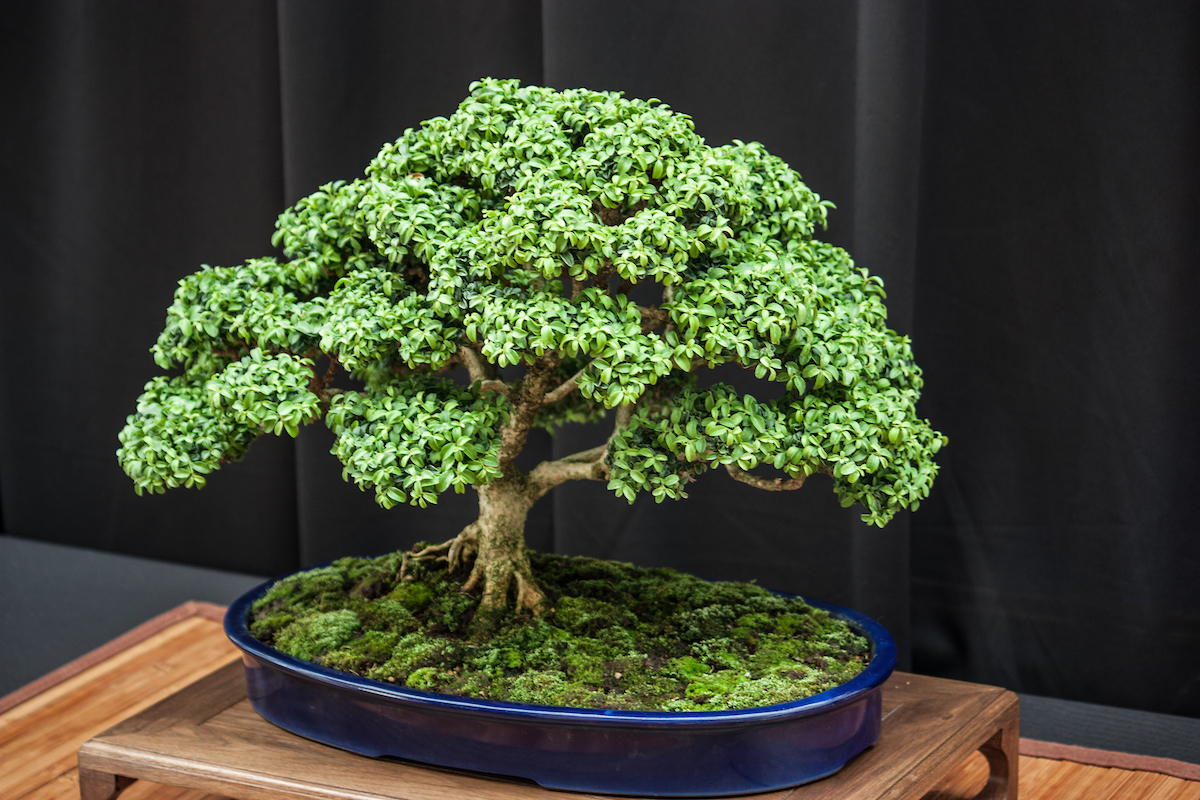
Bonsai (lit. plantings in tray, from bon, a tray or low-sided pot and sai, a planting or plantings) is the Japanese art of growing small trees in pots. This is done by growing the tree in a small pot or tray and pruning (cutting) the branches and roots to keep the tree small over time. Bonsai trees are trained to grow into a shape that is pleasing to look at. The best bonsai trees appear to be old, and to have a shape that seems like a real tree except much smaller.
The word bonsai means "tree in tray" in the Japanese language. Bonsai is a very old art form in Japan. It is a Japanese form of the older Chinese art called penjing. Penjing is a Chinese art form that also uses trees growing in pots. Other nations also have arts like bonsai and penjing.
People like bonsai because it is nice to look at, and because it is fun to grow a bonsai tree. A bonsai tree can live for a very long time, longer than a person can live. In a family, a bonsai might be started by a grandparent, then given to a parent, then given to a child over many years.
A bonsai starts with a small tree. This tree can be grown from a seed, or can be found already growing in a yard or a park or the forest. It can also be bought from a plant store.
To make the bonsai, the small tree is taken out of the ground. Its roots are carefully cleaned of dirt. The roots may be trimmed (cut) a little to help them fit in a small pot. The branches may also be trimmed to make the tree smaller. Then it is put in a bonsai pot, which has low sides. Fresh soil (dirt) is put in the pot to cover the bonsai tree's roots. Then it is watered and put outdoors to live.
Good trees to make into bonsai have small leaves (pine tree needles are leaves too). If the leaves are too big, the bonsai will not look like a small tree. A good bonsai tree will have old-looking bark and old-looking roots too.
Details
Bonsai is the Japanese art of growing and shaping miniature trees in containers, with a long documented history of influences and native Japanese development over a thousand years, and with unique aesthetics, cultural history, and terminology derived from its evolution in Japan. Similar arts exist in other cultures, including Korea's bunjae, the Chinese art of penjing, and the miniature living landscapes of Vietnamese Hòn non bộ.
The loanword bonsai has become an umbrella term in English, attached to many forms of diminutive potted plants, and also on occasion to other living and non-living things. According to Stephen Orr in The New York Times, "in the West, the word is used to describe virtually all miniature container trees, whether they are authentically trained bonsai or just small rooted cuttings. Technically, though, the term should be reserved for plants that are grown in shallow containers following the precise tenets of bonsai pruning and training, resulting in an artful miniature replica of a full-grown tree in nature." In the most definitive sense, "bonsai" refers to miniaturized, container-grown trees adhering to Japanese bonsai tradition and principles.
Purposes of bonsai are primarily contemplation for the viewer, and the pleasant exercise of effort and ingenuity for the grower. Bonsai are not grown for the production of food or medicine.
A bonsai is created beginning with a specimen of source material. This may be a cutting, seedling, a tree from the wild (known as yamadori) or small tree of a species suitable for bonsai development. Bonsai can be created from nearly any perennial woody-stemmed tree or shrub species that produces true branches and can be cultivated to remain small through pot confinement with crown and root pruning. Some species are popular as bonsai material because they have characteristics, such as small leaves or needles or aged-looking bark, that make them appropriate for the compact visual scope of bonsai.
The source specimen is shaped to be relatively small and to meet the aesthetic standards of bonsai, which emphasizes not the entirety of a landscape but the unique form of a specimen bonsai tree or trees. When the candidate bonsai nears its planned final size, it is planted in a display pot, usually one designed for bonsai display in one of a few accepted shapes and proportions. From that point forward, its growth is restricted by the pot environment. Throughout the year, the bonsai is shaped to limit growth, redistribute foliar vigor to areas requiring further development, and meet the artist's detailed design.
The practice of bonsai is sometimes confused with dwarfing, but dwarfing generally refers to research, discovery, or creation of plants that are permanent, genetic miniatures of existing species. Plant dwarfing often uses selective breeding or genetic engineering to create dwarf cultivars. Bonsai does not require genetically dwarfed trees but rather depends on growing small trees from regular stock and seeds. Bonsai uses cultivation techniques like pruning, root reduction, potting, defoliation, and grafting to produce small trees that mimic the shape and style of mature, full-size trees.
Additional Information
Bonsai is a living dwarf tree or trees or the art of training and growing them in containers.
Bonsai specimens are ordinary trees and shrubs (not hereditary dwarfs) that are dwarfed by a system of pruning roots and branches and training branches by tying with wire. The art originated in China, where, perhaps over 1,000 years ago, trees were cultivated in trays, wooden containers, and earthenware pots and trained in naturalistic shapes. Bonsai, however, has been pursued and developed primarily by the Japanese. The first Japanese record of dwarfed potted trees is in the Kasuga-gongen-genki (1309), a picture scroll by Takashina Takakane.
The direct inspiration for bonsai is found in nature. Trees that grow in rocky crevices of high mountains, or that overhang cliffs, remain dwarfed and gnarled throughout their existence. The Japanese prize in bonsai an aged appearance of the trunk and branches and a weathered character in the exposed upper roots. These aesthetic qualities are seen to embody the philosophical concept of the mutability of all things.
Bonsai may live for a century or more and may be handed down from one generation to another as valued family possessions. Aesthetics of scale call for short needles on conifers and relatively small leaves on deciduous trees. Small-flowered, small-fruited varieties of trees are favoured. Open space between branches and between masses of foliage are also important aesthetically. In diminutive forests the lower portions of the trunks should be bare.
Good bonsai specimens are usually hardy species that can be kept outdoors the year round wherever winters are mild. They can be brought into the house occasionally for appreciation and enjoyment. In Japan they are customarily displayed in an alcove or on small tables in a living room and later returned to their outdoor bonsai stands.
The selection of the appropriate container in which to cultivate a bonsai is an essential element of the art. Bonsai pots are usually earthenware, with or without a colourful exterior glaze. They may be round, oval, square, rectangular, octagonal, or lobed and have one or more drainage holes in the bottom. Containers are carefully chosen to harmonize in colour and proportion with the tree. If the container is rectangular or oval, the tree is planted not quite halfway between the midpoint and one side, according to the spread of the branches. In a square or round container the tree is placed slightly off centre, except for cascade types, which are planted toward the opposite side of the container from which they overhang. Bonsai are trained to have a front, or viewing side, oriented toward the observer when on exhibit.
Although categorizations vary considerably, miniature bonsai are known broadly as shohin. The smallest of these (keishi and math) range in size up to about 2 inches (5–7 cm) in height and, started from seeds or cuttings, may take three to five years to come to quality stage. They may live several decades. Small bonsai (mame), 2 to 6 inches (7 to 15 cm) in height, require 5 to 10 or more years to train. Medium bonsai generally range from roughly 7 to 15 inches (20 to 40 cm) in height but can be up to about 2 feet (60 cm) tall and can be produced in as little as three years. Large (dai) bonsai can be as tall as 47 inches (120 cm) and require two or more people to move them.
Naturally dwarfed trees collected in the wild frequently fail to adapt to cultivation as bonsai because of the severe shock brought about by the change of environment and substrate.
Bonsai must be repotted every one to five years, depending on the species and extent of root growth. Gradual root pruning during transplanting in subsequent years reduces the size of the soil ball so that the tree can ultimately go into the desired small and shallow container. Water is usually provided on a daily basis; liquid fertilizer is also used. Pruning and nipping of shoots is performed through the growing season.
A bonsai industry of considerable size exists as part of the nursery industry in sections of Japan. The technique is also pursued on a small industrial scale in California.
It appears to me that if one wants to make progress in mathematics, one should study the masters and not the pupils. - Niels Henrik Abel.
Nothing is better than reading and gaining more and more knowledge - Stephen William Hawking.
Offline
Pages: 1
- Index
- » This is Cool
- » Bonsai