Math Is Fun Forum
You are not logged in.
- Topics: Active | Unanswered
Pages: 1
#1 2026-03-22 17:57:47
- Jai Ganesh
- Administrator

- Registered: 2005-06-28
- Posts: 53,833
Bone Marrow
Bone Marrow
Gist
Bone marrow is the soft, spongy, and highly vascularized tissue located in the cavities of bones—primarily the pelvis, ribs, and sternum—that serves as the body's main blood cell "factory". It produces red blood cells (oxygen transport), white blood cells (immune defense), and platelets (clotting) from hematopoietic stem cells, making it essential for life.
Bone marrow is the soft, spongy, highly vascular tissue found in the center of bones, primarily acting as the body's main blood cell factory. It contains stem cells that produce essential components: red blood cells (oxygen delivery), white blood cells (immune defense), and platelets (clotting).
Summary
Bone marrow is a semi-solid tissue found within the spongy (also known as cancellous) portions of bones. In birds and mammals, bone marrow is the primary site of new blood cell production (or haematopoiesis). It is composed of hematopoietic cells, marrow adipose tissue, and supportive stromal cells. In adult humans, bone marrow is primarily located in the ribs, vertebrae, sternum, and bones of the pelvis. Bone marrow comprises approximately 5% of total body mass in healthy adult humans, such that a person weighing 73 kg (161 lbs) will have around 3.7 kg (8 lbs) of bone marrow.
Human marrow produces approximately 500 billion blood cells per day, which join the systemic circulation via permeable vasculature sinusoids within the medullary cavity. All types of hematopoietic cells, including both myeloid and lymphoid lineages, are created in bone marrow; however, lymphoid cells must migrate to other lymphoid organs (e.g. thymus) in order to complete maturation.
Bone marrow transplants can be conducted to treat severe diseases of the bone marrow, including certain forms of cancer such as leukemia. Several types of stem cells are related to bone marrow. Hematopoietic stem cells in the bone marrow can give rise to hematopoietic lineage cells, and mesenchymal stem cells, which can be isolated from the primary culture of bone marrow stroma, can give rise to bone, adipose, and cartilage tissue.
Details
Bone marrow is the soft, fatty tissue inside of the bones in your body. Bone marrow contains cells that produce blood cells and platelets and it is responsible for making billions of new blood cells each day.
Overview:
What is bone marrow?
Bone marrow is the soft, fatty tissue inside of bone cavities. Components of your blood including red and white blood cells and platelets form inside of your bone marrow.
Function:
What does bone marrow do?
Bone marrow makes nearly all the components of your blood. It's responsible for creating billions of red blood cells daily, along with white blood cells and platelets. Bone marrow also stores fat that turns into energy as needed.
Can you live without bone marrow?
Bone marrow makes the components of your blood that you need to survive. Bone marrow produces red blood cells that carry oxygen, white blood cells that prevent infection and platelets that control bleeding. The absence of bone marrow can be fatal since it's an essential part of your body.
Can I donate bone marrow?
Yes, bone marrow and the healthy cells it produces are necessary for humans to live. Often, cell mutations harm healthy bone marrow cells, and a bone marrow transplant would be a treatment option for people diagnosed with blood cancers like leukemia.
A bone marrow transplant takes healthy cells from a donor and puts them into your bloodstream. The donor’s cells help your body grow healthy red and white blood cells and platelets.
Anatomy:
Where is bone marrow located?
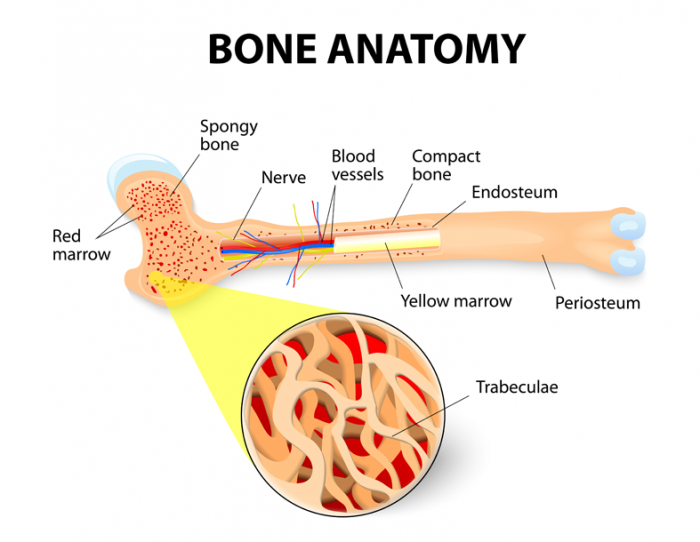
There are three parts to the anatomy of your bones: compact bone, spongy bone and bone marrow. Compact bone is the strong, outer layer of your bones. Spongy bone makes up the ends of your bones. Bone marrow is in the center of most bones and in the end of spongy bones in your body. Bone marrow and blood vessels fill cavities in your bones, where they store fat and stem cells and produce blood cells that make your whole blood.
What does bone marrow look like?
Bone marrow is a spongy, soft tissue that resembles a jelly or jam that you would spread on toast. It comes in two colors, red and yellow. Bone marrow fills the cavities of your bones and holds cells that create red and white blood cells and platelets, which make whole blood. The color of red bone marrow is the result of red blood cell production.
What are the two types of bone marrow?
There are two types of bone marrow in your body, which are characterized by their color. Your body holds just under 6 lbs. (about 2.5 kg.) of red and yellow bone marrow.
* Red: Red bone marrow produces blood cells (hematopoiesis). Stem cells in your red bone marrow (hematopoietic stem cells) create red and white blood cells and platelets, all of which are components of your whole blood.
* Yellow: Yellow bone marrow stores fat. There are two types of stem cells in yellow bone marrow (adipocytes and mesenchymal stem cells). These cells preserve fat for energy production and develop bone, cartilage, muscles and fat cells for your body.
Red bone marrow makes up all of your bone marrow until about age seven. Yellow bone marrow gradually replaces red bone marrow as you age.
What is bone marrow made of?
Bone marrow is made of stem cells. These stem cells make red bone marrow, which creates blood cells and platelets for your blood. Yellow bone marrow consists mostly of fat and stem cells that produce bone and cartilage in your body.
Conditions and Disorders:
What are common conditions and disorders that affect bone marrow?
Directly targeting bone marrow is leukemia, which is a blood and bone marrow cancer. Leukemia forms when a cell mutation occurs in your bone marrow and mutated cells multiply out of control, reducing the production of healthy, normal cells.
Since bone marrow is the foundation for the creation of blood cells, blood-related conditions often are the result of abnormally functioning bone marrow. These conditions include:
* Multiple myeloma: Your body produces cancerous plasma cells in your bone marrow.
* Aplastic anemia: Your bone marrow doesn’t produce enough blood cells.
* Polycythemia vera: Your body makes too many red blood cells, which causes your blood to thicken.
* Myelodysplastic syndromes: A group of diseases characterized by your bone marrow not producing enough healthy blood cells (anemia).
What are common symptoms of bone marrow conditions?
Common symptoms of bone marrow conditions include:
* Bleeding easily,
* Bruising.
* Fatigue.
* Frequent infections.
* Muscle weakness.
What are common tests to check the health of my bone marrow?
There are two tests to check the health of your bone marrow and/or blood cells:
* Bone marrow aspiration: A needle removes fluid and cells from your bone marrow (bone marrow concentrate). The aspirate test identifies what cells are present in your bone marrow, verifies whether or not those cells are normal or abnormal and gives other information about the characteristics of your cells.
* Bone marrow biopsy: A large needle removes a piece of your bone marrow. The biopsy shows where, how many and the types of cells are present in your bone marrow.
Is it painful to remove my bone marrow?
For a bone marrow test or donation, you’ll receive an anesthetic, so you won't feel any pain during the procedure. After the procedure, you may feel side effects, which include aches and pain at the site of the incision. Each individual experiences pain differently, so the severity could vary from person to person. The pain may last for a few days or up to several weeks.
What are common treatments for bone marrow conditions?
Treatments for bone marrow conditions vary based on the severity and progress of the diagnosis. Treatment options include:
* Antibiotics.
* Blood transfusions.
* Bone marrow transplant.
* Chemotherapy.
* Supportive care to relieve symptoms.
* Stem cell transplant.
Care:
How do I keep my bone marrow healthy?
Bone marrow is the foundation of your bones, blood and muscles. Keeping your bone marrow healthy focuses on supporting components of your body that grow from bone marrow cells. You can keep your bone marrow healthy by:
* Eating a diet rich in protein (lean meats, fish, beans, nuts, milk, eggs).
* Taking vitamins (iron, B9, B12).
* Treating medical conditions where bone marrow abnormalities are a side effect.
Additional Information
Bone marrow is a soft, gelatinous tissue that fills the cavities of the bones. Bone marrow is either red or yellow, depending upon the preponderance of hematopoietic (red) or fatty (yellow) tissue. In humans the red bone marrow forms all of the blood cells with the exception of the lymphocytes, which are produced in the marrow and reach their mature form in the lymphoid organs. Red bone marrow also contributes, along with the liver and spleen, to the destruction of old red blood cells. Yellow bone marrow serves primarily as a storehouse for fats but may be converted to red marrow under certain conditions, such as severe blood loss or fever. At birth and until about the age of seven, all human marrow is red, as the need for new blood formation is high. Thereafter, fat tissue gradually replaces the red marrow, which in adults is found only in the vertebrae, hips, breastbone, ribs, and skull and at the ends of the long bones of the arm and leg; other cancellous, or spongy, bones and the central cavities of the long bones are filled with yellow marrow.
Red marrow consists of a delicate, highly vascular fibrous tissue containing stem cells, which differentiate into various blood cells. Stem cells first become precursors, or blast cells, of various kinds; normoblasts give rise to the red blood cells (erythrocytes), and myeloblasts become the granulocytes, a type of white blood cell (leukocyte). Platelets, small blood cell fragments involved in clotting, form from giant marrow cells called megakaryocytes. The new blood cells are released into the sinusoids, large thin-walled vessels that drain into the veins of the bone. In mammals, blood formation in adults takes place predominantly in the marrow. In lower vertebrates a number of other tissues may also produce blood cells, including the liver and the spleen.
Because the white blood cells produced in the bone marrow are involved in the body’s immune defenses, marrow transplants have been used to treat certain types of immune deficiency and hematological disorders, especially leukemia. The sensitivity of marrow to damage by radiation therapy and some anticancer drugs accounts for the tendency of these treatments to impair immunity and blood production.
Examination of the bone marrow is helpful in diagnosing certain diseases, especially those related to blood and blood-forming organs, because it provides information on iron stores and blood production. Bone marrow aspiration, the direct removal of a small amount (about 1 ml) of bone marrow, is accomplished by suction through a hollow needle. The needle is usually inserted into the hip or sternum (breastbone) in adults and into the upper part of the tibia (the larger bone of the lower leg) in children. The necessity for a bone marrow aspiration is ordinarily based on previous blood studies and is particularly useful in providing information on various stages of immature blood cells. Disorders in which bone marrow examination is of special diagnostic value include leukemia, multiple myeloma, Gaucher disease, unusual cases of anemia, and other hematological diseases.
It appears to me that if one wants to make progress in mathematics, one should study the masters and not the pupils. - Niels Henrik Abel.
Nothing is better than reading and gaining more and more knowledge - Stephen William Hawking.
Offline
Pages: 1