Math Is Fun Forum
You are not logged in.
- Topics: Active | Unanswered
Pages: 1
#1 2026-03-22 00:58:58
- Jai Ganesh
- Administrator

- Registered: 2005-06-28
- Posts: 53,833
Iguazu Falls
Gist
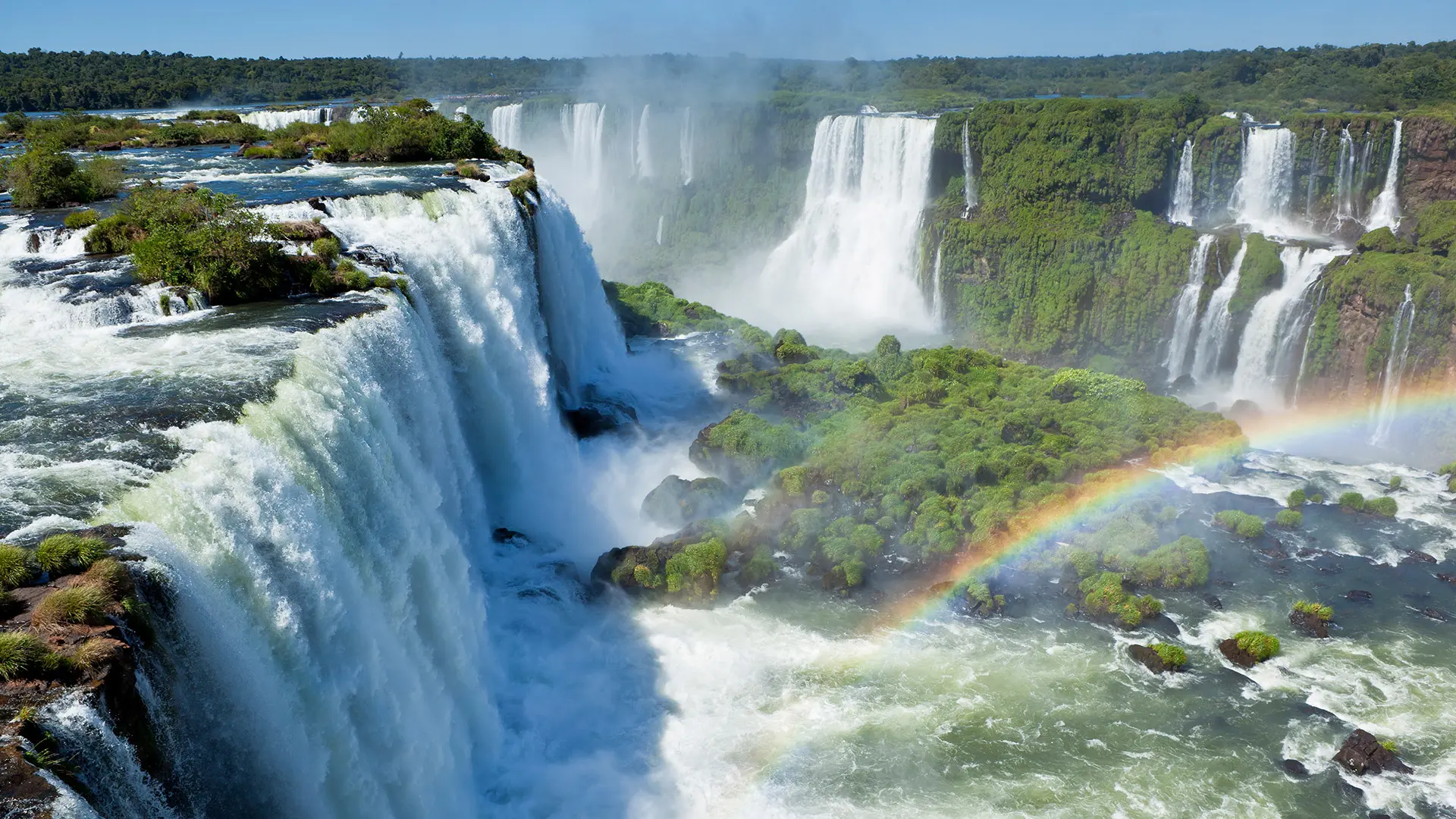
Iguazu Falls is the world's largest waterfall system, featuring 275 individual cascades stretching nearly 3 kilometers along the Argentina-Brazil border. As a UNESCO World Heritage site and one of the new seven natural wonders, it features the dramatic 80-meter-tall "Devil's Throat" (Garganta del Diablo).
Iguazu Falls exists within a protected UNESCO World Heritage site that's home to over 2,000 species of vascular plants and countless animal species, including jaguars, ocelots, and over 400 bird species.
Iguazu Falls is one of the new seven natural wonders of the world. At over 1.5 miles wide it is wider than Niagara Falls and is 60% taller than Niagara Falls.
Summary
“My poor Niagara …”
That is what Eleonor Roosevelt said when she saw Iguazu Falls.
Welcome to Iguazu Falls! One of the most important destinations in Argentina, Brazil and South America!
Every year, millions of people come to visit this beautiful natural attraction that Argentina and Brazil have to offer. During 2019, the park received 1,640,000 visitors, both local and foreign.
And everyone is amazed with this destination!
The Iguazu Falls consists of two national parks, one in Foz de Iguazu (Brazil) and the other one in Puerto Iguazu (Argentina). The curious thing is that although one only sees the falls as the main attraction, the park has a size of 252,982 hectares (67,720 on the Argentine side and 185,262 on the Brazilian side).
These falls in Argentina and Brazil managed to attract so much attention that almost at the same time they were declared National Parks (1934 in Argentina and 1939 in Brazil). And after some years and millions of visitors fascinated by the landscape and the sound of this natural attraction, UNESCO declared them as World Heritage Site in 1984, and reaffirmed as Exceptional Universal Value (their cultural and nature it’s so important that it’s conservation should be of worldwide interest) in 2013.
Why are they so famous? It is enough to just see photos and videos to be amazed by its beauty. But it is not only about tourism: the Iguazu National Park is home to many species of animals and flora that create an important natural ecosystem connected to all Latin America.
Each visitor who comes to the Iguazu Falls collaborates to continue the conservation work for the area.
And obviously, Iguazu Falls have allowed the development of local economies, making the city of Puerto Iguazu and Foz de Iguazu grow and improve the quality of life of its inhabitants.
Location of Iguazu Falls
Iguazu Falls are in the continent of South America, and as we mentioned, it is shared by two countries: Argentina and Brazil. Although Paraguay is nearby, it only shares the river that Iguazu Falls feeds, but it is quite far from the falls and cannot even be seen from there.
The city in Argentina where the Iguazu Falls are located is called Puerto Iguazu, and in Brazil it is called Foz de Iguazu. Both cities are very close to each other: only 16km from center to center.
Iguazu Falls on the Argentine side are located 18km from Puerto Iguazu and 29km from the center of Foz de Iguazu.
Iguazu Falls on the Brazilian side are 27km from Puerto Iguazu, and 29km from downtown Foz de Iguazu
Both cities are very close to each national park, that is why all the excursions that we offer on both sides of the falls can pick up from any hotel in both destinations (except in hotels far from the center such as Recanto Cataratas).
The destination is close to several major cities with direct flights. For example, going to Iguazu Falls from Buenos Aires only needs to take a plane to get there in about 2 hours. From Rio de Janeiro you can also get to Iguazu in two hours.
The Iguazu Falls on the Argentine side is at latitude -25.68352837588661 and longitude -54.4547103472097.
The Iguazu Falls on the Brazilian side is at latitude -25.61524025766296 and longitude -54.479225906855845.
Airports Near Iguazu Falls
As the Iguazu Falls are shared by Argentina and Brazil, you have two airports to choose from where to get there: Puerto Iguazu (airport code IGR) and Foz de Iguazu (airport code IGU).
Getting to one or the other airport depends on where you come from to visit the destination.
If you want to visit Iguazu from destinations in Argentina such as Buenos Aires, Cordoba, Salta or other, you should look for flights arriving in Puerto Iguazu (airport code IGR).
Now if you come from Rio de Janeiro, Sao Paulo, or even some international destination like Lima (Peru), then look for flights that arrive at Foz de Iguazu (airport code IGU).
Both airports are fairly close to Iguazu Falls, in fact it is quite normal to offer one-day tours that visit the park on flights that arrive and depart the same day – although it may seem rushed, it is an excellent option for passengers who come from cruise ships or who have very little time.
Iguazu Falls on the Argentine side are 9km (15-20 minutes by car). And the falls on the Brazilian side are 4 kilometers away (less than 10 minutes by car).
Details
Iguazú Falls or Iguaçu Falls are waterfalls of the Iguazu River on the border of the Argentine province of Misiones and the Brazilian state of Paraná. Together, they make up the largest waterfall system in the world. The falls divide the river into the upper and lower Iguazu. The Iguazu River rises near the heart of the city of Curitiba. For most of its course, the river flows through Brazil; however, most of the falls are on the Argentine side. Below its confluence with the San Antonio River, the Iguazu River forms the border between Argentina and Brazil.
The name Iguazú comes from the Guarani or Tupi words y, meaning 'water', and ûasú [waˈsu], meaning 'big'. Legend has it that a deity planned to marry a beautiful woman named Naipí, who fled with her mortal lover Tarobá in a canoe. In a rage, the deity sliced the river, creating the waterfalls and condemning the lovers to an eternal fall. The first European to record the existence of the falls was the Spanish Conquistador Álvar Núñez Cabeza de Vaca in 1541. It was inscribed into the UNESCO World Heritage List in 2013.
Geology and geography
The staircase character of the falls consists of a two-step waterfall formed by three layers of basalt. The steps are 35 and 40 metres (115 and 131 ft) in height. The columnar basalt rock sequences are part of the 1,000-metre-thick (3,300 ft) Serra Geral formation within the Paleozoic-Mesozoic Paraná Basin. The tops of these sequences are characterized by 8–10 m (26–33 ft) of highly resistant vesicular basalt and the contact between these layers controls the shape of the falls. Headwater erosion rates are estimated at 1.4–2.1 cm/year (0.55–0.83 in/year). Numerous islands along the 2.7-kilometre-long (1.7 mi) edge divide the falls into many separate waterfalls and cataracts, varying between 60 and 82 m (197 and 269 ft) high. The number of these smaller waterfalls fluctuates from 150 to 300, depending on the water level. About half of the river's flow falls into a long and narrow chasm called the Devil's Throat (Garganta del Diablo in Spanish or Garganta do Diabo in Portuguese).
The Devil's Throat canyon is 80–90 m (260–300 ft) wide and 70–80 m (230–260 ft) deep. Left of this canyon, another part of the river forms 160–200 individual falls, which merge into a single front during the flood stage. The largest falls are named San Martín, Adam and Eva, Penoni, and Bergano.
About 900 m (2,950 ft) of the 2.7 km (1.7 mi) length does not have water flowing over it. The water of the lower Iguazu collects in a canyon that drains into the Paraná River, a short distance downstream from the Itaipu Dam. The junction of the water flows marks the border between Brazil, Argentina, and Paraguay. Some points in the cities of Foz do Iguaçu, Brazil, Puerto Iguazú, Argentina, and Ciudad del Este, Paraguay, have access to the Iguazu River, where the borders of all three nations may be seen, a popular tourist attraction for visitors to the three cities.
The layout of Iguazu Falls resembles a reversed letter "J". The Argentina–Brazil border runs through the Devil's Throat. On the right bank is the Brazilian territory, which is home to more than 95% of the Iguazu River basin but has just over 20% of the jumps of these falls, and the left side jumps are Argentine, which make up almost 80% of the falls.
Access
The falls may be reached from two main towns, with one on either side of the falls: Foz do Iguaçu in Brazil and Puerto Iguazú in Argentina, as well as from Ciudad del Este, Paraguay, on the other side of the Paraná River from Foz do Iguaçu, each of those three cities having commercial airports. The falls are shared by the Iguazú National Park (Argentina) and Iguaçu National Park (Brazil). The two parks were designated UNESCO World Heritage Sites in 1984 and 1986, respectively.
The first proposal for a Brazilian national park aimed at providing a pristine environment to "future generations", just as "it had been created by God" and endowed with "all possible preservation, from the beautiful to the sublime, from the picturesque to the awesome" and "an unmatched flora" located in the "magnificent Iguaçu waterfalls". These were the words used by André Rebouças, an engineer, in his book Provinces of Paraná, Railways to Mato Grosso and Bolivia, which started up the campaign aimed at preserving the Iguaçu Falls in 1876. At this time, Yellowstone National Park in the US, the first national park in the world, was four years old.
On the Brazilian side, a walkway along the canyon has an extension to the lower base of Devil's Throat. Helicopter rides offering aerial views of the falls have been available from Brazil, but Argentina has prohibited such helicopter tours because of the adverse environmental impact on the flora and fauna of the falls.
Aerolíneas Argentinas has direct flights from Buenos Aires to Iguazu International Airport. Azul, GOL, and LATAM Brasil offer services from main Brazilian cities to Foz do Iguaçu. From Foz do Iguaçu airport, the park may be reached by taking a taxi or bus to the entrance of the park. Their park has an entrance fee on both sides. Once inside, free and frequent buses are provided to various points within the park. The town of Foz do Iguaçu is about 20 km (12 mi) away, and the airport is between the park and the town.
The Argentine access, across the forest, is by a Rainforest Ecological Train very similar to the one in Disney's Animal Kingdom. The train brings visitors to the entrance of Devil's Throat, as well as the upper and lower trails. The Paseo Garganta del Diablo is a 1 km-long (0.6 mi) trail that brings visitors directly over the falls of Devil's Throat, the highest and deepest of the falls. Other walkways allow access to the elongated stretch of falls across the forest on the Argentine side and to the boats that connect to San Martin Island. Also on the Argentine side, inflatable boat services take visitors very close to the falls.
The Brazilian transportation system aims at allowing an increase in the number of visitors, while reducing the adverse environmental impact, through an increase in the average number of passengers per vehicle inside the park. The new transportation system has a 72-passenger capacity and panoramic-view, double-deck buses.
Comparison with other notable falls
Upon seeing Iguazu, the United States First Lady Eleanor Roosevelt reportedly exclaimed, "Poor Niagara!" (which, at 50 m or 165 feet, are a third shorter). Often, Iguazu also is compared with Victoria Falls in Southern Africa, which separates Zambia and Zimbabwe. Iguazu is wider but is split into roughly 275 distinct falls and large islands, whereas Victoria has the largest curtain of water in the world, at more than 1,600 m (5,249 ft) wide and over 100 m (328 ft) in height (in low flow, Victoria is split into five by islands but in high flow, it may be uninterrupted). The only wider falls are extremely large rapid-like falls, such as the Boyoma Falls (Stanley Falls).
With the flooding of the Guaíra Falls in 1982, Iguazu currently has the sixth-greatest average annual flow of any waterfall in the world, following number five Niagara, with an average rate of 1,746 {m}^{3}/s (61,660 cu ft/s). Its maximum recorded flow was 45,700 {m}^{3}/s (1,614,000 cu ft/s) on 9 June 2014. By comparison, the average flow of Niagara Falls is 2,400 {m}^{3}/s (85,000 cu ft/s), with a maximum recorded flow of 8,300 {m}^{3}/s (293,000 cu ft/s). The average flow at Victoria Falls is 1,088 {m}^{3}/s (38,420 cu ft/s), with a maximum recorded flow of 7,100 {m}^{3}/s (250,000 cu ft/s).
Climate
The Iguazu Falls experience a humid subtropical climate (Cfa, according to the Köppen climate classification) with abundant precipitation and high temperatures year-round. During the summer of 2006, a severe drought caused the Iguazu River to become diminished, reducing the amount of water flowing over the falls to 300 cubic metres per second (11,000 cu ft/s) until early December. This was unusual, as dry periods normally last only a few weeks. The period with the greatest volume of water flowing over the falls is usually December to February, coinciding with one of the periods of greatest rainfall.
Additional Information
Iguazu Falls, Iguazú Falls, Iguassu Falls, or Iguaçu Falls (Spanish: Cataratas del Iguazú [kataˈɾatas ðel iɣwaˈsu]; Guarani: Chororo Yguasu [ɕoɾoɾo ɨɣʷasu]; Portuguese: Cataratas do Iguaçu [kataˈɾatɐʒ du iɡwaˈsu]) are waterfalls of the Iguazu River on the border of the Argentine province of Misiones and the Brazilian state of Paraná. They are the largest waterfalls system in the world. The falls divide the river into the upper and lower Iguazu. The Iguazu River rises near the city of Curitiba. For most of its course, the river flows through Brazil, however, most of the falls are on the Argentine side. Below its confluence with the San Antonio River, the Iguazu River forms the boundary between Argentina and Brazil.
The name “Iguazu” comes from the Guarani or Tupi words “y”, meaning “water”, and “ûasú “[waˈsu], meaning “big”. Legend has it that a deity planned to marry a beautiful woman named Naipí, who fled with her mortal lover Tarobá in a canoe. In a rage, the deity sliced the river, creating the waterfalls and condemning the lovers to an eternal fall. The first European to record the existence of the falls was the Spanish conquistador Álvar Núñez Cabeza de Vaca in 1541.
Iguaçu Falls is a series of cataracts on the Iguaçu River, 14 miles (23 km) above its confluence with the Alto (Upper) Paraná River, at the Argentina-Brazil border. The falls resemble an elongated horseshoe that extends for 1.7 miles (2.7 km)—nearly three times wider than Niagara Falls in North America and significantly greater than the width of Victoria Falls in Africa. Numerous rocky and wooded islands on the edge of the escarpment over which the Iguaçu River plunges divide the falls into some 275 separate waterfalls or cataracts, varying between 200 and 269 feet (60 and 82 metres) in height. The name of the falls, like that of the river, is derived from a Guaraní word meaning “great water.”
The rate of flow of the falls may rise to a maximum of 450,000 cubic feet (12,750 cubic metres) per second during the rainy season from November to March. Minimum flow occurs during the dry season from August to October. The mean annual rate of flow is about 62,000 cubic feet (1,756 cubic metres) per second.
The falls occur along a wide span where the Iguaçu River, flowing westward and then northward, tumbles over the edge of the Paraná Plateau before continuing its course in a canyon. Above the falls, islands and islets spread the river into numerous flows that feed the cataracts. A major portion of the river tumbles into a narrow, semicircular chasm called the Garganta do Diabo (Spanish: Garganta del Diablo [“Devil’s Throat”]); the effect has been described as that of “an ocean plunging into an abyss.” Excellent views of this section (also called Union Falls) can be obtained from both the Brazilian and Argentine sides. Many of the individual falls are broken midway by protruding ledges; the resultant deflection of the water, as well as the spray that arises, creates an array of rainbows. From the foot of the Garganta do Diabo, a curtain of mist rises some 500 feet (150 metres) into the air.
Among the many islands along the falls, the most notable is Isla Grande San Martín, which is situated downstream from the Garganta do Diabo (on the Argentine side). From this island, a fine view of many of the cataracts may be had. Individual falls to be seen from the forest paths and trails on the Argentine side include those known as Dos Hermanas (“Two Sisters”), Bozzetti, San Martín, Escondido (“Hidden”), and Rivadavia. From the Brazilian shore, an impressive panorama of falls can also be seen; among individual Brazilian falls are those known as Benjamin Constant, Deodoro, and Floriano.
The first Spanish explorer to visit the falls was Álvar Núñez Cabeza de Vaca in 1541. In 1897 Edmundo de Barros, a Brazilian army officer, envisaged the establishment of a national park at Iguaçu Falls. Following boundary rectifications between Brazil and Argentina, two separate national parks were established, one by each country—Iguaçu National Park (1939) in Brazil and Iguazú National Park (1934) in Argentina. Both parks were created to preserve the vegetation, wildlife, and scenic beauty associated with the falls. In 1984 the Argentine park was designated a UNESCO World Heritage site, and two years later the Brazilian park was also granted World Heritage status. The Iguaçu area is served by three airports, in Argentina, Brazil, and Paraguay.
The vegetation of the region is rich and varied, ranging from semi-deciduous to tropical, and has been a focus of botanical interest. Water plants include a family (Podostemaceae) that grows only in rushing water and is found on the ledges of the falls. Contrasts are also abundant, with orchids growing next to pines, bamboos next to palm trees, and mosses next to lianas and colourful begonias.
Animal life is equally varied and abundant but has been much less studied. Iguanas are a common sight. Among the mammals are several members of the cat family (ocelots and jaguars), deer, tapir, and innumerable smaller animals. Toucans and birds of many other varieties are also to be found. Fish include the dorado (golden salmon), mandi, and cascudo.
It appears to me that if one wants to make progress in mathematics, one should study the masters and not the pupils. - Niels Henrik Abel.
Nothing is better than reading and gaining more and more knowledge - Stephen William Hawking.
Offline
Pages: 1