Math Is Fun Forum
You are not logged in.
- Topics: Active | Unanswered
Pages: 1
#1 2026-03-10 17:38:29
- Jai Ganesh
- Administrator

- Registered: 2005-06-28
- Posts: 53,831
Gotthard Base Tunnel (GBT)
Gotthard Base Tunnel (GBT)
Gist
The Gotthard Base Tunnel (GBT) in Switzerland is the world's longest and deepest railway tunnel, measuring 57.1 km (35.5 miles) in length and up to 2,450 meters deep. Opened in 2016, it provides a high-speed flat route through the Alps, connecting Erstfeld and Bodio, significantly reducing travel time between Zurich and Milan.
Is the Gotthard Tunnel the longest tunnel in the world?
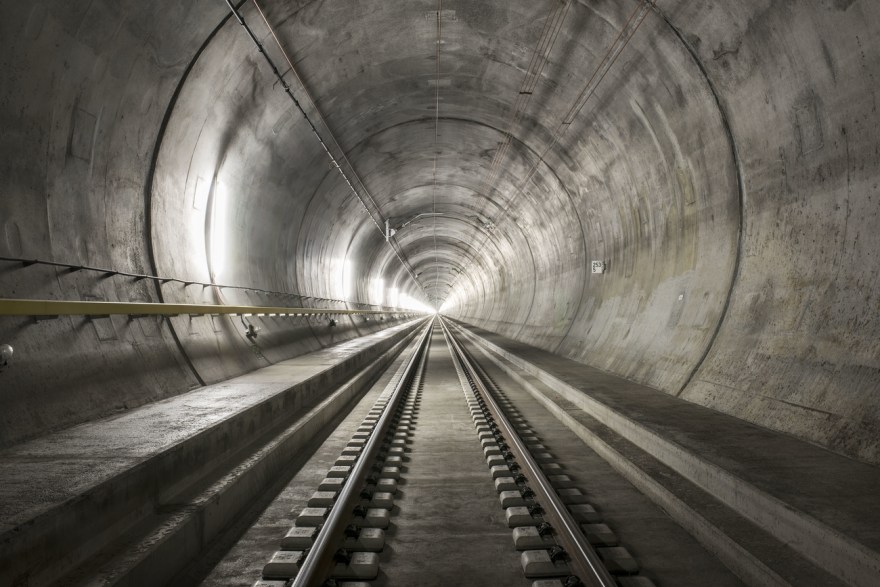
Switzerland's Gotthard Base Tunnel is the world's longest (and deepest) railway tunnel. Opened in 2016 after 17 years of construction, it consists of two 57.1km single-track tunnels for freight trains and passenger trains connecting Erstfeld in canton Uri with Bodio in canton Ticino.
Summary
The Gotthard Base Tunnel (GBT; German: Gotthard-Basistunnel, Italian: Galleria di base del San Gottardo, Romansh: Tunnel da basa dal Sogn Gottard) is a railway tunnel through the Alps in Switzerland. It opened in June 2016 and full service began the following December. With a route length of 57.09 km (35.47 mi), it is the world's longest railway and deepest traffic tunnel and the first flat, low-level route through the Alps. Located at the heart of the Gotthard axis, it is the third tunnel to connect the cantons of Uri and Ticino, after the Gotthard Tunnel and the Gotthard Road Tunnel.
The GBT consists of a large complex with, at its core, two single-track tunnels connecting Erstfeld (Uri) with Bodio (Ticino) and passing below Sedrun (Grisons). It is part of the New Railway Link through the Alps (NRLA) project, which also includes the Ceneri Base Tunnel further south (opened on 3 September 2020) and the Lötschberg Base Tunnel on the other main north–south axis. It is referred to as a "base tunnel" since it bypasses most of the existing vertex line, the Gotthard railway line, a winding mountain route opened in 1882 across the Saint-Gotthard Massif, which was operating at its capacity before the opening of the GBT. The new base tunnel establishes a direct route usable by high-speed rail and heavy freight trains.
The main purpose of the Gotthard Base Tunnel is to increase local transport capacity through the Alpine barrier, especially for freight on the Rotterdam–Basel–Genoa corridor. The tunnel is specifically meant to shift freight to trains from trucks, and thereby to reduce environmental damage and deadly road crashes. The tunnel also provides a faster connection between the canton of Ticino and the rest of Switzerland, as well as between northern and southern Europe, cutting the Basel/Zürich–Lugano–Milan journey time for passenger trains by one hour (and from Lucerne to Bellinzona by 45 minutes).
After 64 percent of Swiss voters accepted the NRLA project in a 1992 referendum, the first preparatory and exploratory work began in 1996. Construction began in November 1999 at Amsteg. Drilling operations were completed in March 2011. Completed in 2016, the final cost was reported to be CHF 12.2 billion (US$12 billion). A freight train derailment in August 2023 forced the tunnel's closure for over a year before reopening in September 2024.
Details
Gotthard Base Tunnel, railway tunnel under the Saint-Gotthard Massif in the Lepontine Alps in southern Switzerland, the world’s longest and deepest railway tunnel. Opened in June 2016, the tunnel provided a high-speed rail link between northern and southern Europe, forming a mainline rail connection between Rotterdam in the Netherlands and Genoa in Italy. Comprising two single-track tunnels, the Gotthard Base Tunnel (GBT) is 57 km (35 miles) in length and has a maximum depth of 2,300 metres (7,546 feet). It runs from Erstfeld, in Uri canton, to Bodio, in Ticino canton, and is a division of the New Railway Link through the Alps (NRLA) project.
Importance
Largely flat and straight, the GBT is a “base tunnel” because it passes through the base of the mountains rather than traversing the difficult terrain. The tunnel significantly increased local transport capacity through the Swiss Alpine barrier, providing a faster, more efficient route than the St. Gotthard Pass, the old St. Gotthard Tunnel (constructed 1872–80), or the St. Gotthard Road Tunnel (opened 1980). The GBT is used for both passenger and freight trains and helped shift freight volume from trucks to rail, with both safety and environmental benefits. With practically no gradient, the GBT can bear heavier and longer trains than the old line and has increased the freight train capacity from about 180 to about 260 trains per day. Passenger trains within the GBT travel at a speed of 200 km (124 miles) per hour and can complete the journey from Erstfeld to Bodio in 20 minutes. Freight trains travel at a minimum speed of 100 km (62 miles) per hour. Four to six freight trains and up to two passenger trains often run per hour in each direction through the tunnel every day.
History and construction
The first visionary idea for the GBT was sketched by engineer Carl Eduard Gruner in 1947. The Swiss government established a committee to evaluate various base tunnel ideas in the 1960s and formally recommended the construction of a Gotthard base tunnel in 1970. In 1992 the Swiss electorate passed the government’s resolution to construct the Swiss Rail Link through the Alps, providing the formal start to the project. Over the next few years, exploratory bores and other investigations were carried out to determine the most geotechnically favourable route for the tunnel, finally landing on the Erstfeld-Bodio route. AlpTransit Gotthard AG, a subsidiary of Swiss Federal Railways, was responsible for construction of the GBT, which officially began on November 4, 1999.
The construction of the GBT was a remarkable feat of modern engineering. The unpredictable quality of the rock, coupled with the intense weight of the mountain above and the resultant extreme temperatures and humidity (without ventilation, the temperature inside the mountain system can reach 46 °C, or 115 °F), posed serious challenges. Tunneling was done from each direction in each of the two bores, with four access tunnels built to facilitate the simultaneous construction. The four construction sites, Erstfeld, Amsteg, Sedrun, and Faido, each had its own base camp with living quarters, cafeterias, and worker transit as well as water treatment facilities and concrete factories that were fed excavated rock from the tunnel construction; a fifth site at Bodio was added later. The tunnels were primarily constructed with four massive tunnel boring machines, Herrenknecht Gripper TBMs, each of which was more than 441 metres (1,446 feet) long; blasting was used for only about 25 percent of the project. After nearly 11 years the final breakthrough in the east tube took place, in October 2010. The breakthrough was one of the most precise breakthroughs in the history of tunnel construction, with a horizontal deviation of just 8 cm (3 inches) and a vertical deviation of a remarkable 1 cm (0.4 inch).The final breakthrough in the west tube was completed in March 2011. From first blast to the extravagant opening ceremony, the tunnel took 17 years to complete and finished both on time and within its $12 billion (12.2 billion Swiss francs) budget. Nine workers died in accidents while the tunnel was under construction.
Additional Information
The Gotthard Base Tunnel (GBT) was inaugurated in 2016. The 57-km long railway tunnel connects northern to southern Europe, enabling passenger and goods transport to reduce travelling time by one hour between Zurich and Milan. It is the world’s longest railway and deepest traffic tunnel and the first flat, low-level route through the Alps.
The primary purpose of the Gotthard Base Tunnel is to increase transport capacity through the Alps, especially for freight, notably on the Rotterdam–Basel–Genoa corridor. A more specific objective is to shift freight volumes from heavy goods vehicles (HGV) to freight trains to reduce the environmental damage caused by HGV significantly.
The Gotthard Base Tunnel mainly consists of two single-track tunnels connecting Erstfeld with Bodio. It is part of the New Railway Link through the Alps (NRLA) project, which also includes the Ceneri Base Tunnel further south (opened in 2020) and the Lötschberg Base Tunnel (opened in 2007) on the other main north-south axis.
Two interesting figures about the Gotthard Base Tunnel construction are outlined below:
* Impact of tunnelling on arch dams of hydraulic power plant
In the central part of the GBT (section Sedrun), three arch dams and hydropower reservoirs are located almost directly above the new GBT, approximately in the middle of the tunnel. The height of the concrete arch dams varies between 117 m for Santa Maria, 127 m for Nalps and 153 m for Curnera.
In 1978, the driving of an exploratory tunnelling gallery for a planned highway tunnel had adverse effects on the arch dam of the Zeuzier reservoir in the Alps, causing significant settlements of up to 13 cm. Well aware of this, tunnelling engineers already started surveying the area four years before the tunnelling works began in the region and developed coupled numerical models for a forecast of the surface deformations.
* Tunnelling challenges in squeezing rocks
Engineers had to face challenging tunnelling conditions in squeezing rock, in the Sedrun section, in the geological section of Tavetsch Intermediate Massif North (TZM North), due to poor rock quality with low strength, squeezing properties and an 800 m thick overburden, and additionally in the Faido section, northern part, with the contact zone between the Leventina and the Lucomagno gneiss formations, under an extremely thick overburden exceeding 2,000 m.
It appears to me that if one wants to make progress in mathematics, one should study the masters and not the pupils. - Niels Henrik Abel.
Nothing is better than reading and gaining more and more knowledge - Stephen William Hawking.
Offline
Pages: 1