Math Is Fun Forum
You are not logged in.
- Topics: Active | Unanswered
Pages: 1
#1 2026-03-08 16:59:23
- Jai Ganesh
- Administrator

- Registered: 2005-06-28
- Posts: 53,904
Mount Kilimanjaro
Mount Kilimanjaro
Gist
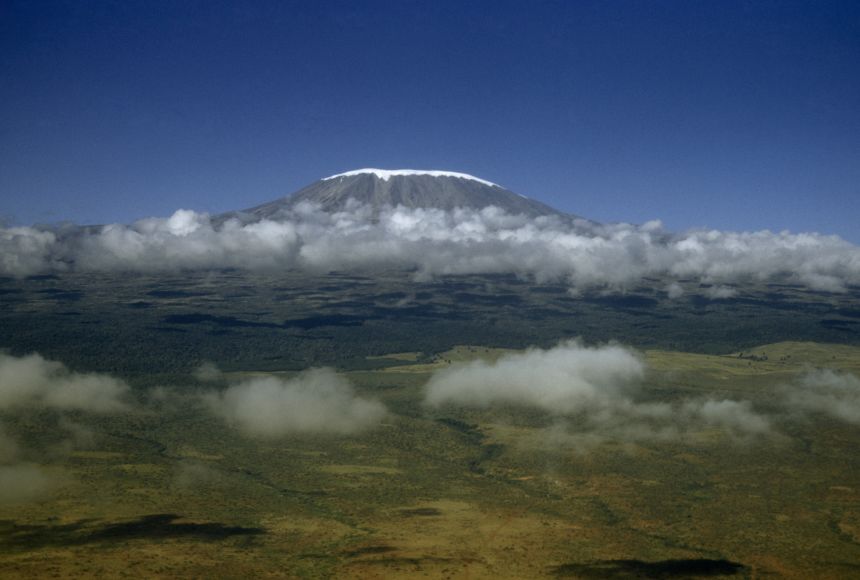
Mount Kilimanjaro, located in Tanzania, is Africa's highest peak (5,895 meters/19,341 feet) and the world's tallest free-standing mountain. It is a dormant stratovolcano with three volcanic cones—Kibo, Mawenzi, and Shira—and is famous for its snow-capped peak and five diverse ecological zones. Climbing is a popular non-technical trek, typically taking 5-9 days.
Kilimanjaro is famous as Africa's highest peak, the world's highest free-standing mountain, and a bucket-list destination for trekkers, known for its iconic snow-capped summit, diverse ecosystems, and status as one of the Seven Summits challenge. Its fame comes from being an accessible yet challenging climb, offering a unique journey through five distinct climate zones, making it a symbol of adventure and a visible indicator of climate change due to its shrinking glaciers.
Summary
Mount Kilimanjaro is a large dormant volcano in Tanzania. It is the highest mountain in Africa and the highest free-standing mountain above sea level in the world, at 5,895 m (19,341 ft) above sea level and 4,900 m (16,100 ft) above its plateau base. It is also the highest volcano in the Eastern Hemisphere and the fourth most prominent peak on Earth.
Kilimanjaro's southern and eastern slopes served as the home of the Chagga Kingdoms until their abolition in 1963 by Julius Nyerere. The origin and meaning of the name Kilimanjaro is unknown, but may mean "mountain of greatness" or "unclimbable". Although described in classical sources, German missionary Johannes Rebmann is credited as the first European to report the mountain's existence, in 1848. After several European attempts, Hans Meyer reached Kilimanjaro's highest summit in 1899.
The mountain was incorporated into Kilimanjaro National Park in 1973. As one of the Seven Summits, Kilimanjaro is a major hiking and climbing destination. There are seven established routes to Uhuru Peak, the mountain's highest point. Although not as technically challenging as similar mountains, the prominence of Kilimanjaro poses a serious risk of altitude sickness.
One of several mountains arising from the East African Rift, Kilimanjaro was formed from volcanic activity over 2 million years ago. Its slopes host montane forests and cloud forests. Multiple species are endemic to Mount Kilimanjaro, including the giant groundsel Dendrosenecio kilimanjari. The mountain possesses a large ice cap and the largest glaciers in Africa, including Credner Glacier, Furtwängler Glacier, and the Rebmann Glacier. This ice cap is rapidly shrinking, with over 80% lost in the 20th century. The cap is projected to disappear entirely by the mid-21st century.
Details
Mount Kilimanjaro is Africa’s tallest mountain and the world’s largest free-standing mountain.
Located in Tanzania, Mount Kilimanjaro is Africa’s tallest mountain at about 5,895 meters (19,340 feet). It is the largest free-standing mountain rise in the world, meaning it is not part of a mountain range.
Also called a stratovolcano (a term for a very large volcano made of ash, lava and rock), Kilimanjaro is made up of three cones: Kibo, Mawenzi and Shira. Kibo is the summit of the mountain and the tallest of the three volcanic formations. While Mawenzi and Shira are extinct, Kibo is considered dormant and could possibly erupt again. Scientists estimate that the last time it erupted was 360,000 years ago. The highest point on Kibo’s crater rim is called Uhuru, the Swahili word for “freedom.”
No one knows how Kilimanjaro got its name. It may come from the Swahili word Kilima (meaning “mountain”) and the KiChagga word Njaro (meaning “shining” or “whiteness”); the mountain is known for its snow-capped peak. Some local people living in the foothills of the mountain, including the Chagga and the Maasai, view it as the seat of God.
Unfortunately, the white snow that the mountain is named for may soon disappear. Over the last hundred years, all of Kilimanjaro’s glaciers have begun to retreat. Some have vanished altogether. Scientists have studied satellite images and learned that Kilimanjaro has lost more than 90 percent of its ice since 1900. Many experts are studying the causes of this catastrophic melt.
The people who live in the vicinity of Kilimanjaro are an important part of the mountain’s history. In 1889, local climber Yohani Kinyala Lauwo (also known as Mzee Lauwo) guided German geographer Hans Meyer and Austrian mountaineer Ludwig Purtscheller to the Kilimanjaro summit. Lauwo then became the first Tanzanian to reach the peak at the age of 18. Purtscheller and Meyer were the first Europeans to summit. Lauwo was a member of the Chagga tribe. The Chagga have lived on Kilimanjaro’s slopes for centuries. Lauwo went on to guide climbers to Kilimanjaro’s summit for more than 50 years, dying at the age of 125.
Kilimanjaro continues to be a popular hiking spot. This is partly because the hiking routes do not require as much equipment or experience as mountains of similar heights. Tens of thousands of climbers ascend the mountain each year. The climb is still dangerous, however, because of the risk of altitude sickness. Climbers can experience altitude sickness if they ascend too quickly, and it can be deadly if not treated right away.
In 1973, the mountain and its six surrounding forest corridors were named Kilimanjaro National Park. The park was named a United Nations Educational, Scientific and Cultural Organization (UNESCO) World Heritage site in 1987. These measures can help protect the area’s unique environment. A variety of animals live in the area surrounding the mountain, including the blue monkey (Cercopithecus mitis).
Additional Information
Kilimanjaro is a volcanic massif in northeastern Tanzania, near the Kenya border. Its central cone, Kibo, rises to 19,340 feet (5,895 metres) and is the highest point in Africa. Kilimanjaro lies about 100 miles (160 km) east of the East African Rift System and about 140 miles (225 km) south of Nairobi, Kenya. The massif extends approximately east-west for 50 miles (80 km) and consists of three principal extinct volcanoes: Kibo (centre), Mawensi (east), and Shira (west). Kibo, the youngest and highest, retains the form of a typical volcanic cone and crater and is linked by a 7-mile (11-km) saddle at about 15,000 feet (4,500 metres) with Mawensi (16,893 feet [5,149 metres]), which is the older core of a former summit. Shira ridge (13,000 feet [3,962 metres]) is a remnant of an earlier crater. Below the saddle, Kilimanjaro slopes in a typical volcanic curve to the plains below, which lie at an elevation of about 3,300 feet (1,000 metres). The breathtaking snow-clad dome of Kibo contains a caldera (crater) on its southern side that is 1.2 miles (2 km) across and some 980 feet (300 metres) deep, with an inner cone that displays residual volcanic activity. Mawensi’s cone is highly eroded, jagged, and precipitous and is cleft east and west by gorges. Only Kibo retains a permanent ice cap. Mawensi has semipermanent ice patches and substantial seasonal snow.
The mountain and its surrounding forests were designated a game reserve in the early part of the 20th century. In 1973 Mount Kilimanjaro National Park was established to protect the mountain above the tree line as well as the six forest corridors that extend downslope through the montane forest belt. The park was designated a UNESCO World Heritage site in 1987.
Kilimanjaro has a succession of vegetation zones consisting of (from base to summit) the semiarid scrub of the surrounding plateau; the massif’s cultivated, well-watered southern slopes; dense cloud forest; open moorland; alpine desert; and moss and lichen communities. Two notable species that grow in the moorlands are the giant lobelia (Lobelia deckenii) and the giant groundsel (Senecio johnstonii cottonii). The forests of the southern slopes and surrounding areas are home to elephants, buffalo, and eland (oxlike antelopes). Smaller mammals inhabiting the forests include black and white colobus monkeys, blue monkeys, and bushbuck and duikers (small African antelopes). The forests also host a rich variety of birdlife, including the rare Abbot’s starling.
The Kilimanjaro formations became known to Europeans when they were reached in 1848 by the German missionaries Johannes Rebmann and Johann Ludwig Krapf, although the news that there were snow-capped mountains so close to the Equator was not believed until more than a decade later. The Kibo summit was first reached in 1889 by the German geographer Hans Meyer and the Austrian mountaineer Ludwig Purtscheller. The Kilimanjaro region is one of Tanzania’s leading producers of mild coffee, barley, wheat, and sugar; other crops include sisal, corn (maize), beans, bananas, wattle bark (Acacia), cotton, pyrethrum, and potatoes. The region is populated by the Chaga (Chagga), Pare, Kahe, and Mbugu peoples. The town of Moshi, at the southern foot of Kilimanjaro, is the chief trading centre and base for ascent. As Kibo’s peak can be reached without the aid of mountaineering equipment, thousands of hikers attempt the ascent each year.
It appears to me that if one wants to make progress in mathematics, one should study the masters and not the pupils. - Niels Henrik Abel.
Nothing is better than reading and gaining more and more knowledge - Stephen William Hawking.
Offline
Pages: 1