Math Is Fun Forum
You are not logged in.
- Topics: Active | Unanswered
Pages: 1
#1 2026-02-11 19:23:03
- Jai Ganesh
- Administrator

- Registered: 2005-06-28
- Posts: 53,904
Cathode Ray Tube
Cathode Ray Tube
Gist
A cathode ray tube (CRT) is a specialized vacuum tube that displays images, data, or electrical waveforms by projecting a focused beam of electrons onto a phosphorescent screen. It operates via an electron gun that emits and accelerates electrons, which are then deflected magnetically or electrostatically to create visible images. Primarily used in older televisions, computer monitors, and oscilloscopes, CRTs are known for their ability to display real-time, high-contrast images.
A CRT is a presentation screen that produces pictures as a video signal. It is a sort of vacuum tube that display pictures when electron beams from an electron gun strike a luminous surface. In other words, the CRT produces beams, accelerates them at high speed, and deflects them to make pictures on a phosphor screen.
Summary
A cathode-ray tube (CRT) is a Vacuum tube that produces images when its phosphorescent surface is struck by electron beams. CRTs can be monochrome (using one electron gun) or colour (typically using three electron guns to produce red, green, and blue images that, when combined, render a multicolour image). They come in a variety of display modes, including CGA (Color Graphics Adapter), VGA (Video Graphics Array), XGA (Extended Graphics Array), and the high-definition SVGA (Super Video Graphics Array).
Details
A cathode ray tube (CRT) is a vacuum tube containing one or more electron guns, which emit electron beams that are manipulated to display images on a phosphorescent screen. The images may represent electrical waveforms on an oscilloscope, a frame of video on an analog television set (TV), digital raster graphics on a computer monitor, or other phenomena like radar targets. A CRT in a TV is commonly called a picture tube. CRTs have also been used as memory devices, in which case the screen is not intended to be visible to an observer. The term cathode ray was used to describe electron beams when they were first discovered, before it was understood that what was emitted from the cathode was a beam of electrons.
In CRT TVs and computer monitors, the entire front area of the tube is scanned repeatedly and systematically in a fixed pattern called a raster. In color devices, an image is produced by controlling the intensity of each of three electron beams, one for each additive primary color (red, green, and blue) with a video signal as a reference. In modern CRT monitors and TVs the beams are bent by magnetic deflection, using a deflection yoke. Electrostatic deflection is commonly used in oscilloscopes.
The tube is a glass envelope which is heavy, fragile, and long from front screen face to rear end. Its interior must be close to a vacuum to prevent the emitted electrons from colliding with air molecules and scattering before they hit the tube's face. Thus, the interior is evacuated to less than a millionth of atmospheric pressure. As such, handling a CRT carries the risk of violent implosion that can hurl glass at great velocity. The face is typically made of thick lead glass or special barium-strontium glass to be shatter-resistant and to block most X-ray emissions. This tube makes up most of the weight of CRT TVs and computer monitors.
Since the early 2010s, CRTs have been superseded by flat-panel display technologies such as liquid-crystal display (LCD), plasma display, and OLED displays which are cheaper to manufacture and run, as well as significantly lighter and thinner. Flat-panel displays can also be made in very large sizes whereas 40–45 inches (100–110 cm) was about the largest size of a CRT.
A CRT works by electrically heating a tungsten coil which in turn heats a cathode in the rear of the CRT, causing it to emit electrons which are modulated and focused by electrodes. The electrons are steered by deflection coils or plates, and an anode accelerates them towards the phosphor-coated screen, which generates light when hit by the electrons
Additional Information
A cathode-ray tube (CRT) is a specialized vacuum tube in which images are produced when an electron beam strikes a phosphorescent surface. Most desktop computer displays make use of CRTs. The CRT in a computer display is similar to the "picture tube" in a television receiver.
A cathode-ray tube consists of several basic components, as illustrated below. The electron gun generates an arrow beam of electrons. The anodes accelerate the electrons. Deflecting coils produce an extremely low frequency electromagnetic field that allows for constant adjustment of the direction of the electron beam. There are two sets of deflecting coils: horizontal and vertical.(In the illustration, only one set of coils is shown for simplicity.) The intensity of the beam can be varied. The electron beam produces a tiny, bright visible spot when it strikes the phosphor-coated screen.
To produce an image on the screen, complex signals are applied to the deflecting coils, and also to the apparatus that controls the intensity of the electron beam. This causes the spot to race across the screen from right to left, and from top to bottom, in a sequence of horizontal lines called the raster. As viewed from the front of the CRT, the spot moves in a pattern similar to the way your eyes move when you read a single-column page of text. But the scanning takes place at such a rapid rate that your eye sees a constant image over the entire screen.
The illustration shows only one electron gun. This is typical of a monochrome, or single-color, CRT. However, virtually all CRTs today render color images. These devices have three electron guns, one for the primary color red, one for the primary color green, and one for the primary color blue. The CRT thus produces three overlapping images: one in red (R), one in green (G), and one in blue (B). This is the so-called RGB color model.
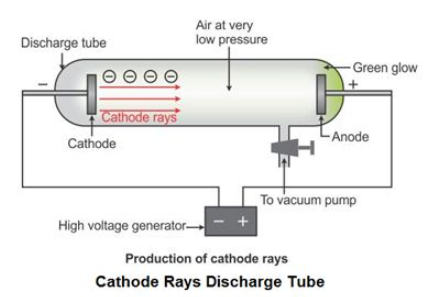
In computer systems, there are several display modes, or sets of specifications according to which the CRT operates. The most common specification for CRT displays is known as SVGA (Super Video Graphics Array). Notebook computers typically use liquid crystal display. The technology for these displays is much different than that for CRTs. The Cathode Ray Tube or Braun’s Tube was invented by the German physicist Karl Ferdinand Braun in 1897 and is today used in computer monitors, TV sets and oscilloscope tubes. The path of the electrons in the tube filled with a low pressure rare gas can be observed in a darkened room as a trace of light. Electron beam deflection can be
effected by means of either an electrical or a magnetic field.
Functional principle
• The source of the electron beam is the electron gun, which produces a stream of electrons through thermionic emission at the heated cathode and focuses it into a thin beam by the control grid (or “Wehnelt cylinder”).
• A strong electric field between cathode and anode accelerates the electrons, before they leave the electron gun through a small hole in the anode.
• The electron beam can be deflected by a capacitor or coils in a way which causes it to display an image on the screen. The image may represent electrical waveforms (oscilloscope), pictures (television, computer monitor), echoes of aircraft detected by radar etc.
• When electrons strike the fluorescent screen, light is emitted.
• The whole configuration is placed in a vacuum tube to avoid collisions between electrons and gas molecules of the air, which would attenuate the beam.
It appears to me that if one wants to make progress in mathematics, one should study the masters and not the pupils. - Niels Henrik Abel.
Nothing is better than reading and gaining more and more knowledge - Stephen William Hawking.
Offline
Pages: 1