Math Is Fun Forum
You are not logged in.
- Topics: Active | Unanswered
- Index
- » This is Cool
- » Civet
Pages: 1
#1 2026-02-01 17:41:38
- Jai Ganesh
- Administrator

- Registered: 2005-06-28
- Posts: 53,843
Civet
Civet
Gist
Is a civet a type of cat?
No, a civet is not a cat, but a nocturnal mammal from the Viverridae family, closely related to mongooses and hyenas, despite its cat-like appearance that earns it the misnomer "civet cat". They have longer snouts, shorter legs, and different feet than true cats (felines), belonging to the broader suborder Feliformia, which includes both cats and viverrids.
Civets are territorial creatures, utilizing scent marking to communicate and defend their territory. While generally shy and elusive, they can become aggressive if cornered or threatened.
Summary
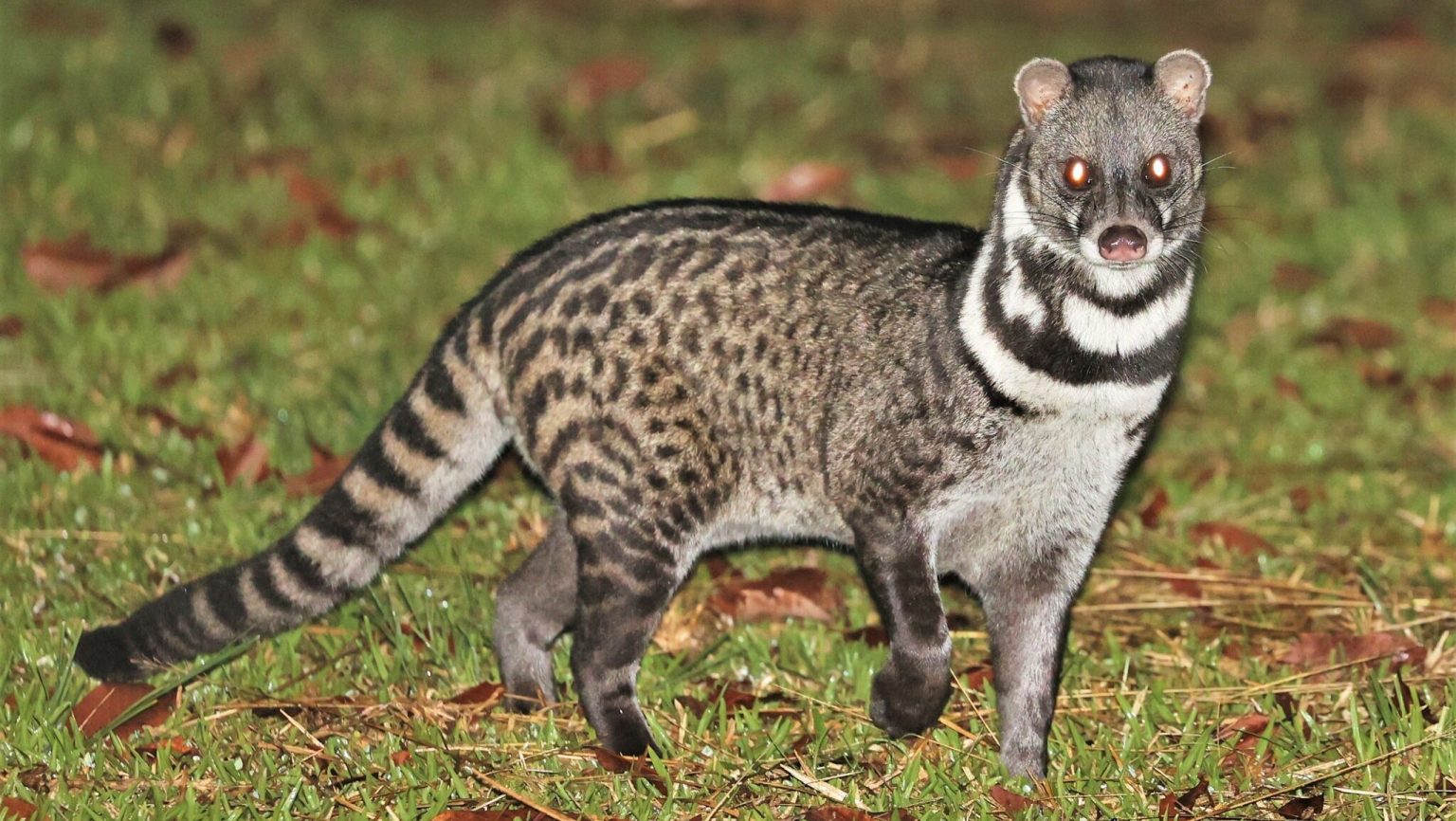
A civet is any of a number of long-bodied, short-legged carnivores of the family Viverridae. There are about 15 to 20 species, placed in 10 to 12 genera. Civets are found in Africa, southern Europe, and Asia. Rather catlike in appearance, they have a thickly furred tail, small ears, and a pointed snout. The coloration varies widely among the species but commonly is buff or grayish with a pattern of black spots or stripes or both. Length ranges from about 40 to 85 cm (16 to 34 inches), with the tail accounting for another 13 to 66 cm (5 to 26 inches), and weight ranges from 1.5 to 11 kg (3.3 to 24 pounds).
Civets are usually solitary and live in tree hollows, among rocks, and in similar places, coming out to forage at night. Except for the arboreal palm civets, such as Paradoxurus (also known as toddy cat because of its fondness for palm juice, or “toddy”) and Nandinia, civets are mainly terrestrial. The Sunda otter civet (Cynogale bennetti), the African civet (Civettictis civetta), and the rare Congo water civet (Genetta piscivora) are semiaquatic. Civets feed on small animals and on vegetable matter. Their litters usually consist of two or three young.
The anal glands of civets open under the tail into a large pouch in which a greasy, musklike secretion accumulates. This secretion, known as civet, is used by the animals in marking territories. The secretion of the small Indian civet, or rasse (Viverricula indica), and of the Oriental civets (Viverra) is employed commercially in the manufacture of perfume. In addition, coffee beans fermented within and excreted from the digestive tracts of civets in the Philippines and Indonesia are sometimes used to enhance the taste of coffee.
The IUCN Red List of Threatened Species lists several civets in danger of extinction; among these are the Malabar civet (Viverra civettina), which lives in the Western Ghats of India, and the Sunda otter civet, which is native to the Malay Peninsula, Sumatra, and Borneo.
Details
A civet is a small, lean, mostly nocturnal mammal native to tropical Asia and Africa, especially the tropical forests. The term civet applies to over a dozen different species, mostly from the family Viverridae. Most of the species's diversity is found in southeast Asia. Civets do not form a monophyletic group, as they consist only of certain members of the Viverridae and Eupleridae.
The African civet, Civettictis civetta, has historically been the main species from which a musky scent used in perfumery, also referred to as "civet", was obtained.
Physical characteristics
Civets have a broadly cat-like general appearance, though the muzzle is extended and often pointed, rather like that of an otter, mongoose or even possibly a ferret. They range in length (excluding the tail) from around 43 to 71 cm (17 to 28 in) and in weight from around 1.4 to 4.5 kg (3 to 10 lb).
The civet produces a musk (named civet after the animal) which is highly valued as a fragrance and stabilizing agent for perfume. Both male and female civets produce the strong-smelling secretion, which is produced by the civet's perineal glands. It is harvested by either killing the animal and removing the glands, or by scraping the secretions from the glands of a live animal. The latter is the preferred method today.
Animal rights groups, such as World Animal Protection, express concern that harvesting musk is cruel to animals. Between these ethical concerns and the availability of synthetic substitutes, the practice of raising civets for musk is dying out. Chanel, maker of the popular perfume Chanel No. 5, claims that natural civet has been replaced with a synthetic substitute since 1998.
Habitat
Viverrids are native to sub-Saharan Africa, Madagascar, the Iberian Peninsula, southern China, South and Southeast Asia. Favoured habitats include woodland, savanna, and mountain biome. In consequence, many are faced with severe loss of habitat; several species are considered vulnerable and the otter civet is classified as endangered. Some species of civet are very rare and elusive and hardly anything is known about them, e.g., the Hose's civet, endemic to the montane forests of northern Borneo, is one of the world's least known carnivores.
Relationship with humans
The Malayan civet is found in many habitats, including forests, secondary habitats, cultivated land, and the outskirts of villages; the species is highly adaptable to human disturbances, including "selective logging" (partial forest removal).
African civets (Civettictis civetta) are listed as Least Concern. However, in certain regions of Africa, the population is declining; this is due to hunting, direct and indirect poisoning, and an increase in large-scale farm fences that limit population flow. They are also seen as comparatively abundant options in the bushmeat trade.
Masked palm civets sold for meat in local markets of Yunnan China, carried the SARS virus from horseshoe bats to humans; this resulted in the 2002–2004 SARS outbreak.
Civets are also raised in captivity by humans for two reasons. In Asia, they are raised to process coffee beans. In Ethiopia, they are raised in captivity to collect their perineal secretions, also called civet, to be used in making perfume.
Urban environments
Palm civets often venture into cities and suburbs, with people often complaining about civet faeces and the noise of the animals' climbing on roofs. Some studies have been undertaken to examine and mitigate such human–animal conflict.
Literature
In William Shakespeare's As You Like It, act II, scene 2, the civet cat is mentioned as the "uncleanly" source of courtiers' perfumes.
It appears to me that if one wants to make progress in mathematics, one should study the masters and not the pupils. - Niels Henrik Abel.
Nothing is better than reading and gaining more and more knowledge - Stephen William Hawking.
Offline
Pages: 1
- Index
- » This is Cool
- » Civet