Math Is Fun Forum
You are not logged in.
- Topics: Active | Unanswered
- Index
- » This is Cool
- » Glacier
Pages: 1
#1 2026-01-27 00:29:44
- Jai Ganesh
- Administrator

- Registered: 2005-06-28
- Posts: 53,843
Glacier
Glacier
Gist
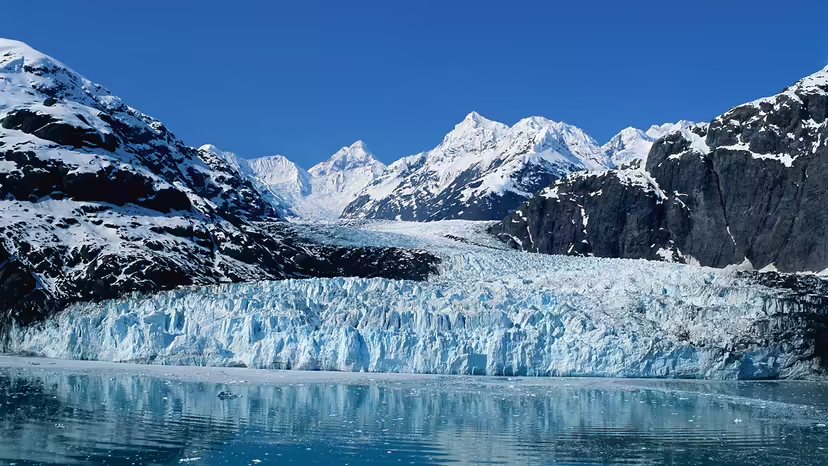
A glacier is a large, persistent body of dense ice that forms on land over centuries as snow accumulates, compresses, and recrystallizes, moving slowly downhill under its own weight. Covering about 10% of Earth's land, these "rivers of ice" store ~69% of the world's freshwater and are critical indicators of climate change.
A glacier is a large, persistent body of dense ice that forms on land from compacted snow and moves slowly downhill under its own weight and gravity, essentially acting as a "river of ice" that carves landscapes as it flows. They form in areas where snow accumulation exceeds melting over many years, compressing into solid glacial ice, and are crucial indicators of climate change, holding vast amounts of freshwater.
Summary
A glacier is a persistent body of dense ice, a form of rock, that is constantly moving downhill under its own weight. A glacier forms where the accumulation of snow exceeds its ablation over many years, often centuries. It acquires distinguishing features, such as crevasses and seracs, as it slowly flows and deforms under stresses induced by its weight. As it moves, it abrades rock and debris from its substrate to create landforms such as cirques, moraines, or fjords. Although a glacier may flow into a body of water, it forms only on land and is distinct from the much thinner sea ice and lake ice that form on the surface of bodies of water.
On Earth, 99% of glacial ice is contained within vast ice sheets (also known as "continental glaciers") in the polar regions, but glaciers may be found in mountain ranges on every continent other than the Australian mainland, including Oceania's high-latitude oceanic island countries such as New Zealand. Between latitudes 35°N and 35°S, glaciers occur only in the Himalayas, Andes, and a few high mountains in East Africa, Mexico, New Guinea and on Zard-Kuh in Iran. With more than 7,000 known glaciers, Pakistan has more glacial ice than any other country outside the polar regions. Glaciers cover about 10% of Earth's land surface. Continental glaciers cover nearly 13 million {km}^{2} (5 million sq mi) or about 98% of Antarctica's 13.2 million sq km (5.1 million sq mi), with an average thickness of ice 2,100 m (7,000 ft). Greenland and Patagonia also have huge expanses of continental glaciers. The volume of glaciers, not including the ice sheets of Antarctica and Greenland, has been estimated at 170,000 {km}^{3}.
Glacial ice is the largest reservoir of fresh water on Earth, holding with ice sheets about 69% of the world's freshwater. Many glaciers from temperate, alpine and seasonal polar climates store water as ice during the colder seasons and release it later in the form of meltwater as warmer summer temperatures cause the glacier to melt, creating a water source that is especially important for plants, animals and human uses when other sources may be scant. However, within high-altitude and Antarctic environments, the seasonal temperature difference is often not sufficient to release meltwater.
Since glacial mass is affected by long-term climatic changes, e.g., precipitation, mean temperature, and cloud cover, glacial mass changes are considered among the most sensitive indicators of climate change and are a major source of variations in sea level.
A large piece of compressed ice, or a glacier, appears blue, as large quantities of water appear blue, because water molecules absorb other colors more efficiently than blue. The other reason for the blue color of glaciers is the lack of air bubbles. Air bubbles, which give a white color to ice, are squeezed out by pressure increasing the created ice's density.
Details
A glacier is any large mass of perennial ice that originates on land by the recrystallization of snow or other forms of solid precipitation and that shows evidence of past or present flow.
Exact limits for the terms large, perennial, and flow cannot be set. Except in size, a small snow patch that persists for more than one season is hydrologically indistinguishable from a true glacier. One international group has recommended that all persisting snow and ice masses larger than 0.1 square kilometre (about 0.04 square mile) be counted as glaciers.
General observations:
Main types of glaciers
Glaciers are classifiable in three main groups: (1) glaciers that extend in continuous sheets, moving outward in all directions, are called ice sheets if they are the size of Antarctica or Greenland and ice caps if they are smaller; (2) glaciers confined within a path that directs the ice movement are called mountain glaciers; and (3) glaciers that spread out on level ground or on the ocean at the foot of glaciated regions are called piedmont glaciers or ice shelves, respectively. Glaciers in the third group are not independent and are treated here in terms of their sources: ice shelves with ice sheets, piedmont glaciers with mountain glaciers. A complex of mountain glaciers burying much of a mountain range is called an ice field.
Distribution of glaciers
A most interesting aspect of recent geological time (some 30 million years ago to the present) has been the recurrent expansion and contraction of the world’s ice cover. These glacial fluctuations influenced geological, climatological, and biological environments and affected the evolution and development of early humans. Almost all of Canada, the northern third of the United States, much of Europe, all of Scandinavia, and large parts of northern Siberia were engulfed by ice during the major glacial stages. At times during the Pleistocene Epoch (from 2.6 million to 11,700 years ago), glacial ice covered 30 percent of the world’s land area; at other times the ice cover may have shrunk to less than its present extent. It may not be improper, then, to state that the world is still in an ice age. Because the term glacial generally implies ice-age events or Pleistocene time, in this discussion “glacier” is used as an adjective whenever reference is to ice of the present day.
Glacier ice today stores about three-fourths of all the fresh water in the world. Glacier ice covers about 11 percent of the world’s land area and would cause a world sea-level rise of about 90 metres (300 feet) if all existing ice melted. Glaciers occur in all parts of the world and at almost all latitudes. In Ecuador, Kenya, Uganda, and Irian Jaya (New Guinea), glaciers even occur at or near the Equator, albeit at high altitudes.
Glaciers and climate
The cause of the fluctuation of the world’s glacier cover is still not completely understood. Periodic changes in the heat received from the Sun, caused by fluctuations in the Earth’s orbit, are known to correlate with major fluctuations of ice sheet advance and retreat on long time scales. Large ice sheets themselves, however, contain several “instability mechanisms” that may have contributed to the larger changes in world climate. One of these mechanisms is due to the very high albedo, or reflectivity of dry snow to solar radiation. No other material of widespread distribution on the Earth even approaches the albedo of snow. Thus, as an ice sheet expands it causes an ever larger share of the Sun’s radiation to be reflected back into space, less is absorbed on the Earth, and the world’s climate becomes cooler. Another instability mechanism is implied by the fact that the thicker and more extensive an ice sheet is, the more snowfall it will receive in the form of orographic precipitation (precipitation resulting from the higher altitude of its surface and attendant lower temperature). A third instability mechanism has been suggested by studies of the West Antarctic Ice Sheet. Portions of an ice sheet called ice streams may periodically move rapidly outward, perhaps because of the buildup of a thick layer of wet, deformable material under the ice. Although the ultimate causes of ice ages are not known with certainty, scientists agree that the world’s ice cover and climate are in a state of delicate balance.
Only the largest ice masses directly influence global climate, but all ice sheets and glaciers respond to changes in local climate—particularly changes in air temperature or precipitation. The fluctuations of these glaciers in the past can be inferred by features they have left on the landscape. By studying these features, researchers can infer earlier climatic fluctuations.
Additional Information
Glaciers are large, thick masses of ice that form on land when fallen snow gets compressed into ice over many centuries.
Glaciers are massive bodies of slowly moving ice. Glaciers form on land, and they are made up of fallen snow that gets compressed into ice over many centuries. They move slowly downward from the pull of gravity.
Most of the world’s glaciers exist in the polar regions, in areas like Greenland, the Canadian Arctic, and Antarctica. Glaciers also can be found closer to the Equator in some mountain regions. The Andes Mountain range in South America contains some of the world’s largest tropical glaciers. About 2 percent of all the water on Earth is frozen in glaciers.
Glaciers can range in age from a couple hundred to thousands of years old. Most glaciers today are remnants of the massive ice sheets that covered Earth during the Ice Age. The Ice Age ended more than 10,000 years ago. During Earth’s history, there have been colder periods—when glaciers formed—and warmer periods—when glaciers melted.
Scientists who study glaciers are called glaciologists. Glaciologists began studying glaciers during the 19th century in order to look for clues about past ice ages. Today, glaciologists study glaciers for clues about global warming. Old photographs and paintings show that glaciers have melted away from mountain regions over time. Indeed, glaciers worldwide have been shrinking—and even disappearing—at an accelerated rate for the past several decades.
Among the scientists studying the changes in glaciers is Erin Christine Pettit, a glaciologist at the University of Alaska Fairbanks. Pettit observes and measures the flow, fracture, and retreat of glaciers. She uses this information to study how much water enters the oceans from melting glaciers. Melting glaciers are one factor contributing to the global sea-level rise.
It appears to me that if one wants to make progress in mathematics, one should study the masters and not the pupils. - Niels Henrik Abel.
Nothing is better than reading and gaining more and more knowledge - Stephen William Hawking.
Offline
Pages: 1
- Index
- » This is Cool
- » Glacier