Math Is Fun Forum
You are not logged in.
- Topics: Active | Unanswered
- Index
- » This is Cool
- » Tuvalu
Pages: 1
#1 2026-01-25 15:49:39
- Jai Ganesh
- Administrator

- Registered: 2005-06-28
- Posts: 53,843
Tuvalu
Tuvalu
Gist
Tuvalu is a low-lying Polynesian island nation in the west-central Pacific, known for its nine coral atolls and islands, rich marine life, and significant threat from rising sea levels due to climate change. An independent Commonwealth realm, it's economically reliant on fishing licenses, remittances, stamps, the ".tv" domain, and aid, with its capital and main government hub on Funafuti. The culture emphasizes strong community ties, while its low elevation makes it a focal point for global climate action discussions.
Nobody visits Tuvalu much because it's incredibly remote, hard to reach due to limited flights, lacks large-scale tourist resorts, and faces serious threats from rising sea levels and climate change, despite its pristine beauty, making it the world's least-visited country. Its tiny size, scarce infrastructure, and isolation combine to make it logistically challenging and expensive for most tourists to access.
Summary
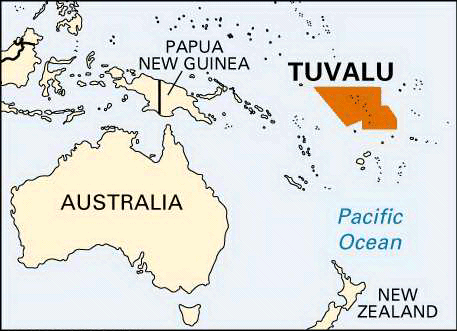
Tuvalu is an island country in the Polynesian sub-region of Oceania in the Pacific Ocean, about midway between Hawaii and Australia. It lies east-northeast of the Santa Cruz Islands (which belong to the Solomon Islands), northeast of Vanuatu, southeast of Nauru, south of Kiribati, west of Tokelau, northwest of Samoa and Wallis and Futuna, and north of Fiji.
Tuvalu is composed of three reef islands and six atolls spread out between the latitude of 5° and 10° south and between the longitude of 176° and 180°. They lie west of the International Date Line. The 2022 census determined that Tuvalu had a population of 10,643, making it the 194th most populous country, exceeding only Niue and the Vatican City in population. Tuvalu's total land area is 25.14 square kilometres (9.71 sq mi).
The first inhabitants of Tuvalu were Polynesians arriving as part of the migration of Polynesians into the Pacific that began about three thousand years ago. Long before European contact with the Pacific islands, Polynesians frequently voyaged using canoes between the islands. Polynesian navigation skills enabled them to make elaborately planned journeys in either double-hulled sailing canoes or outrigger canoes. Scholars believe that the Polynesians spread out from Samoa and Tonga into the Tuvaluan atolls, which then served as a stepping stone for further migration into the Polynesian outliers in Melanesia and Micronesia.
In 1568, Spanish explorer and cartographer Álvaro de Mendaña became the first European known to sail through the archipelago, sighting the island of Nui during an expedition he was making in search of Terra Australis. The island of Funafuti, currently serving as the capital, was named Ellice's Island in 1819. Later, the whole group was named Ellice Islands by English hydrographer Alexander George Findlay. In the late 19th century, Great Britain claimed control over the Ellice Islands, designating them as within their sphere of influence. Between 9 and 16 October 1892, Captain Herbert Gibson of HMS Curacoa declared each of the Ellice Islands a British protectorate. Britain assigned a resident commissioner to administer the Ellice Islands as part of the British Western Pacific Territories (BWPT). From 1916 to 1975, they were managed as part of the Gilbert and Ellice Islands colony.
A referendum was held in 1974 to determine whether the Gilbert Islands and Ellice Islands should each have their own administration. As a result, the Gilbert and Ellice Islands colony legally ceased to exist on 1 October 1975; on 1 January 1976, the old administration was officially separated, and two separate British colonies, Kiribati and Tuvalu, were formed. On 1 October 1978, Tuvalu became fully independent as a sovereign state within the Commonwealth, and is a constitutional monarchy with Charles III as King of Tuvalu. On 5 September 2000, Tuvalu became the 189th member of the United Nations.
The islands do not have a significant amount of soil, so the country relies heavily on imports and fishing for food. Licensing fishing permits to international companies, grants and aid projects, and remittances to their families from Tuvaluan seafarers who work on cargo ships are important parts of the economy. Because it is a low-lying island nation, Tuvalu is extremely vulnerable to sea level rise due to climate change. It is active in international climate negotiations as part of the Alliance of Small Island States.
Details
Tuvalu, country in the west-central Pacific Ocean. It is composed of nine small coral islands scattered in a chain lying approximately northwest to southeast over a distance of some 420 miles (676 km).
The de facto capital is the village of Vaiaku, where most government offices are located. It is on Fongafale islet, a constituent part of Funafuti Atoll. Together with what is now Kiribati (formerly the Gilbert Islands), Tuvalu formed the British Gilbert and Ellice Islands Colony before separately gaining its independence in 1978.
Land
The group includes both atolls and reef islands. The atolls—Nanumea, Nui, Nukufetau, Funafuti, and Nukulaelae—have islets encircling a shallow lagoon; the reef islands—Nanumanga, Niutao, Vaitupu, and Niulakita—are compact with a fringing reef. The islands are low-lying, most being 13 to 16 feet (4 to 5 meters) above sea level. There are no rivers; rain catchment and wells provide the only fresh water. Rainfall averages 100 inches (2,500 mm) in the north and 125 inches (3,175 mm) in the south. The prevailing winds are southeast trades; westerly storms occur from November to February. Daytime temperatures range from 80 to 85 °F (27 to 29 °C).
Because the soils are porous, agriculture is limited. Coconut palms thrive, and breadfruit trees, pandanus, taro, and bananas are grown. Pigs and chickens are raised, and seabirds, fish, and shellfish are caught for food. The islands increasingly depend on imported food.
People
The Tuvaluans are Polynesian, and their language, Tuvaluan, is closely related to Samoan. Nui, however, was heavily settled in prehistoric times by Micronesians from the Gilbert Islands (now Kiribati). English is taught in the schools and widely used. The vast majority of the population belongs to the Church of Tuvalu (the former Ellice Islands Protestant Church).
Although most people live on the outer islands in extended family households clustered into villages, about one-third of the population lives on Funafuti, the center of government and commerce. Population growth has been slowed by family planning; life expectancy at birth is about 60 years. About 10 percent of the population lives overseas, either pursuing education, working in the Nauru phosphate industry, or working on merchant ships.
Economy
Most Tuvaluans are subsistence farmers and are aided by remittances from relatives working overseas. A small quantity of copra is produced for export, the sale of stamps accounts for modest earnings, and fees are collected from foreign fishing fleets, but the country depends heavily on foreign aid. It imports most of its food, fuel, and manufactured goods. Fiji, Australia, New Zealand, and Japan are among the country’s major trade partners. Retailing is handled by community-based cooperative societies. Tuvalu uses Australian currency but also issues its own coinage. There is a single bank, a joint government-commercial venture.
Tuvalu has air links with Kiribati and Fiji; for international shipping, it depends on irregular regional services. Seaplanes have been used for interisland travel, but generally the outer islands depend on a single government vessel. Motorcycles are common on Funafuti, but there are few automobiles.
Government and society
Tuvalu is a constitutional monarchy within the Commonwealth, with the British monarch (through a governor-general) as head of state. The government is a parliamentary democracy with a unicameral legislature elected by universal adult suffrage. There are no political parties: the prime minister is chosen by and from the legislature. Tuvalu is a member of the South Pacific Forum.
The government provides universal primary education and, under a joint arrangement with the Church of Tuvalu, secondary education to school certificate level for selected pupils. A few are sent overseas for further education and training. Medical facilities are centralized on Funafuti, but all other islands have clinics with trained medical staff.
Cultural life
The Tuvaluan lifestyle has been Westernized to an extent, but Western-style amenities are few. Only Funafuti has a regular electricity supply; the government publishes a brief news sheet, but there is no newspaper; a few motion pictures are shown; satellite television service is available only by subscription; and there is only a single radio station. Most Tuvaluans live in villages of a few hundred people, tend their gardens, and fish from handcrafted canoes. Traditional music and dancing still enjoy a strong following, along with Western forms. Volleyball, football (soccer), and cricket are popular. Tuvaluan life, despite modernization, still rests on a firm traditional base that emphasizes the importance of community consensus and identity.
History of Tuvalu
The first settlers were from Samoa and probably arrived in the 14th century ad. Smaller numbers subsequently arrived from Tonga, the northern Cook Islands, Rotuma, and the Gilbert Islands. Niulakita, the smallest and southernmost island, was uninhabited before European contact; the other islands were settled by the 18th century, giving rise to the name Tuvalu, or “Cluster of Eight.”
Europeans first discovered the islands in the 16th century through the voyages of Álvaro de Mendaña de Neira, but it was only from the 1820s, with visits by whalers and traders, that they were reliably placed on European charts. In 1863 labor recruiters from Peru kidnapped some 400 people, mostly from Nukulaelae and Funafuti, reducing the population of the group to less than 2,500. A few were later recruited for plantations in Queensland, Australia, as well as in Fiji, Samoa, and Hawaii. Concern over labor recruiting and a desire for protection helps to explain the enthusiastic response to Samoan pastors of the London Missionary Society who arrived in the 1860s. By 1900, Protestant Christianity was firmly established.
With imperial expansion the group, then known as the Ellice Islands, became a British protectorate in 1892 and part of the Gilbert and Ellice Islands Colony in 1916. There was a gradual expansion of government services, but most administration was through island governments supervised by a single district officer based in Funafuti. Ellice Islanders sought education and employment at the colonial capital in the Gilbert group or in the phosphate industry at Banaba or Nauru. During World War II, U.S. forces were based on Nanumea, Nukufetau, and Funafuti, but hostilities did not reach the group.
From the 1960s, racial tension and rivalries over employment emerged between Gilbertese and Ellice Islanders. Ellice Islanders’ demands for secession resulted in a referendum in 1974, transition to separate colonial status between October 1975 and January 1976, and independence as Tuvalu in 1978. After independence the main priorities were to establish the infrastructure for a separate, if small, nation, and to seek foreign assistance to match political independence with economic viability.
Additional Information
Tuvalu is a small island nation located in the Pacific Ocean, composed of nine islands and atolls. It is known for its stunning natural beauty, including pristine beaches and rich marine biodiversity. The country has a population of around 11,000 people, who primarily engage in subsistence farming and fishing. Tuvalu faces significant challenges related to climate change, particularly rising sea levels, which threaten its very existence and have garnered international attention. The culture of Tuvalu is deeply rooted in Polynesian traditions, with a strong emphasis on community and family ties. The official languages are Tuvaluan and English, reflecting its colonial history and modern connections. Economically, Tuvalu relies on fishing, remittances from citizens abroad, and tourism, though it remains one of the least developed countries globally. Its unique cultural heritage, combined with pressing environmental concerns, makes Tuvalu a focal point for discussions on sustainability and climate action.
Tuvalu is a small independent island nation in the South Pacific (Oceania) consisting of nine low-lying coral atolls and reef islands. With a population of roughly 10,600 as of 2026, it is one of the world's smallest nations, heavily reliant on fishing, tourism, foreign aid, and the .tv internet domain. The capital is Funafuti, and the nation faces severe climate change threats.
It appears to me that if one wants to make progress in mathematics, one should study the masters and not the pupils. - Niels Henrik Abel.
Nothing is better than reading and gaining more and more knowledge - Stephen William Hawking.
Offline
Pages: 1
- Index
- » This is Cool
- » Tuvalu