Math Is Fun Forum
You are not logged in.
- Topics: Active | Unanswered
Pages: 1
#1 2026-01-02 17:03:48
- Jai Ganesh
- Administrator

- Registered: 2005-06-28
- Posts: 53,903
Kidney stone
Kidney stone
Gist
Kidney stones form when urine becomes too concentrated with minerals like calcium, oxalate, and uric acid, causing crystals to form and clump together, often due to dehydration, high-salt/sugar/animal protein diets, obesity, certain medications, digestive issues (like IBD), family history, or conditions like diabetes and gout. Lack of fluids to dilute these substances creates an environment where stones can develop, with calcium oxalate stones being the most common type. (IBD : Inflammatory Bowel Disease)
Summary
Kidney stone disease is a crystal concretion formed usually within the kidneys. It is an increasing urological disorder of human health, affecting about 12% of the world population. It has been associated with an increased risk of end-stage renal failure. The etiology of kidney stone is multifactorial. The most common type of kidney stone is calcium oxalate formed at Randall's plaque on the renal papillary surfaces. The mechanism of stone formation is a complex process which results from several physicochemical events including supersaturation, nucleation, growth, aggregation, and retention of urinary stone constituents within tubular cells. These steps are modulated by an imbalance between factors that promote or inhibit urinary crystallization. It is also noted that cellular injury promotes retention of particles on renal papillary surfaces. The exposure of renal epithelial cells to oxalate causes a signaling cascade which leads to apoptosis by p38 mitogen-activated protein kinase pathways. Currently, there is no satisfactory drug to cure and/or prevent kidney stone recurrences. Thus, further understanding of the pathophysiology of kidney stone formation is a research area to manage urolithiasis using new drugs.
Details
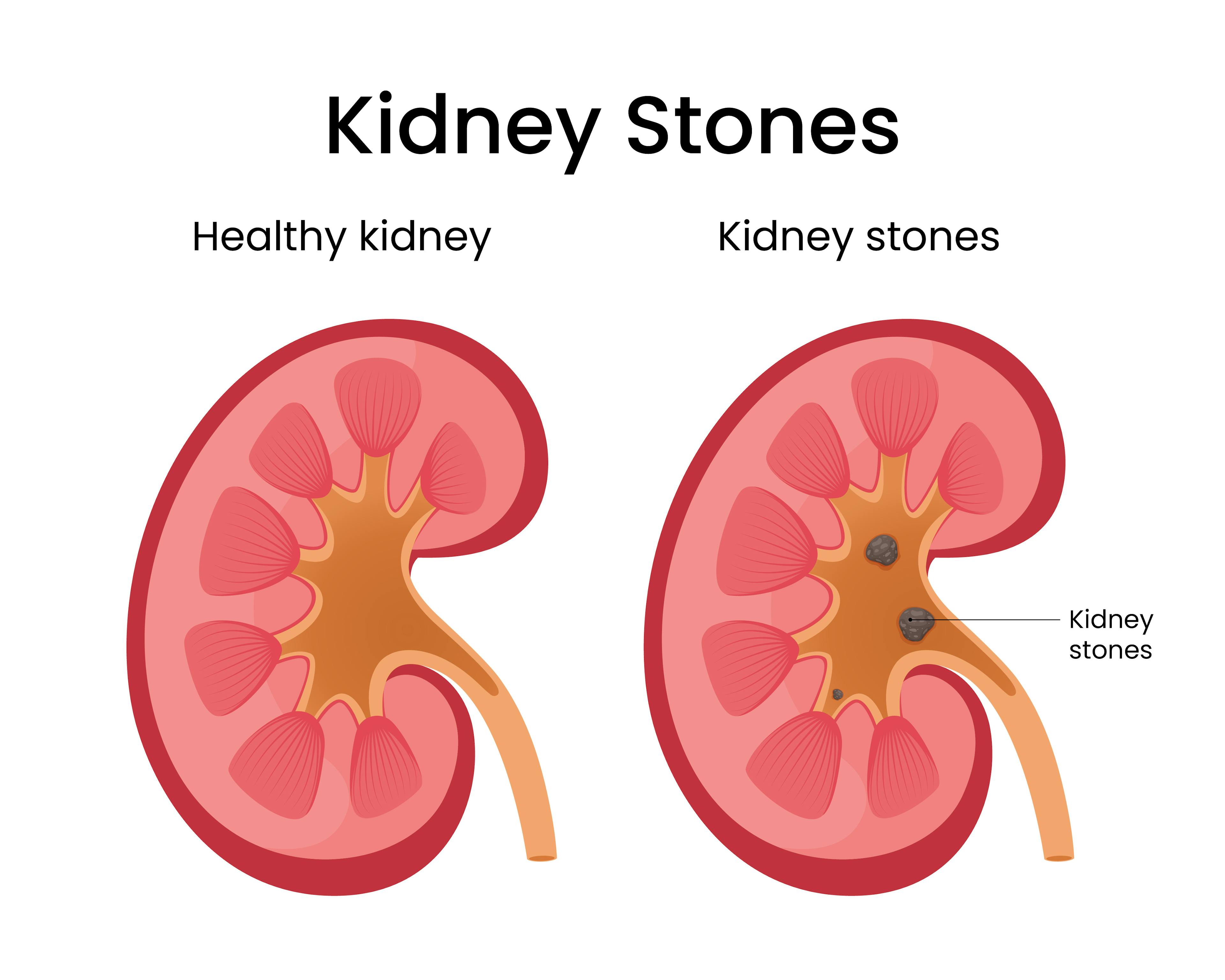
Kidney stone disease or urinary stone disease is a crystallopathy that occurs when there are too many minerals in the urine and not enough liquid or hydration. This imbalance causes tiny pieces of crystal to aggregate and form hard masses, or calculi (stones) in the upper urinary tract. Because renal calculi typically form in the kidney, if small enough, they are able to leave the urinary tract via the urine stream. A small calculus may pass without causing symptoms. However, if a stone grows to more than 5 millimeters (0.2 inches), it can cause a blockage of the ureter, resulting in extremely sharp and severe pain (renal colic) in the lower back that often radiates downward to the groin. A calculus may also result in blood in the urine, vomiting (due to severe pain), swelling of the kidney, or painful urination. About half of all people who have had a kidney stone are likely to develop another within ten years.
Most calculi form by a combination of genetics and environmental factors. Risk factors include high urine calcium levels, obesity, certain foods, some medications, calcium supplements, gout, hyperparathyroidism, and not drinking enough fluids. Calculi form in the kidney when minerals in urine are at high concentrations. The diagnosis is usually based on symptoms, urine testing, and medical imaging. Blood tests may also be useful. Calculi are typically classified by their location, being referred to medically as nephrolithiasis (in the kidney), ureterolithiasis (in the ureter), or cystolithiasis (in the bladder). Calculi are also classified by what they are made of, such as from calcium oxalate, uric acid, struvite, or cystine.
In those who have had renal calculi, drinking fluids, especially water, is a way to prevent them. Drinking fluids such that more than two liters of urine are produced per day is recommended. If fluid intake alone is not effective to prevent renal calculi, the medications thiazide diuretic, citrate, or allopurinol may be suggested. Soft drinks containing phosphoric acid (typically colas) should be avoided. When a calculus causes no symptoms, no treatment is needed. For those with symptoms, pain control is usually the first measure, using medications such as nonsteroidal anti-inflammatory drugs or opioids. Larger calculi may be helped to pass with the medication tamsulosin, or may require procedures for removal such as extracorporeal shockwave therapy (ESWT), laser lithotripsy (LL), or a percutaneous nephrolithotomy (PCNL).
Renal calculi have affected humans throughout history with a description of surgery to remove them dating from as early as 600 BC in ancient India by Sushruta. Between 1% and 15% of people globally are affected by renal calculi at some point in their lives. In 2015, 22.1 million cases occurred, resulting in about 16,100 deaths. They have become more common in the Western world since the 1970s. Generally, more men are affected than women, mainly between the ages of 40 and 60. The prevalence and incidence of the disease rises worldwide and continues to be challenging for patients, physicians, and healthcare systems alike. In this context, epidemiological studies are striving to elucidate the worldwide changes in the patterns and the burden of the disease and identify modifiable risk factors that contribute to the development of renal calculi.
Signs and symptoms
The hallmark of a stone that obstructs the ureter or renal pelvis is excruciating, intermittent pain that radiates from the flank to the groin or to the inner thigh. This is due to the transfer of referred pain signals from the lower thoracic splanchnic nerves to the lumbar splanchnic nerves as the stone passes down from the kidney or proximal ureter to the distal ureter. This pain, known as renal colic, is often described as one of the strongest pain sensations known. Renal colic caused by kidney stones is commonly accompanied by urinary urgency, restlessness, frequent urination, blood in the urine, sweating, nausea, and vomiting. It typically comes in waves lasting 20 to 60 minutes caused by peristaltic contractions of the ureter as it attempts to expel the stone.
The embryological link between the urinary tract, the genital system, and the gastrointestinal tract is the basis of the radiation of pain to the gonads, as well as the nausea and vomiting that are also common in urolithiasis. Postrenal azotemia and hydronephrosis can be observed following the obstruction of urine flow through one or both ureters.
Pain in the lower-left quadrant can sometimes be confused with diverticulitis because the sigmoid colon overlaps the ureter, and the exact location of the pain may be difficult to isolate due to the proximity of these two structures.
Additional Information
Kidney stones are clusters of crystals that form from minerals and other substances in your urinary tract. Most stones pass out of your body in your pee on their own, but they can be very painful as they move through. You might need a procedure to break up or remove the stone if it can’t pass on its own or is causing a blockage.
Kidney stones are solid masses or crystals that form from substances (like minerals, acids and salts) in your kidneys. They can be as small as a grain of sand or — rarely — larger than a golf ball. Kidney stones are also called renal calculi or nephrolithiasis.
Depending on the size of your kidney stone (or stones), you may not even realize that you have one. Smaller stones can pass through your urinary tract in your pee with no symptoms. Large kidney stones can get trapped in your ureter (the tube that drains urine from your kidney down to your bladder). This can cause pee to back up and limit your kidney’s ability to filter waste from your body. It can also cause bleeding.
It can take as long as three weeks for kidney stones to pass on their own. Even some small stones can cause extreme pain as they go through your urinary tract and out of your body. You may need a provider to break up and remove a stone that can’t pass on its own.
How common are kidney stones?
About 1 in 10 people will get a kidney stone during their lifetime. They’re most common in men in their 30s and 40s. They’re also more common among non-Hispanic white people.
Symptoms and Causes:
What are the symptoms of kidney stones?
The most common symptom of kidney stones is pain in your lower back, belly or side (flank pain). It might feel like it extends from your groin to your side. It can be a dull pain or sharp and severe. It’s sometimes called colicky pain because it can get worse in waves.
Other kidney stone symptoms include:
* Nausea and vomiting.
* Bloody pee.
* Pain when you pee.
* Inability to pee.
* Feeling the urge to pee a lot.
* Fever or chills.
* Cloudy or foul-smelling pee.
Smaller kidney stones may not cause pain or other symptoms.
What causes kidney stones?
Your pee contains minerals, acids and other substances, like calcium, sodium, oxalate and uric acid. When you have too many particles of these substances in your pee and too little liquid, they can start to stick together, forming crystals or stones. Kidney stones can form over months or years.
Types of kidney stones
Stones are named for the type of crystals they’re made up of:
* Calcium-oxalate and calcium phosphate stones. Calcium-based stones can form when you eat high-oxalate or low-calcium foods and aren’t drinking enough fluids. Calcium-oxalate stones are the most common type of kidney stones.
* Uric acid stones. Eating animal proteins (beef, poultry, pork, eggs and fish) can cause uric acid stones to form.
* Struvite stones. Bacterial infections can cause struvite stones. Repeated infections can lead to a staghorn calculus, a very large kidney stone that usually needs to be surgically removed.
* Cystine stones. An inherited condition called cystinuria causes cystine stones. Cystine is a substance made of two cysteine amino acids bound together.
What are the risk factors for kidney stones?
You might be at a higher risk of developing kidney stones if you:
* Don’t drink enough fluids.
* Eat meat and other protein-rich foods.
* Eat foods high in sodium or sugars (sucrose and fructose).
* Take vitamin C supplements.
* Have a family history of kidney stones.
* Have a blockage in your urinary tract.
* Have had stomach or intestine surgery, including gastric bypass surgery.
* Take certain medications. This includes some diuretics, calcium-based antacids, some antiseizure medications.
* Have certain medical conditions.
Medical conditions that increase kidney stone risk
Certain health conditions can put you at a higher risk for kidney stones. These include:
* Cystic fibrosis.
* Cystinuria, a genetic disorder that causes a buildup of cystine.
* Diabetes.
* Gout.
* High blood pressure.
* High calcium levels in your urine (hypercalciuria).
* Inflammatory bowel disease (IBD).
* Kidney cysts.
* Obesity.
* Osteoporosis.
* Parathyroid disease.
* Primary hyperoxaluria.
* Hemiplegia or paraplegia (types of paralysis).
It appears to me that if one wants to make progress in mathematics, one should study the masters and not the pupils. - Niels Henrik Abel.
Nothing is better than reading and gaining more and more knowledge - Stephen William Hawking.
Offline
Pages: 1