Math Is Fun Forum
You are not logged in.
- Topics: Active | Unanswered
Pages: 1
#1 2026-03-24 01:05:27
- Jai Ganesh
- Administrator

- Registered: 2005-06-28
- Posts: 53,833
Periodic Table
Periodic Table
Gist
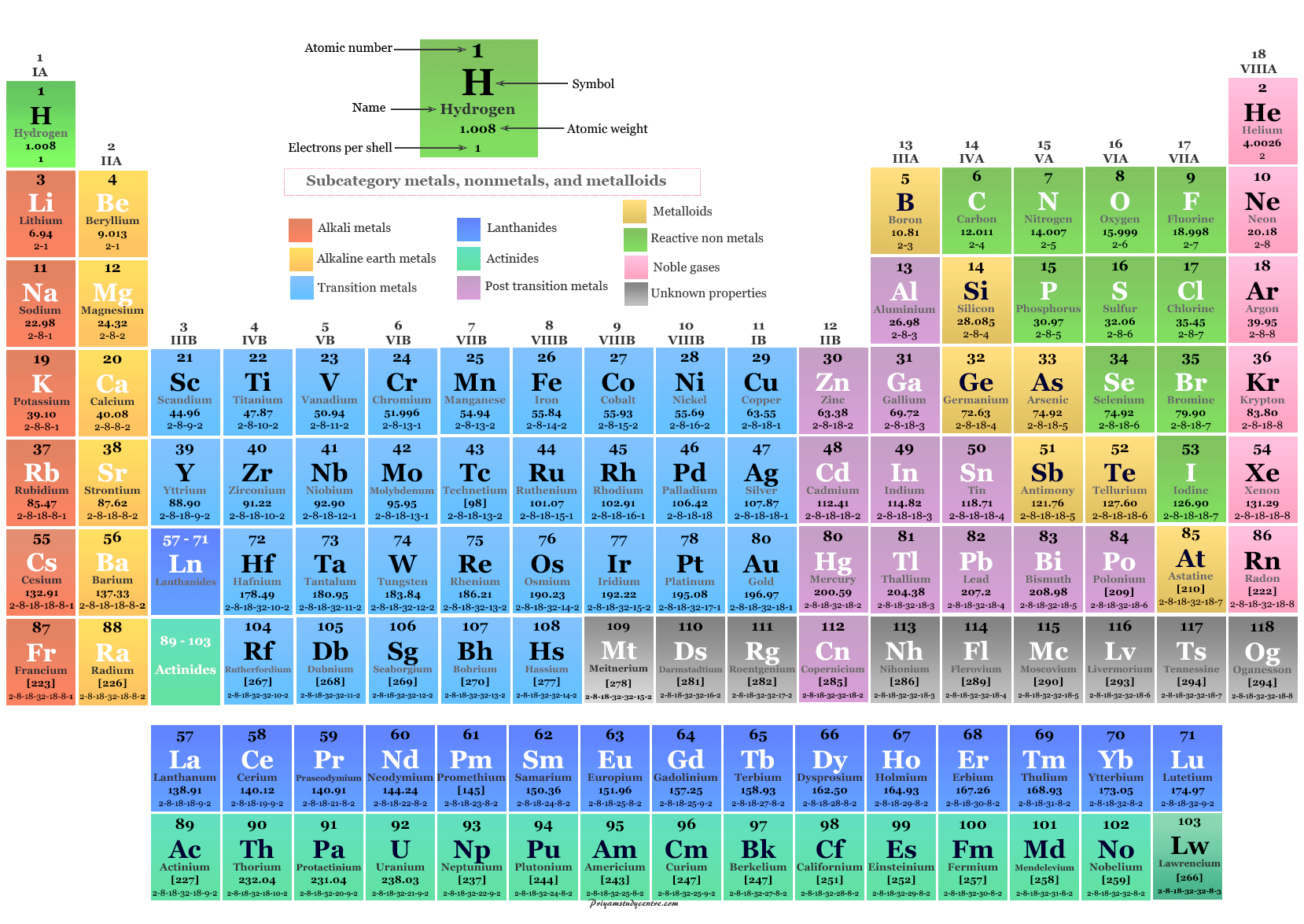
The periodic table, also known as the periodic table of the elements, is an ordered arrangement of the chemical elements into rows ("periods") and columns ("groups"). An icon of chemistry, the periodic table is widely used in physics and other sciences.
The periodic table consists of 118 officially recognized elements, organized by atomic number, name, and symbol. Elements are ordered by increasing proton count, with symbols often matching the English name (e.g., Helium, He) or Latin roots (e.g., Gold, Au). Key groupings include metals, non-metals, halogens, and noble gases.
Summary
The periodic table of elements is widely used in the field of Chemistry to look up chemical elements as they are arranged in a manner that displays periodic trends in the chemical properties of the elements. However, the Periodic table generally displays only the symbol of the element and not its entire name.
Most of the symbols are similar to the name of the element but some symbols of elements have Latin roots. An example for this is silver which is denoted by Ag from its Latin name “Argentum”. Another such example would be the symbol ‘Fe’ which is used to denote Iron and can be traced to the Latin word for iron, “Ferrum”. It could prove difficult for a beginner in chemistry to learn the names of all the elements in the periodic table because these symbols do not always correspond to the English names of the elements.
Frequently Asked Questions – FAQs
Q1: What is the atomic number?
A1: The atomic number of an atom is equivalent to the total number of electrons present in a neutral atom or the total number of protons present in the nucleus of an atom.
Q2: What is an element?
A2. An element is a substance that can not be decomposed into simpler substances by ordinary chemical processes. It is the fundamental unit of the matter.
Q3: How many elements are there in the modern periodic table?
A3: There is a total of 118 elements present in the modern periodic table.
Q4: What is a chemical symbol?
A cA4: hemical symbol is a notation of one or two letters denoting a chemical element.
Example: The symbol of chlorine is Cl.
Q5: What are the rules for chemical symbols?
A5. The first letter is always capitalised for writing the chemical symbol of an element, while the second letter is small.
Q6: What is the significance of chemical symbols?
A6: Chemical symbols play a crucial role in easing the writing. It is universal, i.e. identical throughout the world.
Q7: What is the chemical symbol of a sodium metal?
A7: The chemical symbol of sodium metal is Na.
Q8: Name the smallest and the largest atom.
A8: Helium is the smallest atom with a radius of 31 pm, while the caesium is the largest atom with a radius of 298 pm.
Q9: Can atoms exist without neutrons?
A9: Yes, there is an isotope of the hydrogen atom, protium, which has no neutron.
Q10: What is the chemical symbol of a gold metal?
A10: The chemical symbol of gold metal is Au.
Details
The periodic table, also known as the periodic table of the elements, is an ordered arrangement of the chemical elements into rows ("periods") and columns ("groups"). An icon of chemistry, the periodic table is widely used in physics and other sciences. It is a depiction of the periodic law, which states that when the elements are arranged in order of their atomic numbers an approximate recurrence of their properties is evident. The table is divided into four roughly rectangular areas called blocks. Elements in the same group tend to show similar chemical characteristics.
Vertical, horizontal and diagonal trends characterize the periodic table. Metallic character increases going down a group and from right to left across a period. Nonmetallic character increases going from the bottom left of the periodic table to the top right.
The first periodic table to become generally accepted was that of the Russian chemist Dmitri Mendeleev in 1869; he formulated the periodic law as a dependence of chemical properties on atomic mass. As not all elements were then known, there were gaps in his periodic table, and Mendeleev successfully used the periodic law to predict some properties of some of the missing elements. The periodic law was recognized as a fundamental discovery in the late 19th century. It was explained early in the 20th century, with the discovery of atomic numbers and associated pioneering work in quantum mechanics, both ideas serving to illuminate the internal structure of the atom. A recognisably modern form of the table was reached in 1945 with Glenn T. Seaborg's discovery that the actinides were in fact f-block rather than d-block elements. The periodic table and law have become a central and indispensable part of modern chemistry.
The periodic table continues to evolve with the progress of science. In nature, only elements up to atomic number 94 exist; elements beyond that can only be synthesized in the laboratory. By 2010, the first 118 elements were known, thereby completing the first seven rows of the table; however, chemical characterization is still needed for the heaviest elements to confirm that their properties match their positions. New discoveries will extend the table beyond these seven rows, though it is not yet known how many more elements are possible; moreover, theoretical calculations suggest that this unknown region will not follow the patterns of the known part of the table. Some scientific discussion also continues regarding whether some elements are correctly positioned in the table. Many alternative representations of the periodic law exist, and there is some discussion as to whether there is an optimal form of the periodic table.
Each chemical element has a unique atomic number (Z— for "Zahl", German for "number") representing the number of protons in its nucleus. Each distinct atomic number therefore corresponds to a class of atom: these classes are called the chemical elements. The chemical elements are what the periodic table classifies and organizes. Hydrogen is the element with atomic number 1; helium, atomic number 2; lithium, atomic number 3; and so on. Each of these names can be further abbreviated by a one- or two-letter chemical symbol; those for hydrogen, helium, and lithium are respectively H, He, and Li. Neutrons do not affect the atom's chemical identity, but do affect its weight. Atoms with the same number of protons but different numbers of neutrons are called isotopes of the same chemical element. Naturally occurring elements usually occur as mixes of different isotopes; since each isotope usually occurs with a characteristic abundance, naturally occurring elements have well-defined atomic weights, defined as the average mass of a naturally occurring atom of that element. All elements have multiple isotopes, variants with the same number of protons but different numbers of neutrons. For example, carbon has three naturally occurring isotopes: all of its atoms have six protons and most have six neutrons as well, but about one per cent have seven neutrons, and a very small fraction have eight neutrons. Isotopes are never separated in the periodic table; they are always grouped together under a single element. When atomic mass is shown, it is usually the weighted average of naturally occurring isotopes; but if no isotopes occur naturally in significant quantities, the mass of the most stable isotope usually appears, often in parentheses.
In the standard periodic table, the elements are listed in order of increasing atomic number. A new row (period) is started when a new electron shell has its first electron. Columns (groups) are determined by the electron configuration of the atom; elements with the same number of electrons in a particular subshell fall into the same columns (e.g. oxygen, sulfur, and selenium are in the same column because they all have four electrons in the outermost p-subshell). Elements with similar chemical properties generally fall into the same group in the periodic table, although in the f-block, and to some respect in the d-block, the elements in the same period tend to have similar properties, as well. Thus, it is relatively easy to predict the chemical properties of an element if one knows the properties of the elements around it.
Today, 118 elements are known, the first 94 of which are known to occur naturally on Earth. The remaining 24, americium to oganesson (95–118), occur only when synthesized in laboratories. Of the 94 naturally occurring elements, 83 are primordial and 11 occur only in decay chains of primordial elements. A few of the latter are so rare that they were not discovered in nature, but were synthesized in the laboratory before it was determined that they exist in nature: technetium (element 43), promethium (element 61), astatine (element 85), neptunium (element 93), and plutonium (element 94). No element heavier than einsteinium (element 99) has ever been observed in macroscopic quantities in its pure form, nor has astatine; francium (element 87) has been only photographed in the form of light emitted from microscopic quantities. Of the 94 natural elements, eighty have a stable isotope and one more (bismuth) has an almost-stable isotope (with a half-life of 2.01×{10}^{19} years, over a billion times the age of the universe). Two more, thorium and uranium, have isotopes undergoing radioactive decay with a half-life comparable to the age of the Earth. The stable elements plus bismuth, thorium, and uranium make up the 83 primordial elements that survived from the Earth's formation. The remaining eleven natural elements decay quickly enough that their continued trace occurrence rests primarily on being constantly regenerated as intermediate products of the decay of thorium and uranium.[d] All 24 known artificial elements are radioactive.
Group names and numbers
Under an international naming convention, the groups are numbered numerically from 1 to 18 from the leftmost column (the alkali metals) to the rightmost column (the noble gases). The f-block groups are ignored in this numbering. Groups can also be named by their first element, e.g. the "scandium group" for group 3. Previously, groups were known by Roman numerals. In the United States, the Roman numerals were followed by either an "A" (if the group was in the s- or p-block) or a "B" (if the group was in the d-block). The Roman numerals used correspond to the last digit of today's naming convention (e.g., the group 4 elements were group IVB, and the group 14 elements were group IVA). In Europe, "A" was used for groups 1 through 7, and "B" was used for groups 11 through 17. In addition, groups 8, 9, and 10 used to be treated as one triple-sized group, known collectively in both notations as group VIII. In 1988, the new IUPAC (International Union of Pure and Applied Chemistry) naming system (1–18) was put into use, and the old group names (I–VIII) were deprecated.
Additional Information
Periodic table, in chemistry, is the organized array of all the chemical elements in order of increasing atomic number—i.e., the total number of protons in the atomic nucleus. When the chemical elements are thus arranged, there is a recurring pattern called the “periodic law” in their properties, in which elements in the same column (group) have similar properties. The initial discovery of this pattern by Dmitri I. Mendeleev in the mid-19th century has been of inestimable value in the development of chemistry.
It was not recognized until the 1910s that the order of elements in the periodic system is that of their atomic numbers, which are equal to the positive electrical charges of the atomic nuclei expressed in electronic units. In subsequent years great progress was made in explaining the periodic law in terms of the electronic structure of atoms and molecules. This clarification has increased the value of the law, which is used as much today as it was at the beginning of the 20th century, when it expressed the only known relationship among the elements.
The periodic table
The periodic table of the elements contains all of the chemical elements that have been discovered or made; they are arranged, in the order of their atomic numbers, in seven horizontal periods, with the lanthanoids (lanthanum, 57, to lutetium, 71) and the actinoids (actinium, 89, to lawrencium, 103) indicated separately below. The periods are of varying lengths. First there is the hydrogen period, consisting of the two elements hydrogen, 1, and helium, 2. Then there are two periods of eight elements each: the first short period, from lithium, 3, to neon, 10, and the second short period, from sodium, 11, to argon, 18. There follow two periods of 18 elements each: the first long period, from potassium, 19, to krypton, 36, and the second long period, from rubidium, 37, to xenon, 54. The first very long period of 32 elements, from cesium, 55, to radon, 86, is condensed into 18 columns by the omission of the lanthanoids (which are indicated separately below), permitting the remaining 18 elements, which are closely similar in their properties to corresponding elements of the first and second long periods, to be placed directly below these elements. The second very long period, from francium, 87, to oganesson, 118, is likewise condensed into 18 columns by the omission of the actinoids.
Groups
The six noble gases—helium, neon, argon, krypton, xenon, and radon—occur at the ends of the six completed periods and constitute the Group 18 (0) group of the periodic system. It is customary to refer to horizontal series of elements in the table as periods and vertical series as groups. The seven elements lithium to fluorine and the seven corresponding elements sodium to chlorine are placed in the seven groups, 1 (Ia), 2 (IIa), 13 (IIIa), 14 (IVa), 15 (Va), 16 (VIa), and 17 (VIIa), respectively. The 17 elements of the fourth period, from potassium, 19, to bromine, 35, are distinct in their properties and are considered to constitute Groups 1–17 (Ia–VIIa) of the periodic system.
The first group, the alkali metals, thereby includes, in addition to lithium and sodium, the metals from potassium down the table to francium but not the much less similar metals of Group 11 (Ib; copper, etc.). Also the second group, the alkaline-earth metals, is considered to include beryllium, magnesium, calcium, strontium, barium, and radium but not the elements of Group 12 (IIb). The boron group includes those elements in Group 13 (IIIa). The other four groups are as follows: The carbon group, 14 (IVa), consists of carbon, silicon, germanium, tin, lead, and flerovium; the nitrogen group, 15 (Va), includes nitrogen, phosphorus, math, antimony, bismuth, and moscovium; the oxygen group, 16 (VIa), includes oxygen, sulfur, selenium, tellurium, polonium, and livermorium; and the halogen group, 17 (VIIa), includes fluorine, chlorine, bromine, iodine, astatine, and tennessine.
Although hydrogen is included in Group 1 (Ia), it is not closely similar to either the alkali metals or the halogens in its chemical properties. It is, however, assigned the oxidation number +1 in compounds such as hydrogen fluoride, HF, and −1 in compounds such as lithium hydride, LiH; and it may hence be considered as being similar to a Group 1 (Ia) element and to a Group 17 (VIIa) element, respectively, in compounds of these two types, taking the place first of Li and then of F in lithium fluoride, LiF. Hydrogen is, in fact, the most individualistic of the elements: No other element resembles it in the way that sodium resembles lithium, chlorine resembles fluorine, and neon resembles helium. It is a unique element, the only element that cannot conveniently be considered a member of a group.
A number of the elements of each long period are called the transition metals. These are usually taken to be scandium, 21, to zinc, 30 (the iron-group transition metals); yttrium, 39, to cadmium, 48 (the palladium-group transition metals); and hafnium, 72, to mercury, 80 (the platinum-group transition metals). By this definition, the transition metals include Groups 3 to 12 (IIIb to VIIIb, and Ib and IIb).
Periodic trends in properties
The periodicity in properties of the elements arranged in order of atomic number is strikingly shown by the consideration of the physical state of the elementary substances and such related properties as the melting point, density, and hardness. The elements of Group 18 (0) are gases that are difficult to condense. The alkali metals, in Group 1 (Ia), are soft metallic solids with low melting points. The alkaline-earth metals, in Group 2 (IIa), are harder and have higher melting points than the adjacent alkali metals. The hardness and melting point continue to increase through Groups 13 (IIIa) and 14 (IVa) and then decrease through Groups 15 (Va), 16 (VIa), and 17 (VIIa). The elements of the long periods show a gradual increase in hardness and melting point from the beginning alkali metals to near the center of the period and then at Group 16 (VIa) an irregular decrease to the halogens and noble gases.
The valence of the elements (that is, the number of bonds formed with a standard element) is closely correlated with position in the periodic table, the elements in the main groups having maximum positive valence, or oxidation number, equal to the group number and maximum negative valence equal to the difference between eight and the group number.
Metallic elements in the periodic table
The general chemical properties described as metallic or base forming, metalloid or amphoteric, and nonmetallic or acid forming are correlated with the periodic table in a simple way: The most metallic elements are to the left and to the bottom of the periodic table and the most nonmetallic elements are to the right and to the top (ignoring the noble gases). The metalloids are adjacent to a diagonal line from boron to polonium.
A closely related property is electronegativity, the tendency of atoms to retain their electrons and to attract additional electrons. The degree of electronegativity of an element is shown by ionization potential, electron affinity, oxidation-reduction potential, the energy of formation of chemical bonds, and other properties. It is shown to depend upon the element’s position in the periodic table in the same way that nonmetallic character does, fluorine being the most electronegative element and cesium (or francium) the least electronegative (most electropositive) element.
The sizes of atoms of elements vary regularly throughout the periodic system. Thus, the effective bonding radius (or one-half the distance between adjacent atoms) in the elementary substances in their crystalline or molecular forms decreases through the first short period from 1.52 Å for lithium to 0.73 Å for fluorine; at the beginning of the second period, the bonding radius rises abruptly to 1.86 Å for sodium and gradually decreases to 0.99 Å for chlorine. The behavior through the long periods is more complex: The bonding radius decreases gradually from 2.31 Å for potassium to a minimum of 1.25 Å for cobalt and nickel, then rises slightly, and finally falls to 1.14 Å for bromine. The sizes of atoms are of importance in the determination of coordination number (that is, the number of groups attached to the central atom in a compound) and hence in the composition of compounds.
The increase in atomic size from the upper right corner of the periodic table to the lower left corner is reflected in the formulas of the oxygen acids of the elements in their highest states of oxidation. The smallest atoms group only three oxygen atoms about themselves; the next larger atoms, which coordinate a tetrahedron of four oxygen atoms, are in a diagonal belt; and the still larger atoms, which form octahedral oxygen complexes (stannic acid, antimonic acid, telluric acid, paraperiodic acid), lie below and to the left of this belt. Only the chemical and physical properties of the elements are determined by the extranuclear electronic structure; these properties show the periodicity described in the periodic law. The properties of the atomic nuclei themselves, such as the magnitude of the packing fraction and the power of entering into nuclear reactions, are, although dependent upon the atomic number, not dependent in the same periodic way.
The basis of the periodic system:
Electronic Structure
The noble gases—helium, neon, argon, krypton, xenon, radon, and oganesson—have the striking chemical property of forming few chemical compounds. This property would depend upon their possessing especially stable electronic structures (that is, structures so firmly knit that they would not yield to accommodate ordinary chemical bonds). During the development of modern atomic physics and the theory of quantum mechanics, a precise and detailed understanding was obtained of the electronic structure of the noble gases and other atoms that explains the periodic law in a thoroughly satisfactory manner.
The Pauli exclusion principle states that no more than two electrons can occupy the same orbit—or, in quantum-mechanical language, orbital—in an atom and that two electrons in the same orbital must be paired (that is, must have their spins opposed, with one spin up and one spin down). The orbitals in an atom may be described by a principal quantum number, n, which may assume the values 1, 2, 3,…, and by an azimuthal quantum number, l, which may assume the values 0, 1, 2,…, n − 1. There are 2l + 1 distinct orbitals for each set of values of n and l.
The most stable orbitals, which bring the electron closest to the nucleus, are those with the smallest values of n and l. The electrons that occupy the orbital with n = 1 (and l = 0) are said to be in the K shell of electrons; the L, M, N,… shells correspond respectively to n = 2, 3, 4,…. Each shell except the K shell is divided into subshells corresponding to the values 0, 1, 2, 3,… of the orbital quantum number l; these subshells are called the s, p, d, and f subshells, and they can accommodate a maximum of 2, 6, 10, and 14 electrons, respectively. (There is no special significance to the letter designations of the quantum numbers or of the shells and subshells.)
The approximate order of stability of the successive subshells in an atom is indicated in the chart below. The number of electrons in the atoms of the elements increases with increasing atomic number, and the added electrons go, of necessity, into successively less stable shells. The most stable shell, the K shell, is completed with helium, which has two electrons. The L shell is then completely filled at neon, with atomic number 10. The atoms of the heavier noble gases do not, however, have a completed outer shell but instead have s and p subshells only. The outer shell of eight electrons is called traditionally an octet. The d subshells and f subshells subsequently are also filled with electrons after the initially less stable orbitals are occupied, an inversion of stability having occurred with increasing atomic number.
The numbers 2, 8, 18, and 32 correspond to filling the s; s and p; s, p, and d; and s, p, d, and f subshells, respectively. The elements in groups 13 through 18 (with the exception of helium) are called p-block elements because in those elements, the p subshells are being filled across the periods.
The first period of the periodic table is complete at helium, when the K shell is filled with two electrons. The first and second short periods represent the filling of the 2s and 2p subshells (completing the L shell at neon) and the 3s and 3p subshells (at argon), leaving the M shell incomplete. The first long period begins with the introduction of electrons into the 4s orbital. Then, at scandium, the five 3d orbitals of the inner M shell begin to be occupied. It is the successive occupancy of these five 3d orbitals by their complement of ten electrons that characterizes the ten elements of the iron-group transition series. At krypton the M shell is complete and there is an octet in the N shell. The second long period, of 18 elements, similarly represents the completion of an outer octet and the next inner subshell of ten 4d electrons.
The very long period of 32 elements results from the completion of the 4f subshell of 14 electrons, the 5d subshell of 10 electrons, and the 6s, 6p octet. The filling of the 4f orbitals corresponds to the sequence of 14 lanthanoids and that of the 5d orbitals to the 10 platinum-group transition metals.
The next period involves the 5f subshell of 14 electrons, the 6d subshell of 10 electrons, and the 7s, 7p octet. The filling of the 5f orbitals corresponds to the actinoids, the elements beginning with thorium, atomic number 90.
There are advantages to replacing the K, L, M,… shells by a different grouping of the subshells, in which those with nearly the same energy are grouped together, in close correlation with the periodic system.
The periodicity of properties of the elements is caused by the periodicity in electronic structure. The noble gases are chemically unreactive, or nearly so, because their electronic structures are stable—their atoms hold their quota of electrons strongly, have no affinity for more electrons, and have little tendency to share electrons with other atoms. An element close to a noble gas in the periodic system, on the other hand, is reactive chemically because of the possibility of assuming the stable electronic configuration of the noble gas, by losing one or more electrons to another atom, by gaining one or more electrons from another atom, or by sharing electrons. The alkali metals, in Group 1 (Ia), can assume the noble-gas configuration by losing one electron, which is loosely held in the outermost (valence) shell, to another element with greater electron affinity, thus producing the stable singly charged positive ions. Similarly the alkaline-earth metals can form doubly charged positive ions with the noble-gas electronic configuration by losing the two loosely held electrons of the valence shell; the positive ionic valences of the elements of the first groups are hence equal to the group numbers. The elements just preceding the noble gases can form negative ions with the noble-gas configuration by gaining electrons; the negative ionic valences of these elements are equal to the difference between eight and their group numbers. The covalence (or number of shared electron pairs) of an atom is determined by its electron number and the stable orbitals available to it. An atom such as fluorine, with seven electrons in its outer shell, can combine with a similar atom by sharing a pair of electrons with it; each atom thus achieves the noble-gas configuration by having three unshared pairs and one shared electron pair in its valence shell.
The properties of elements in the same group of the periodic system are, although similar, not identical. The trend in properties from the lighter to the heavier elements may be attributed to changes in the strength of binding of the outer electrons and especially to the increasing size of the atoms.
It appears to me that if one wants to make progress in mathematics, one should study the masters and not the pupils. - Niels Henrik Abel.
Nothing is better than reading and gaining more and more knowledge - Stephen William Hawking.
Offline
Pages: 1