Math Is Fun Forum
You are not logged in.
- Topics: Active | Unanswered
- Index
- » Science HQ
- » Lungs
Pages: 1
#1 2026-03-21 15:57:44
- Jai Ganesh
- Administrator

- Registered: 2005-06-28
- Posts: 53,933
Lungs
Lungs
Gist
Lungs are the primary, spongy, pinkish-gray respiratory organs in the chest that enable breathing by exchanging oxygen for carbon dioxide, a process vital for life. They consist of lobes (three on the right, two on the left), fill with air via the trachea and bronchial tree during inhalation, and are protected by the rib cage and pleural membrane.
The lungs are the primary organs of the respiratory system, responsible for taking in oxygen from the air (inhalation) and expelling carbon dioxide (exhalation). They deliver oxygen to the bloodstream for cellular energy and remove metabolic waste, maintaining pH balance and supporting immune functions.
Summary
The lungs are the primary organs of the respiratory system in many animals, including humans. In mammals and most other tetrapods, two lungs are located near the backbone on either side of the heart. Their function in the respiratory system is to extract oxygen from the atmosphere and transfer it into the bloodstream, and to release carbon dioxide from the bloodstream into the atmosphere, in a process of gas exchange. Respiration is driven by different muscular systems in different species. Mammals, reptiles and birds use their musculoskeletal systems to support and foster breathing. In early tetrapods, air was driven into the lungs by the pharyngeal muscles via buccal pumping, a mechanism still seen in amphibians. In humans, the primary muscle that drives breathing is the diaphragm. The lungs also provide airflow that makes vocalisation including speech possible.
Humans have two lungs, a right lung and a left lung. They are situated within the thoracic cavity of the chest. The right lung is bigger than the left, and the left lung shares space in the chest with the heart. The lungs together weigh approximately 1.3 kilograms (2.9 lb), and the right is heavier. The lungs are part of the lower respiratory tract that begins at the trachea and branches into the bronchi and bronchioles, which receive air breathed in via the conducting zone. These divide until air reaches microscopic alveoli, where gas exchange takes place. Together, the lungs contain approximately 2,400 kilometers (1,500 mi) of airways and 300 to 500 million alveoli. Each lung is enclosed within a pleural sac of two pleurae which allows the inner and outer walls to slide over each other whilst breathing takes place, without much friction. The inner visceral pleura divides each lung as fissures into sections called lobes. The right lung has three lobes and the left has two. The lobes are further divided into bronchopulmonary segments and lobules. The lungs have a unique blood supply, receiving deoxygenated blood sent from the heart to receive oxygen (the pulmonary circulation) and a separate supply of oxygenated blood (the bronchial circulation).
The tissue of the lungs can be affected by several respiratory diseases including pneumonia and lung cancer. Chronic diseases such as chronic obstructive pulmonary disease and emphysema can be related to smoking or exposure to harmful substances. Diseases such as bronchitis can also affect the respiratory tract. Medical terms related to the lung often begin with pulmo-, from the Latin pulmonarius (of the lungs) as in pulmonology, or with pneumo- as in pneumonia.
In embryonic development, the lungs begin to develop as an outpouching of the foregut, a tube which goes on to form the upper part of the digestive system. When the lungs are formed the fetus is held in the fluid-filled amniotic sac and so they do not function to breathe. Blood is also diverted from the lungs through the ductus arteriosus. At birth however, air begins to pass through the lungs, and the diversionary duct closes so that the lungs can begin to respire.
Details:
What Are Lungs?
Your lungs are a pair of organs that are the main part of your respiratory system, a network of structures and tissues that allow you to breathe. They pull air into your body so your tissues can get oxygen.
You have two lungs, a right and a left. Many people think of them like balloons. But they’re actually made up of spongy tissue, airways (tubes that air travels through), air sacs (alveoli) and blood vessels. The blood vessels pick up oxygen from the air sacs and deliver it to the rest of your body.
Function:
What do lungs do?
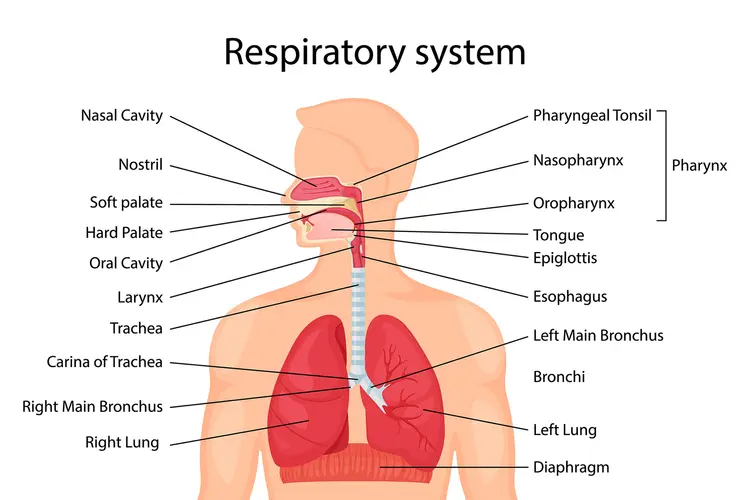
Your lungs’ main function is to bring oxygen to your blood and remove carbon dioxide from your body. When you inhale through your nose or mouth, air travels down your pharynx (back of your throat), passes through your larynx (voice box) and into your trachea (windpipe). Then, it moves into your left and right bronchial tubes and into smaller and smaller passages (bronchioles).
Your airways end in tiny air sacs called alveoli. These are surrounded by blood vessels. Your alveoli hold the air, and the blood that flows by picks up oxygen. Your blood delivers the oxygen to your tissues to use for energy. At the same time, your blood also drops off carbon dioxide to your lungs, which you breathe out on your next exhale. This process happens 12 to 20 times per minute.
Anatomy:
Where are your lungs in your body?
Your lungs are located in your chest (thorax), inside your rib cage. Your thoracic cavity is the space that contains your lungs and other organs of your chest.
Lung structure
Your lungs are made up of spongy, pinkish-gray tissue (connective tissue). They’re thicker in your back and get thinner as they curve around to your chest. They’re shaped a bit like cones or upside-down elephant ears: They have a narrow top part that extends toward your shoulders and a wider bottom.
Your bronchial tubes enter your lungs and branch into smaller and smaller airways until they reach the alveoli. The alveoli look a bit like a bunch of tiny grapes. Your lungs are covered in thin layers of tissue called pleura. These layers reduce friction as your lungs get bigger when they fill and smaller when they empty. Many blood vessels bring blood into and out of your lungs.
You have two lungs, one on each side of your chest. Each lung is divided into sections (lobes). They’re separated by folds called fissures. Your lungs rest on your diaphragm, a muscle that contracts and relaxes to pull air into your lungs.
Right lung
The lung on your right side is divided into three lobes: the superior, the middle and the inferior. It’s shorter and wider than your left lung.
Left lung
Your left lung has two lobes: the superior and the inferior. The superior lobe has an indent (cardiac notch) to make space for your heart. The piece of the superior lobe that curls down around the left and bottom of your heart is called the lingula.
How big are your lungs?
A typical adult lung weighs about 2.2 pounds (1 kilogram) and is a little longer than 9 inches (about 24 centimeters) when you’re breathing normally. It’s about 10.5 inches (27 cm) when your lungs are completely expanded.
Conditions and Disorders:
What diseases affect your lungs?
Conditions that affect your lungs include:
* Asthma: Inflammation of your airways when you’re exposed to triggers
* Bronchiectasis: Widened airways that can develop pouches
* Bronchitis: Inflammation and mucus in your airways
* COPD (chronic obstructive pulmonary disease): Damage to your airways that blocks your breathing and gets worse over time
* Cystic fibrosis: An inherited condition that causes sticky mucus to build up in your lungs and other organs
* Infections: Flu, COVID-19, RSV, tuberculosis and other germs can infect your lungs and airways
* Interstitial lung disease: Damage and scarring in your lungs, like pulmonary fibrosis and asbestosis
* Lung cancer: Growths in your lungs that can spread to other organs
* Mesothelioma: A type of cancer in the lining of your lungs
* Pneumonia: Inflammation and fluid in your lungs caused by an infection
* Pulmonary nodules: “Spots” on your lungs
Signs and symptoms
Symptoms of lung disease can include:
* Cough
* Chest pain, tightness or discomfort
* Shortness of breath
* Tiredness
These symptoms are common, and many other conditions can cause them. Talk to a healthcare provider if you’re experiencing symptoms that affect your breathing.
Care:
How to care for your lungs
To keep your lungs healthy:
* Don’t smoke or vape. It’s never too late to quit.
* If you have to work with materials that create dust or fumes, wear a respirator mask and make sure the area is well-ventilated.
* Maintain a weight that’s healthy for you.
* Get regular physical activity. This helps your heart and lung muscles stay strong.
* Drink plenty of fluids.
* Take steps to avoid respiratory infections. This includes washing your hands frequently and wearing a mask when respiratory illnesses, like the flu and COVID-19, are spreading. Ask a provider which vaccines are recommended for you.
Additional Information:
Why Are Lungs Important?
Every cell in your body needs oxygen to live. The air we breathe contains oxygen and other gases. The respiratory system's main job is to move fresh air into your body while removing waste gases.
Once in the lungs, oxygen is moved into the bloodstream and carried through your body. At each cell in your body, oxygen is exchanged for a waste gas called carbon dioxide. Your bloodstream then carries this waste gas back to the lungs where it is removed from the bloodstream and then exhaled. Your lungs and respiratory system automatically perform this vital process, called gas exchange.
In addition to gas exchange, your respiratory system performs other roles important to breathing. These include:
* Bringing air to the proper body temperature and moisturizing it to the right humidity level.
* Protecting your body from harmful substances. This is done by coughing, sneezing, filtering or swallowing them.
* Supporting your sense of smell.
The Parts of the Respiratory System and How They Work:
Airways
* SINUSES are hollow spaces in the bones of your head above and below your eyes that are connected to your nose by small openings. Sinuses help regulate the temperature and humidity of inhaled air.
* The NOSE is the preferred entrance for outside air into the respiratory system. The hairs lining the nose's wall are part of the air-cleaning system.
* Air also enters through the MOUTH, especially for those who have a mouth-breathing habit, whose nasal passages may be temporarily blocked by a cold, or during heavy exercise.
* The THROAT collects incoming air from your nose and mouth then passes it down to the windpipe (trachea).
* The WINDPIPE (trachea) is the passage leading from your throat to your lungs.
* The windpipe divides into the two main BRONCHIAL TUBES, one for each lung, which divides again into each lobe of your lungs. These, in turn, split further into bronchioles.
Lungs and Blood Vessels
* Your right lung is divided into three LOBES, or sections. Each lobe is like a balloon filled with sponge-like tissue. Air moves in and out through one opening—a branch of the bronchial tube.
* Your left lung is divided into two LOBES.
* The PLEURA are the two membranes, actually, one continuous one folded on itself, that surround each lobe of the lungs and separate your lungs from your chest wall.
* Your bronchial tubes are lined with CILIA (like very small hairs) that move like waves. This motion carries MUCUS (sticky phlegm or liquid) upward and out into your throat, where it is either coughed up or swallowed. Mucus catches and holds much of the dust, germs, and other unwanted matter that has invaded your lungs. You get rid of this matter when you cough, sneeze, clear your throat or swallow.
* The smallest branches of the bronchial tubes are called BRONCHIOLES, at the end of which are the air sacs or alveoli.
* ALVEOLI are the very small air sacs where the exchange of oxygen and carbon dioxide takes place.
* CAPILLARIES are blood vessels in the walls of the alveoli. Blood passes through the capillaries, entering through your PULMONARY ARTERY and leaving via your PULMONARY VEIN. While in the capillaries, blood gives off carbon dioxide through the capillary wall into the alveoli and takes up oxygen from air in the alveoli.
Muscles and Bones
* Your DIAPHRAGM is the strong wall of muscle that separates your chest cavity from the abdominal cavity. By moving downward, it creates suction in the chest, drawing in air and expanding the lungs.
* RIBS are bones that support and protect your chest cavity. They move slightly to help your lungs expand and contract.
Keeping Lungs Healthy
Lung capacity declines as you age. Keep your lungs healthy by taking good care of yourself every day. Eat a balanced diet, exercise and reduce stress to breathe easier. Get more tips for healthy lungs.
It appears to me that if one wants to make progress in mathematics, one should study the masters and not the pupils. - Niels Henrik Abel.
Nothing is better than reading and gaining more and more knowledge - Stephen William Hawking.
Offline
Pages: 1
- Index
- » Science HQ
- » Lungs