Math Is Fun Forum
You are not logged in.
- Topics: Active | Unanswered
- Index
- » Science HQ
- » Stomach
Pages: 1
#1 2026-03-20 16:21:48
- Jai Ganesh
- Administrator

- Registered: 2005-06-28
- Posts: 53,933
Stomach
Stomach
Gist
The stomach is a muscular, J-shaped organ located in the upper abdomen that acts as a central part of the digestive system. It functions by storing food, mixing it with gastric acid and enzymes to form chyme, and breaking down proteins, usually holding food for 2 to 4 hours. It consists of five parts: the cardia, fundus, body, antrum, and pylorus.
The stomach is a J-shaped muscular organ in the upper abdomen that acts as a vital, expandable reservoir in the gastrointestinal tract, storing food for roughly 2–5 hours. It breaks down food mechanically (churning) and chemically (gastric juices), converting it into a semi-liquid mixture called chyme, which it passes to the small intestine.
Summary
The stomach is a muscular, hollow organ in the upper gastrointestinal tract of humans and many other animals, including several invertebrates. The Ancient Greek name for the stomach is gaster which is used as gastric in medical terms related to the stomach. The stomach has a dilated structure and functions as a vital organ in the digestive system. The stomach is involved in the gastric phase of digestion, following the cephalic phase in which the sight and smell of food and the act of chewing are stimuli. In the stomach a chemical breakdown of food takes place by means of secreted digestive enzymes and gastric acid. It also plays a role in regulating gut microbiota, influencing digestion and overall health.
The stomach is located between the esophagus and the small intestine. The pyloric sphincter controls the passage of partially digested food (chyme) from the stomach into the duodenum, the first and shortest part of the small intestine, where peristalsis takes over to move this through the rest of the intestines.
Details
Your stomach is a muscular organ that digests food. It is part of your gastrointestinal (GI) tract. When your stomach receives food, it contracts and produces acids and enzymes that break down food. When your stomach has broken down food, it passes it to your small intestine.
Overview:
What is the stomach?
The stomach is a J-shaped organ that digests food. It produces enzymes (substances that create chemical reactions) and acids (digestive juices). This mix of enzymes and digestive juices breaks down food so it can pass to your small intestine.
Your stomach is part of the gastrointestinal (GI) tract. The GI tract is a long tube that starts at your mouth. It runs to your math, where stool (poop) leaves your body. The GI tract is a key part of your digestive system.
Function:
What is the stomach’s function?
Your stomach’s purpose is to digest food and send it to your small intestine. It has three functions:
* Temporarily store food.
* Contract and relax to mix and break down food.
* Produce enzymes and other specialized cells to digest food.
How does the stomach work with the rest of the GI tract?
Each part of your GI tract breaks down food and liquid and carries it through your body. During the digestive process, your body absorbs nutrients and water. Then, you expel the waste products of digestion through your large intestine.
Food moves through your GI tract in a few steps:
* Mouth: As you chew and swallow, your tongue pushes food into your throat. A small piece of tissue called the epiglottis covers your windpipe. The epiglottis prevents choking.
* Esophagus: Food travels down a hollow tube called the esophagus. At the bottom, your esophageal sphincter relaxes to let food pass to your stomach. (A sphincter is a ring-shaped muscle that tightens and loosens.)
* Stomach: Your stomach creates digestive juices and breaks down food. It holds food until it is ready to empty into your small intestine.
* Small intestine: Food mixes with the digestive juices from your intestine, liver and pancreas. Your intestinal walls absorb nutrients and water from food and send waste products to the large intestine.
* Large intestine: Your large intestine turns waste products into stool. It pushes the stool into your rectum.
* Rectum: The rectum is the lower portion of your large intestine. It stores stool until you have a bowel movement.
Anatomy:
Where is the stomach located?
Your stomach sits in your upper abdomen on the left side of your body. The top of your stomach connects to a valve called the esophageal sphincter (a muscle at the end of your esophagus). The bottom of your stomach connects to your small intestine.
How big is your stomach?
The size of the stomach varies from person to person. Your stomach expands when full and deflates when empty. Because of this, your stomach size can vary depending on how recently and how much you have eaten.
What are the parts of the stomach’s anatomy?
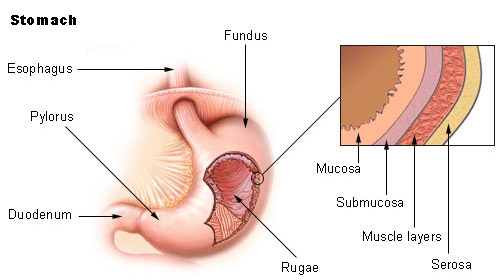
Your stomach has five distinct sections:
1. The cardia is the top part of your stomach. It contains the cardiac sphincter, which prevents food from traveling back up your esophagus.
2. The fundus is a rounded section next to the cardia. It's below your diaphragm (the dome-shaped muscle that helps you breathe).
3. The body (corpus) is the largest section of your stomach. In the body, your stomach contracts and begins to mix food.
4. The antrum lies below the body. It holds food until your stomach is ready to send it to your small intestine.
5. The pylorus is the bottom part of your stomach. It includes the pyloric sphincter. This ring of tissue controls when and how your stomach contents move to your small intestine.
What is the stomach’s structure?
Several layers of muscle and other tissues make up your stomach:
* Mucosa is your stomach’s inner lining. When your stomach is empty, the mucosa has small ridges (rugae). When your stomach is full, the mucosa expands, and the ridges flatten.
* Submucosa contains connective tissue, blood vessels, lymph vessels (part of your lymphatic system) and nerve cells. It covers and protects the mucosa.
* Muscularis externa is the primary muscle of your stomach. It has three layers that contract and relax to break down food.
* Serosa is a layer of membrane that covers your stomach.
Conditions and Disorders:
What conditions and disorders affect your stomach?
Gastrointestinal diseases may affect your stomach. You may have gastrointestinal symptoms only under specific circumstances, such as getting heartburn during pregnancy. Or you may have a chronic (long-lasting) condition.
Common conditions that affect your stomach include:
* Gastric ulcers: Erosion in your stomach’s lining that can lead to pain and bleeding.
* Gastritis: Stomach inflammation.
* Gastroesophageal reflux disease (GERD): When stomach contents travel up to your esophagus, causing heartburn or coughing.
* Gastroparesis: Nerve damage that affects your stomach’s muscle contractions.
* Indigestion (dyspepsia): Discomfort, pain or burning in your upper stomach.
* Peptic ulcer disease: Ulcers (sores) in either your stomach or the first portion of your small intestine (duodenum).
* Stomach cancer: When cancerous cells grow uncontrollably in your stomach.
Additional Information
The stomach, is an intraperitoneal digestive organ located between the oesophagus and the duodenum.
It has a ‘J’ shape, and features a lesser and greater curvature. The anterior and posterior surfaces are smoothly rounded with a peritoneal covering.
Anatomical Position
The stomach lies within the superior aspect of the abdomen.
It primarily lies in the epigastric and umbilical regions, however, the exact size, shape and position of the stomach can vary from person to person and with position and respiration.
Anatomical Structure:
Divisions of the Stomach
The stomach has four main anatomical divisions; the cardia, fundus, body and pylorus:
Cardia – surrounds the superior opening of the stomach at the T11 level.
Fundus – the rounded, often gas filled portion superior to and left of the cardia.
Body – the large central portion inferior to the fundus.
Pylorus – This area connects the stomach to the duodenum. It is divided into the pyloric antrum, pyloric canal and pyloric sphincter. The pyloric sphincter demarcates the transpyloric plane at the level of L1.
Greater and Lesser Curvatures
The medial and lateral borders of the stomach are curved, forming the lesser and greater curvatures:
* Greater curvature – forms the long, convex, lateral border of the stomach.
** Arising at the cardiac notch, it arches backwards and passes inferiorly to the left.
** It curves to the right as it continues medially to reach the pyloric antrum.
** The short gastric arteries and the right and left gastro-omental arteries supply branches to the greater curvature.
* Lesser curvature – forms the shorter, concave, medial surface of the stomach.
** The most inferior part of the lesser curvature, the angular notch, indicates the junction of the body and pyloric region.
** The lesser curvature gives attachment to the hepatogastric ligament and is supplied by the left gastric artery and right gastric branch of the hepatic artery.
It appears to me that if one wants to make progress in mathematics, one should study the masters and not the pupils. - Niels Henrik Abel.
Nothing is better than reading and gaining more and more knowledge - Stephen William Hawking.
Offline
Pages: 1
- Index
- » Science HQ
- » Stomach