Math Is Fun Forum
You are not logged in.
- Topics: Active | Unanswered
Pages: 1
#1 2026-03-08 16:23:04
- Jai Ganesh
- Administrator

- Registered: 2005-06-28
- Posts: 53,783
Radius (Bone)
Radius (Bone)
Gist
The radius (or radial bone) is one of two long bones in the forearm, extending from the lateral (thumb) side of the elbow to the wrist. It runs parallel to the ulna, is shorter and thicker than the ulna, and is crucial for rotating the forearm (pronation/supination) and supporting wrist movement.
The radius is located in the forearm and provides articulation at the elbow and wrist joints. The radius extends from the elbow to the wrist. The ulna lies adjacent to the radius and the two bones work together to move the arm at the wrist and elbow. The humerus is the solitary long bone of the upper arm.
Summary
The radius is a long bone in the forearm. It lies laterally and parallel to ulna, the second of the forearm bones. The radius pivots around the ulna to produce movement at the proximal and distal radio-ulnar joints.
The radius articulates in four places:
* Elbow joint – Partly formed by an articulation between the head of the radius, and the capitulum of the humerus.
* Proximal radioulnar joint – An articulation between the radial head, and the radial notch of the ulna.
* Wrist joint – An articulation between the distal end of the radius and the carpal bones.
* Distal radioulnar joint – An articulation between the ulnar notch and the head of the ulna.
Proximal End
The proximal end of the radius articulates in both the elbow and proximal radioulnar joints.
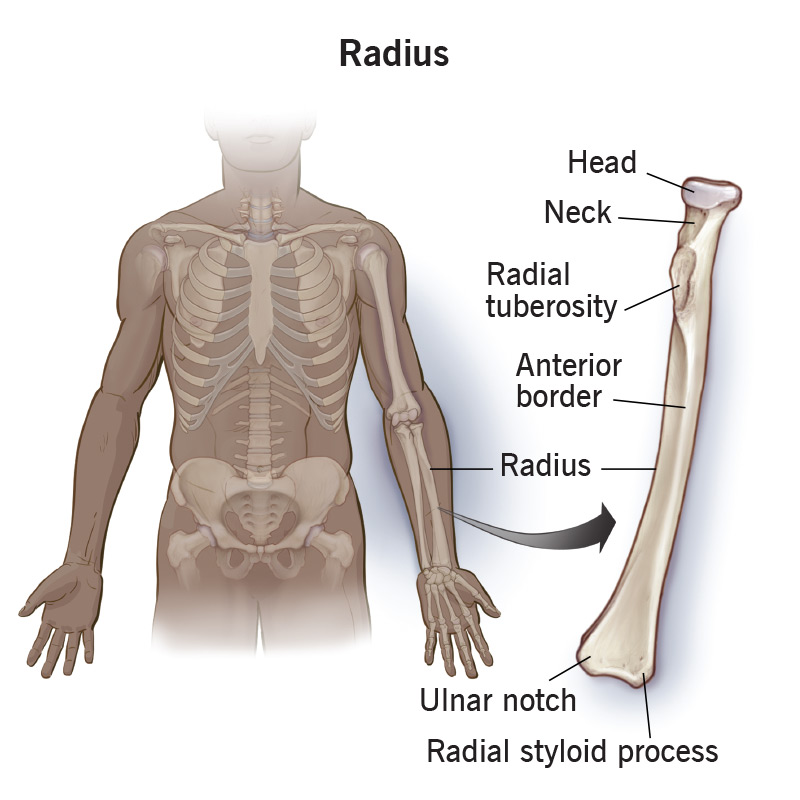
Important bony landmarks include the head, neck and radial tuberosity:
Head of radius – A disk shaped structure, with a concave articulating surface. It is thicker medially, where it takes part in the proximal radioulnar joint.
Neck – A narrow area of bone, which lies between the radial head and radial tuberosity.
Radial tuberosity – A bony projection, which serves as the place of attachment of the biceps brachii muscle.
Shaft
The radial shaft expands in diameter as it moves distally. Much like the ulna, it is triangular in shape, with three borders and three surfaces.
In the middle of the lateral surface, there is a small roughening for the attachment of the pronator teres muscle.
Distal End
In the distal region, the radial shaft expands to form a rectangular end. The lateral side projects distally as the styloid process. In the medial surface, there is a concavity, called the ulnar notch, which articulates with the head of ulna, forming the distal radioulnar joint.
The distal surface of the radius has two facets, for articulation with the scaphoid and lunate carpal bones. This makes up the wrist joint.
Details
The radius or radial bone (pl.: radii or radiuses) is one of the two large bones of the forearm, the other being the ulna. It extends from the lateral side of the elbow to the thumb side of the wrist and runs parallel to the ulna. The ulna is longer than the radius, but the radius is thicker. The radius is a long bone, prism-shaped and slightly curved longitudinally.
The radius is part of three joints: the elbow and the wrist, both of which are synovial joints; and the radioulnar joint, which is a syndesmosis. At the elbow, it joins with the capitulum of the humerus, and in a separate region, with the ulna at the radial notch. At the wrist, the radius forms a joint with the ulna bone. The radioulnar joint allows for supination and pronation of the forearm.
The corresponding bone in the leg is the tibia.
Structure
The long narrow medullary cavity is enclosed in a strong wall of compact bone. It is thickest along the interosseous border and thinnest at the extremities, same over the cup-shaped articular surface (fovea) of the head.
The trabeculae of the spongy tissue are somewhat arched at the upper end and pass upward from the compact layer of the shaft to the fovea capituli (the humerus's cup-shaped articulatory notch); they are crossed by others parallel to the surface of the fovea. The arrangement at the lower end is somewhat similar. It is missing in radial aplasia.
The radius has a body and two extremities. The upper extremity of the radius consists of a somewhat cylindrical head articulating with the ulna and the humerus, a neck, and a radial tuberosity. The body of the radius is self-explanatory, and the lower extremity of the radius is roughly quadrilateral in shape, with articular surfaces for the ulna, scaphoid and lunate bones. The distal end of the radius forms two palpable points, radially the styloid process and Lister's tubercle on the ulnar side. Along with the proximal and distal radioulnar articulations, an interosseous membrane originates medially along the length of the body of the radius to attach the radius to the ulna.
Additional Information
Your radius is one of the bones in your forearm. It helps you move your arm and wrist. When you injure your radius, it’s likely the muscles and nerves attached to it will be damaged, too.
Overview:
What is the radius?
The radius is one of the bones in your forearm. It helps you move your arm and wrist. Your radius also supports lots of important muscles, tendons, ligaments and blood vessels.
If you experience a fractured (broken) radius, you might need surgery to repair your bone and physical therapy to help you regain your strength and ability to move.
Your radius — like all bones — can be affected by osteoporosis.
Because your radius is connected to so many muscles and nerves, injuries to one often can affect the others.
Function:
What does the radius do?
Your radius has several important jobs, including:
* Helping your forearm and wrist move, flex and rotate.
* Holding seven muscles in place.
* Stabilizing the rest of your arm, wrist and hand.
Anatomy:
Where is the radius located?
Your radius is one of two bones in your forearm. The other is your ulna. The radius is opposite your ulna, on the lateral (thumb) side of your forearm. Your radius rotates over your ulna when you stretch your arm straight out in front of you with your palms facing down. They’re more parallel to each other when you hold your arms straight out with your palms face up.
What does the radius look like?
Your radius has a small end where it meets your humerus (upper arm bone), a long shaft in the middle that’s slightly curved and a wider end that meets your wrist. It’s thicker and slightly shorter than your ulna.
Even though it’s one long bone, your radius is made up of several parts. These include:
Radius proximal aspect
The upper (proximal) end of your radius connects to your humerus. The proximal end (aspect) contains the:
* Head.
* Neck.
* Radial tuberosity.
Radius shaft
The shaft is the long middle portion of the radius that supports the weight of your forearm and gives it its shape.
Radius distal aspect
The lower (distal) end of your radius forms the top of your wrist joint. It’s wider than the rest of your radius where it meets your scaphoid and lunate (wrist or carpal bones). The distal end of the radius includes:
* Styloid process.
* Ulnar notch.
All these parts and labels are usually more for your healthcare provider to use as they describe where you’re having pain or issues. If you ever break your radius — a radial fracture — your provider might use some of these terms to describe where your bone was damaged.
How big is the radius?
Your radius is the third longest bone in your arm and is one of the longest bones in your body. Most adults’ radius bones are around 10 inches long.
Conditions and Disorders:
What are the common conditions and disorders that affect the radius?
The most common issues that affect the radius are fractures, osteoporosis and damage to nerves or muscles around it.
Radius fractures
A bone fracture is the medical term for a broken bone. The most common causes of radius fractures include:
* Sports injuries.
* Car accidents.
* Falls.
Symptoms of a fracture include:
* Pain.
* Swelling.
* Tenderness.
* Inability to move your arm like you usually can.
* Bruising or discoloration.
* A deformity or bump that’s not usually on your body.
Some fractures that affect the radius include:
* Colles fractures.
* Smith fractures.
* Greenstick fractures.
* Growth plate fractures.
Go to the emergency room right away if you’ve experienced a trauma or think you have a fracture.
Osteoporosis
Osteoporosis weakens bones, making them more susceptible to sudden and unexpected fractures. It usually doesn’t cause any symptoms you can notice, so many people don’t know they have osteoporosis until after it causes them to break a bone.
Females and adults older than 65 have an increased risk for developing osteoporosis. Talk to your provider about a bone density test that can catch osteoporosis before it causes a fracture.
Nursemaid elbow
Nursemaid elbow is a common injury for young children. You might also see it referred to as a “pulled elbow.” It’s a partially dislocated radius where it meets a child’s elbow. It happens because kids’ ligaments are looser than adults’. Pulling on your child’s arm or hand causes nursemaid elbow. It usually happens accidentally after motions like tugging your child’s arm so they don’t walk into the street, or playfully lifting them up by their hands.
What tests are done on the radius?
The most common test done to check the health of your radius is a bone density test. It’s sometimes called a DEXA or DXA scan. A bone density test uses low levels of X-rays to measure how strong your bones are. It’s a way for your provider to track bone loss as you age.
If you’ve experienced a humeral fracture, your provider or surgeon might need imaging tests, including:
* X-rays.
* Magnetic resonance imaging (MRI).
* CT scan.
What are common treatments done to the radius?
Your radius won’t need treatment unless you’ve experienced a fracture or injury or have osteoporosis.
Radius fracture treatment
How your fracture is treated depends on which type it is and what caused it. You’ll need some form of immobilization like a splint or cast. You might need surgery to realign (set) your bone to its correct position so it can heal.
Osteoporosis treatment
Treatments for osteoporosis can include exercise, vitamin and mineral supplements and medications.
Your provider will help you develop a treatment plan that’s customized for you and your bone health.
It appears to me that if one wants to make progress in mathematics, one should study the masters and not the pupils. - Niels Henrik Abel.
Nothing is better than reading and gaining more and more knowledge - Stephen William Hawking.
Offline
Pages: 1