Math Is Fun Forum
You are not logged in.
- Topics: Active | Unanswered
Pages: 1
#1 2026-03-05 17:13:13
- Jai Ganesh
- Administrator

- Registered: 2005-06-28
- Posts: 53,904
River Amazon
River Amazon
Gist
The Amazon River in South America is the world's largest river by discharge volume, carrying more water than the next eight largest rivers combined. It is generally considered the second longest (approx. 6,400 km/4,000 miles) after the Nile, though some studies claim it is longer. Originating in the Andes, it traverses Peru, Colombia, and Brazil, emptying into the Atlantic Ocean.
The Amazon River in South America is the largest river by discharge volume of water in the world, and the longest or second-longest river system in the world, a title which is disputed with the Nile.
Summary
The Amazon River in South America is the largest river by discharge volume of water in the world, and the longest or second-longest river system in the world, a title which is disputed with the Nile.
The headwaters of the Apurímac River on Nevado Mismi had been considered, for nearly a century, the Amazon basin's most distant source until a 2014 study found it to be the headwaters of the Mantaro River on the Cordillera Rumi Cruz in Peru. The Mantaro and Apurímac rivers join, and with other tributaries form the Ucayali River, which in turn meets the Marañón River upstream of Iquitos, Peru, forming what countries other than Brazil consider to be the main stem of the Amazon. Brazilians call this section the Solimões River above its confluence with the Rio Negro forming what Brazilians call the Amazon at the Meeting of Waters (Portuguese: Encontro das Águas) at Manaus, the largest city on the river.
The Amazon River has an average discharge of about 215,000–230,000 cubic meters per second (7,600,000–8,100,000 cu ft/s)—approximately 6,591–7,570 cubic kilometers (1,581–1,816 cu mi) per year, greater than the next seven largest independent rivers combined. Two of the top ten rivers by discharge are tributaries of the Amazon river. The Amazon represents 20% of the global riverine discharge into oceans. The Amazon basin is the largest drainage basin in the world, with an area of approximately 7,000,000 square kilometers (2,700,000 sq mi). The portion of the river's drainage basin in Brazil alone is larger than any other river's basin. The Amazon enters Brazil with only one-fifth of the flow it finally discharges into the Atlantic Ocean, yet already has a greater flow at this point than the discharge of any other river in the world. It has a recognized length of 6,400 kilometers (4,000 mi), but according to some reports, its length varies from 6,575–7,062 kilometers (4,086–4,388 mi).
Details
Amazon River is the greatest river of South America and the largest drainage system in the world in terms of the volume of its flow and the area of its basin. The total length of the river—as measured from the headwaters of the Ucayali-Apurímac river system in southern Peru—is at least 4,000 miles (6,400 km), which makes it slightly shorter than the Nile River but still the equivalent of the distance from New York City to Rome. Its westernmost source is high in the Andes Mountains, within 100 miles (160 km) of the Pacific Ocean, and its mouth is in the Atlantic Ocean, on the northeastern coast of Brazil. However, both the length of the Amazon and its ultimate source have been subjects of debate since the mid-20th century, and there are those who claim that the Amazon is actually longer than the Nile. (See below The length of the Amazon.)
The vast Amazon basin (Amazonia), the largest lowland in Latin America, has an area of about 2.7 million square miles (7 million square km) and is nearly twice as large as that of the Congo River, the Earth’s other great equatorial drainage system. Stretching some 1,725 miles (2,780 km) from north to south at its widest point, the basin includes the greater part of Brazil and Peru, significant parts of Colombia, Ecuador, and Bolivia, and a small area of Venezuela; roughly two-thirds of the Amazon’s main stream and by far the largest portion of its basin are within Brazil. The Tocantins-Araguaia catchment area in Pará state covers another 300,000 square miles (777,000 square km). Although considered a part of Amazonia by the Brazilian government and in popular usage, it is technically a separate system. It is estimated that about one-fifth of all the water that runs off Earth’s surface is carried by the Amazon. The flood-stage discharge at the river’s mouth is four times that of the Congo and more than 10 times the amount carried by the Mississippi River. This immense volume of fresh water dilutes the ocean’s saltiness for more than 100 miles (160 km) from shore.
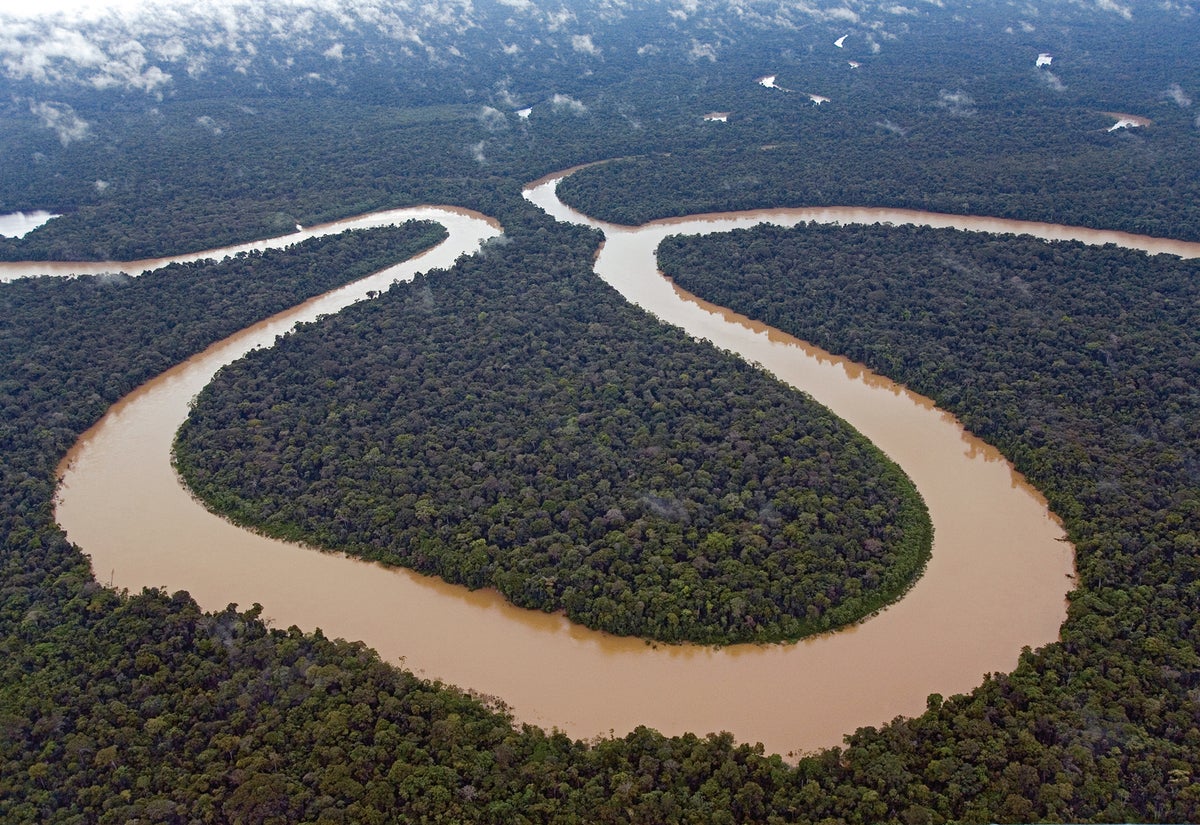
The extensive lowland areas bordering the main river and its tributaries, called várzeas (“floodplains”), are subject to annual flooding, with consequent soil enrichment; however, most of the vast basin consists of upland, well above the inundations and known as terra firme. More than two-thirds of the basin is covered by an immense rainforest, which grades into dry forest and savanna on the higher northern and southern margins and into montane forest in the Andes to the west. The Amazon Rainforest, which represents about half of the Earth’s remaining rainforest, also constitutes its single largest reserve of biological resources.
Since the later decades of the 20th century, the Amazon basin has attracted international attention because human activities have increasingly threatened the equilibrium of the forest’s highly complex ecology. Deforestation has accelerated, especially south of the Amazon River and on the piedmont outwash of the Andes, as new highways and air transport facilities have opened the basin to a tidal wave of settlers, corporations, and researchers. Significant mineral discoveries have brought further influxes of population. The ecological consequences of such developments, potentially reaching well beyond the basin and even gaining worldwide importance, have attracted considerable scientific attention.
The first European to explore the Amazon, in 1541, was the Spanish soldier Francisco de Orellana, who gave the river its name after reporting pitched battles with tribes of female warriors, whom he likened to the Amazons of Greek mythology. Although the name Amazon is conventionally employed for the entire river, in Peruvian and Brazilian nomenclature it properly is applied only to sections of it. In Peru the upper main stream (fed by numerous tributaries flowing from sources in the Andes) down to the confluence with the Ucayali River is called Marañón, and from there to the Brazilian border it is called Amazonas. In Brazil the name of the river that flows from Peru to its confluence with the Negro River is Solimões; from the Negro out to the Atlantic the river is called Amazonas.
Additional Information
Occupying much of Brazil and Peru, and also parts of Guyana, Colombia, Ecuador, Bolivia, Suriname, French Guiana, and Venezuela, the Amazon River Basin is the world’s largest drainage system. The Amazon Basin supports the world’s largest rainforest, which accounts for more than half the total volume of rainforests in the world.
The Amazon River is the second longest river in the world, flowing through South America. It is also the largest river by volume, carrying more water than all of the other rivers in the world combined. The Amazon River basin is home to the largest rainforest in the world, which is home to an incredible diversity of plant and animal life. The Amazon River is also a vital resource for the people of South America, providing food, water, and transportation. However, the Amazon River is also facing a number of threats, including deforestation, pollution, and climate change.
Amazon River – Discharge
The Amazon River is the largest river in the world by volume, with a discharge of approximately 209,000 cubic meters per second. This means that the Amazon River carries more water than all of the other rivers in the world combined. The Amazon River’s discharge is so large that it can be seen from space.
The Amazon River’s discharge is driven by the rainfall in the Amazon rainforest. The Amazon rainforest is one of the wettest places on Earth, with an average annual rainfall of over 2,000 millimeters (mm). This rainfall creates a large amount of runoff, which flows into the Amazon River.
The Amazon River’s discharge also varies throughout the year. During the wet season, from January to May, the Amazon River’s discharge can reach up to 300,000 m³/s. During the dry season, from June to December, the Amazon River’s discharge can drop to as low as 100,000 cubic meters per second.
The Amazon River’s discharge has a significant impact on the environment. The Amazon River’s discharge provides water for the Amazon rainforest, which is home to a vast array of plant and animal life. The Amazon River’s discharge also helps to regulate the climate in the Amazon rainforest.
The Amazon River’s discharge is also important to humans. The Amazon River is a major source of water for drinking, irrigation, and transportation. The Amazon River is also a major source of food, with fish being a staple of the diet of many people who live in the Amazon rainforest.
Here are some examples of the Amazon River’s discharge:
* The Amazon River’s discharge is so large that it can be seen from space.
* The Amazon River’s discharge is greater than the combined discharge of all of the other rivers in the world.
* The Amazon River’s discharge varies throughout the year, with the highest discharge occurring during the wet season and the lowest discharge occurring during the dry season.
* The Amazon River’s discharge has a significant impact on the environment, providing water for the Amazon rainforest, regulating the climate, and supporting a vast array of plant and animal life.
* The Amazon River’s discharge is also important to humans, providing water for drinking, irrigation, transportation, and food.
Amazon River Basin
The Amazon River Basin is the largest drainage basin in the world, covering an area of approximately 7 million square kilometers (2.7 million square miles). It is located in South America and includes parts of Brazil, Peru, Bolivia, Ecuador, Colombia, and Venezuela. The Amazon River is the main waterway of the basin and is the second longest river in the world, after the Nile River.
Geography
The Amazon River Basin is a vast, lowland region that is covered in dense rainforest. The basin is bordered by the Andes Mountains to the west, the Guiana Highlands to the north, and the Brazilian Highlands to the south. The Amazon River flows from the Andes Mountains in Peru and empties into the Atlantic Ocean near the city of Belém, Brazil.
Climate
The Amazon River Basin has a tropical climate, with high temperatures and abundant rainfall throughout the year. The average temperature in the basin is around 25 degrees Celsius (77 degrees Fahrenheit). The rainy season lasts from December to May, and the dry season lasts from June to November.
Biodiversity
The Amazon River Basin is one of the most biodiverse regions on Earth. It is home to an estimated 10% of the world’s known species, including many endangered species. Some of the most iconic animals of the Amazon River Basin include the jaguar, the giant anteater, the sloth, and the piranha.
Human Activity
The Amazon River Basin is home to a large population of people, including indigenous peoples, settlers, and migrants. The main economic activities in the basin are agriculture, logging, mining, and fishing. However, these activities have also led to environmental problems, such as deforestation, pollution, and climate change.
Conservation
The Amazon River Basin is a vital ecosystem that provides a number of important services, such as regulating the climate, providing food and water, and supporting biodiversity. However, the basin is facing a number of threats, including deforestation, pollution, and climate change. Conservation efforts are underway to protect the Amazon River Basin and its biodiversity.
Examples of Conservation Efforts
* The Brazilian government has created a number of protected areas in the Amazon River Basin, including national parks, wildlife refuges, and sustainable development reserves.
* The Amazon Conservation Association (ACA) is a non-profit organization that works to protect the Amazon River Basin and its biodiversity. The ACA supports sustainable development projects, promotes education and research, and advocates for policies that protect the Amazon.
* The World Wildlife Fund (WWF) is another non-profit organization that works to protect the Amazon River Basin. The WWF supports conservation projects, raises awareness about the importance of the Amazon, and advocates for policies that protect the environment.
These are just a few examples of the many conservation efforts that are underway to protect the Amazon River Basin. By working together, we can help to ensure that this vital ecosystem is preserved for future generations.
It appears to me that if one wants to make progress in mathematics, one should study the masters and not the pupils. - Niels Henrik Abel.
Nothing is better than reading and gaining more and more knowledge - Stephen William Hawking.
Offline
Pages: 1