Math Is Fun Forum
You are not logged in.
- Topics: Active | Unanswered
Pages: 1
#1 2026-03-03 18:02:56
- Jai Ganesh
- Administrator

- Registered: 2005-06-28
- Posts: 53,904
Switzerland
Switzerland
Gist
Switzerland is famous for its stunning Alpine scenery, high-quality watches, delicious chocolate and cheese, political neutrality, and efficient transport, blending traditional charm with modern innovation in finance and technology, making it known for luxury, precision, and breathtaking natural beauty.
Switzerland is famous for its neutrality, diverse languages (German, French, Italian, Romansh), high quality of life, precise watches, and rich chocolate, all set within stunning Alpine landscapes featuring numerous lakes and mountains. Key facts include its unique square flag, non-EU membership, efficient trains, and a tradition of high gun ownership alongside its neutrality.
Summary
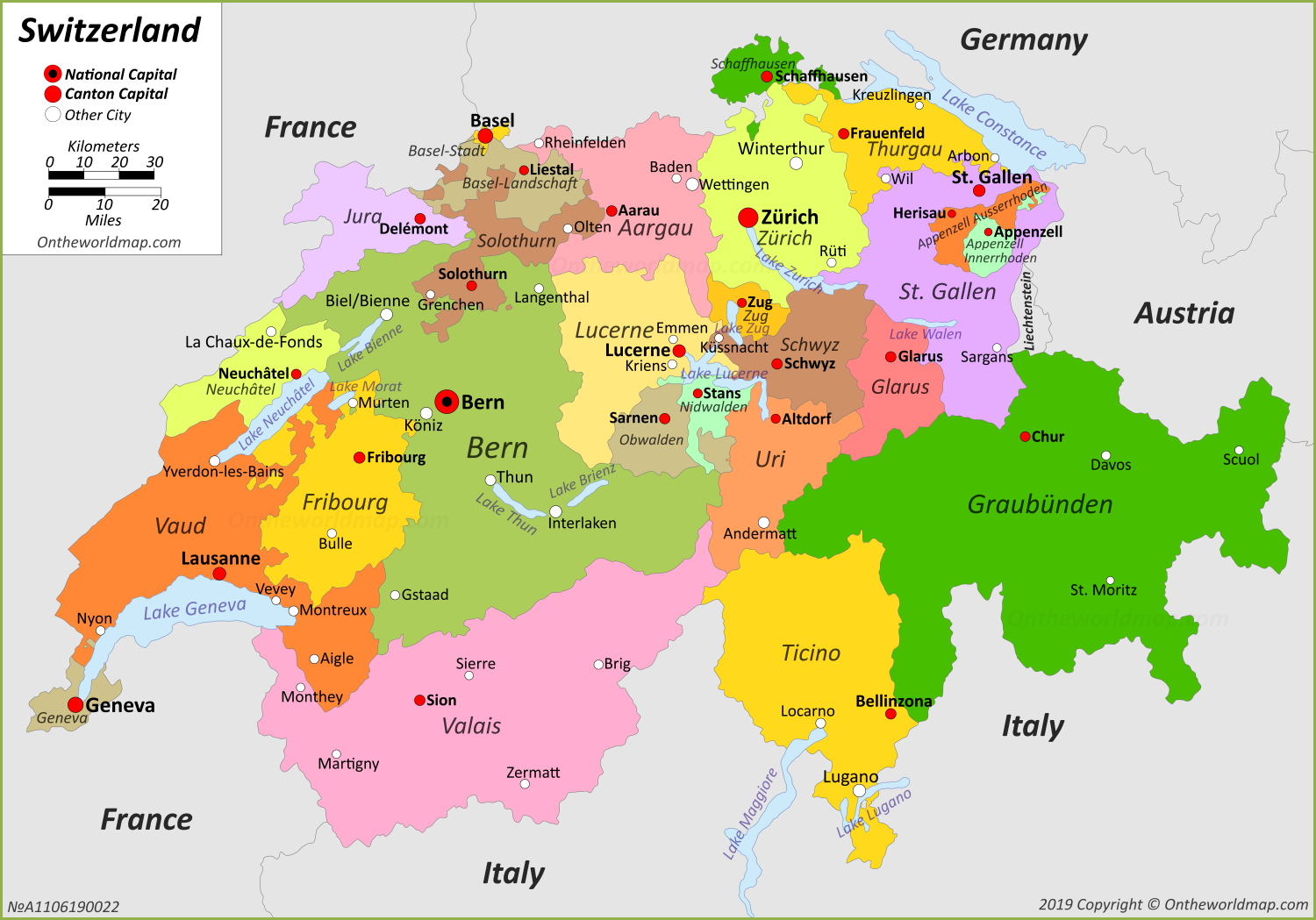
Switzerland, officially the Swiss Confederation, is a landlocked country located at the intersection of Central, Western, and Southern Europe. It is bordered by Germany to the north, France to the west, Austria and Liechtenstein to the east, and Italy to the south. Switzerland is geographically divided among the Swiss Alps, the Swiss Plateau, and the Jura Mountains; the Alps cover most of the country's territory, whereas the majority of its 9 million people are concentrated on the plateau, which hosts many of the largest cities and economic centres, including Zurich, Geneva, Basel, Bern, Lausanne, Winterthur, and Lucerne.
Switzerland is a federal republic composed of 26 cantons, with Bern serving as the federal city and the seat of the national government. The country encompasses four principal linguistic and cultural regions—German, French, Italian, and Romansh—reflecting a long-standing tradition of multilingualism and cultural pluralism. Swiss national identity nonetheless remains fairly cohesive, rooted in a shared historical background, common values such as federalism and direct democracy, and Alpine symbolism. Swiss nationhood transcends language, ethnicity, and religion, leading to Switzerland being described as a Willensnation ("nation of volition") rather than a conventional nation state.
The country originates from the Old Swiss Confederacy established in the Late Middle Ages as a defensive and commercial alliance; the Federal Charter of 1291 is considered the country's founding document. The confederation steadily expanded and consolidated despite external threats and internal political and religious strife. Swiss independence from the Holy Roman Empire was formally recognized in the Peace of Westphalia in 1648. The confederation was among the first and few republics of the early modern period, and the only one besides San Marino to survive the Napoleonic Wars. Switzerland remained a network of self-governing states until 1798, when revolutionary France invaded and imposed the centralist Helvetic Republic. Napoleon abolished the republic in 1803 and reinstated a confederation. Following the Napoleonic Wars, Switzerland restored its pre-revolutionary system, but by 1830 faced growing division and conflict between liberal and conservative movements; this culminated in a new constitution in 1848 that established the current federal system and enshrined principles such as individual rights, separation of powers, and parliamentary bicameralism.
Switzerland has maintained a policy of armed neutrality since the 16th century and has not fought an international war since 1815. It joined the Council of Europe in 1964 and the United Nations (UN) in 2002, pursuing an active foreign policy that includes frequent involvement in peace building and global governance. Switzerland is the birthplace of the Red Cross and hosts the headquarters or offices of most major international institutions, including the WTO, the WHO, the ILO, FIFA, the WEF, and the UN. It is a founding member of the European Free Trade Association (EFTA) and participates in the European single market and the Schengen Area. Switzerland is among the world's most developed countries, with the highest nominal wealth per adult and the eighth-highest gross domestic product (GDP) per capita. It performs highly on several international metrics, including economic competitiveness, democratic governance, and press freedom. Zurich, Geneva and Basel rank among the highest in quality of life, albeit with some of the highest costs of living. Switzerland has a longstanding banking and financial sector, advanced pharmaceutical and biotechnology industries, and a strong tradition of watchmaking, precision engineering, and technology. It is known for its chocolate and cheese production, well-developed tourism industry, and growing startup sector.
Details
Switzerland is a federated country of central Europe. Switzerland’s administrative capital is Bern, while Lausanne serves as its judicial center. Switzerland’s small size—its total area is about half that of Scotland—and its modest population give little indication of its international significance.
A landlocked country of towering mountains, deep Alpine lakes, grassy valleys dotted with neat farms and small villages, and thriving cities that blend the old and the new, Switzerland is the nexus of the diverse physical and cultural geography of western Europe, renowned for both its natural beauty and its way of life. Aspects of both have become bywords for the country, whose very name conjures images of the glacier-carved Alps beloved of writers, artists, photographers, and outdoor sports enthusiasts from around the world.
For many outsiders, Switzerland also evokes a prosperous if rather staid and unexciting society, an image that is now dated. Switzerland remains wealthy and orderly, but its mountain-walled valleys are far more likely to echo the music of a local rock band than a yodel or an alphorn. Most Swiss live in towns and cities, not in the idyllic rural landscapes that captivated the world through Johanna Spyri’s Heidi (1880–81), the country’s best-known literary work. Switzerland’s cities have emerged as international centers of industry and commerce connected to the larger world, a very different tenor from Switzerland’s isolated, more inward-looking past. As a consequence of its remarkably long-lived stability and carefully guarded neutrality, Switzerland—Geneva, in particular—has been selected as headquarters for a wide array of governmental and nongovernmental organizations, including many associated with the United Nations (UN)—an organization the Swiss resisted joining until the early 21st century.
Switzerland’s rugged topography and multicultural milieu have tended to emphasize difference. People living in close proximity may speak markedly distinct, sometimes nearly mutually unintelligible dialects of their first language, if not a different language altogether. German, French, Italian, and Romansh all enjoy national status, and English is spoken widely. Invisible lines separate historically Protestant from historically Roman Catholic districts, while the tall mountains of the St. Gotthard Pass separate northern from southern Europe and their diverse sensibilities and habits. Yet, Switzerland has forged strength from all these differences, creating a peaceful society in which individual rights are carefully balanced against community and national interests.
Switzerland was formed in 1291 by an alliance of cantons against the Habsburg dynasty—the Confoederatio Helvetica (or Swiss Confederation), from which the abbreviation CH for Switzerland derives—though only in 1848, when a new constitution was adopted, was the present nation formed. Prior to 1848, internal conflict was quite common, but Switzerland has enjoyed relative domestic tranquility since the mid-19th century, and its organization has remained essentially the same: it is a union of more than 3,000 communes, or municipalities, situated in 26 cantons, six of which are traditionally referred to as demicantons (half cantons) but function as full cantons. Ordinary citizens are able to participate at every level of politics and regularly exercise their will in referenda and initiatives, through which Swiss citizens directly make numerous policy decisions at the national and subnational levels. Two effects of this popular involvement are evident: Swiss taxes are rather low by European standards, because voters are able to review and approve a broad range of expenditures, and political decision making tends to be slow, because contending individual claims and opinions must be allowed to be expressed at every step.
That high level of citizen involvement prompted the renowned 20th-century Swiss playwright and ironist Friedrich Dürrenmatt to allegorize Switzerland as a prison in which each Swiss citizen was at the same time prisoner and guard. Even so, the Swiss blend of federalism and direct democracy is unique in the world and is considered central to the country’s political and economic success. And Switzerland is indeed a major economic power, thanks to its long tradition of financial services and high-quality, specialized manufactures of items such as precision timepieces, optics, chemicals, and pharmaceuticals, as well as of specialty foodstuffs such as Emmentaler cheese and milk chocolate. Switzerland is regularly judged to have among the world’s highest standards of living.
Bern is a placid city whose name derives from the bear pits the canton’s medieval rulers established there as a heraldic symbol; the bear pits are now part of the city’s popular zoo. A metropolis extending along a large lake where the mountains meet the plains, Zürich is by far the country’s largest and most cosmopolitan city, its famed Bahnhofstrasse rivaling shopping districts found in other leading cities in the world. Basel and Lucerne are major German-speaking cities, Geneva and Lausanne the centers of the country’s French-speaking cantons, and Bellinzona and Lugano the principal cities in the Italian-speaking Ticino.
Switzerland has long been a model multiethnic, multilingual society, a place in which diverse peoples can live in social harmony and unite in common interest.
Land
Switzerland is bordered to the west by France, to the north by Germany, to the east by Austria and Liechtenstein, and to the south by Italy. It extends about 135 miles (220 km) from north to south and 220 miles (350 km) at its widest extent from west to east. Switzerland’s landscape is among the world’s most unusual, and it has long had to contend with a variety of environmental problems that threaten its integrity. Economic development and high population density have caused severe environmental stress, resulting in pollution and debates over the use of natural resources. During the 1970s and ’80s, ambitious environmental policies were implemented by the cantons and municipalities, and this led to impressive progress on pollution abatement. For example, air-pollution emissions in Switzerland are among the lowest in industrialized countries.
Relief and drainage
Situated at the hydrographic center of Europe, Switzerland is the source of many major rivers. The two most important are the Rhône, which flows into the Mediterranean Sea, and the Rhine, which empties into the North Sea. Switzerland’s small area contains an unusual diversity of topographic elements, which are divisible into three distinct regions: the Jura Mountains in the northwest, the Alps to the south and east, and the Mittelland, or central plateau, between the two mountain ranges.
The Jura (Celtic: “Forest”), a rolling mountain range in the northwest, occupies about one-eighth of the country. The region was formed under the extended impact of the general Alpine folding, which created the folded Jura that abuts the Mittelland and the tabular plateau Jura that forms the northern edge of the range. Jurassic limestone and marl with rich fossil content are the characteristic rocks that dip below the Mittelland and appear again in the pre-Alps. The limestone has been eroded in typical karst fashion, with sinkholes, caves, and underground drainage common. The ridges, covered with meadows and only sparsely forested, receive more precipitation than do the valleys, the slopes of which are wooded. Between Saint-Imier Valley (Vallon St. Imier) and the Doubs, a river that forms part of the border with France, the Jura has been reduced by denudation to form an undulating plateau that extends into France. Known as the Franches Montagnes (French: “Free Mountains”), a name acquired in 1384 when the bishop of Basel freed the inhabitants from taxation to encourage settlement of the remote area, this tableland is characterized by mixed agriculture and dairying. The highest point in the Jura, Monte Tendre, at about 5,500 feet (1,700 meters), is well below the Alps; indeed, the Jura was not a significant barrier to surface movement even before modern railroads and highways were constructed. Entrenched transverse valleys known as cluses have been eroded across the Jura ridges, providing relatively easy routes for transportation. The climate of the Jura, which has abundant precipitation, is the most continental of Switzerland; cross-country skiing is popular during the long winters. Switzerland’s watchmaking industry had its beginning in these mountains.
The Alps were built of large complexes of massed overthrusts of extremely varied sedimentary, metamorphic, and igneous rocks that were shaped by glaciation. The canton of Valais contains many striking Alpine peaks, including the Dufourspitze on the Monte Rosa massif, at 15,203 feet (4,634 meters) the highest point in Switzerland; the Weisshorn (14,780 feet [4,405 meters]), overlooking the valley called the Mattertal; the Dom (14,912 feet [4,545 meters]), above the village of Saas Fee; and the ice-sculpted Matterhorn (14,691 feet [4,478 meters]), long a symbol of Switzerland. The northern and southern Swiss Alps are separated by the trough formed by the Rhône and upper Rhine valleys, the narrowest portion being the Urseren valley, which lies between two crystalline central massifs, the Gotthard and the Aare.
The Alps’ role as the European watershed is most apparent in the central Alpine region of Switzerland, where the different chains meet; from there the Rhône River flows west, the Rhine River east, the Ticino River south to the Po River, and the Reuss River north to the Aare. The fundamental Alpine source point, however, is located in the upper Engadin valley at the Piz Lunghin, from which streams flow toward the North and Adriatic seas and from which the headwaters of the Inn River flow toward the Danube and ultimately into the Black Sea.
The country’s geographically destined role as guardian of Europe’s natural trans-Alpine routes has been both a reason for and a basic tenet of its existence—a role expressed in its traditional neutrality in times of war. In the central Alpine region lies the St. Gotthard route, the first and shortest north-south passage through the mountains and an important European linkage; it was opened in the early 13th century with the construction of a bridge in the Schöllenen Gorge, which traverses the northern chain, while the southern range is crossed by the St. Gotthard Pass at an elevation of 6,916 feet (2,108 meters). The 9-mile (14-km) St. Gotthard rail tunnel through the pass was opened in 1882; a twin 10.5-mile (17-km) road tunnel was opened in 1980.
Despite the tunnels, increasing rail and highway traffic often resulted in long delays through the mountains. For example, on weekends during the peak summer tourist season, cars and trucks were often backed up some 10 to 15 miles (16 to 25 km). To address this congestion, in 1992 Swiss voters approved the construction of a massive 35-mile (57-km) rail tunnel well beneath the existing St. Gotthard tunnels. Primary excavation was completed in 2010, and upon its official opening in June 2016, the Gotthard Base Tunnel was the longest and most deeply set rail tunnel in the world. Because the tunnel was excavated at virtually zero-grade, it could accommodate high-speed trains that would slash travel times between northern and southern Europe and reduce traffic-choked-up Alpine roads.
Between the Jura and main Alpine ranges lies the hilly Mittelland, accounting for nearly one-fourth of the country and enclosed by the two mountain ranges and the two largest lakes, Lake Geneva (Lac Léman) in the west and Lake Constance (Bodensee) in the east. The fertile rolling land of the Mittelland is the agricultural heartland of the country and is where the majority of Swiss settlements, population, and industry are situated. Furthermore, vital east-west highway and rail routes bind the urban areas. As a result, the Mittelland is highly urbanized, with large chunks of land sterilized by shopping centers, housing estates, motorways, oil-storage tanks, container depots, warehouses, automobile distribution centers, and industrial complexes.
Soils
Soil conditions and agriculture reflect the diversity of Switzerland’s climate and geologic structure. The major soil groups consist of gray-brown podzolic soils and brown forest soils, loess, glacial drift, and alluvium in the Mittelland; brown forest soils, rendzinas, and the heavier glacial clays in the Jura valleys; and the lithosol and podzolized soils of the high Alps.
Climate of Switzerland
Four major European climates affect Switzerland. From the west, influenced by the North Atlantic Drift, come mild and moist air masses; dry and cold air arrives from the North Arctic areas; continental air from the east brings dry colder air in winter and warmer air in summer; and relatively moist and warm air flows northward from the Mediterranean. The mixing of these air masses over Switzerland produces weather patterns that not only change according to which air masses are involved but also are characterized by great variation in temperature and precipitation because of local relief.
Wind systems
Prevailing winds are mainly from the west, but in valleys air currents are channeled into particularly frequent or violent local winds such as the Bise, a cold northeast wind that sweeps across the Mittelland and funnels down Lake Geneva to the city of Geneva. Foehn (German: Föhn) winds, which are associated with the leading edge of a low-pressure system moving across Europe north of Switzerland, often blow for one or two days; though they may occur anytime during the year, they are most frequent in spring. Sudden temperature increases occur because the foehn, which crosses the Alps from south to north (it can also blow from north to south, affecting Ticino), cools at a slower rate rising over the mountains because of precipitation; it is then heated and dried as it descends down the northern valleys, thereby moderating the climate on the northern slopes of the Alps.
Precipitation
Since rainfall tends to increase in direct proportion to altitude, precipitation varies according to relief. Thus, because of the marked variation in relief that characterizes Switzerland, differences in precipitation within short linear distances are often very great. For example, Sankt Gallen (St. Gall), at 2,556 feet (779 meters), has an average annual precipitation of about 50 inches (1,300 mm), while precipitation at Säntis, at an elevation of 8,202 feet (2,500 meters) but only some 12 miles (20 km) away, is more than 110 inches (2,800 mm). The average annual precipitation of three-fourths of the country exceeds 40 inches (1,000 mm), varying amounts of which fall as snow. In Lugano (at 896 feet [273 meters]), which is located in the canton of Ticino in the southeast and has a modified Mediterranean climate, little precipitation is in the form of snow; in Zürich (at 1,824 feet [556 meters]) about one-tenth is snow; and on the Säntis nearly three-fourths is snow. At elevations above 11,500 feet (3,500 meters), all precipitation is in the form of snow, which compacts into perpetual snowfields and glaciers; the snow line is at about 9,200 feet (2,800 meters) in the northern Alps and about 10,800 feet (3,300 meters) in the southern Alps of the Valais.
Dry areas
There are distinct dry pockets in the mountains of Switzerland’s interior. The best-known dry area is the Rhône valley in the Valais, which is closely encircled by the highest (13,000 feet [4,000 meters]) mountain groups. Although precipitation is slight on the slopes near the cantonal capital of Sion (at 1,581 feet [482 meters]), extensive irrigation is possible, since the valley is surrounded by large snowfields and by glaciers that extend down the upper valleys. The rarefied and dry though somewhat polluted air of such high-altitude towns as Davos (5,216 feet [1,590 meters]) and Arosa (5,987 feet [1,825 meters]) permits a more intense, broader-spectrum solar irradiation and thus produces a climate famous in the past for tuberculosis cures. Today the climate attracts skiers as well as tourists seeking an escape from the polluted air of lowland Europe. At elevations of 13,000 feet (4,000 meters), precipitation levels rise to some 160 inches (4,000 mm), and the Mönch (13,448 feet [4,099 meters]) in the Jungfrau group of mountains has the highest average annual precipitation in Switzerland, 163 inches (4,140 mm), while Stalden in the entrenched Vispa valley, 4 miles (6 km) south of the main Rhône valley, has the lowest, 21 inches (533 mm).
Skies and temperatures
The stable high-pressure weather conditions prevailing over central Europe and the Alps during autumn and winter create cold air masses that result in lowland fog, a climatic phenomenon with widely varying consequences. The mouths of the northern Alpine valleys, the basins of the Jura Mountains, and the villages and cities of the low areas of the Mittelland are blanketed for days and often for weeks on end, while towns located at higher altitudes enjoy warm, brilliant, high-pressure conditions and the view of the glistening sea of fog below them. Temperature inversions between mountain and valley locations in close proximity can be quite pronounced, with higher elevations having higher temperature readings. Frequent temperature inversion has made Switzerland’s high-altitude resorts healthful places even during winter and has helped the Alpine winter season gain popularity in Europe for sports; in addition, because of these inversions polluted air is much less common in areas of high elevation than in the lowlands. In fact, the temperature inversions that affect the Mittelland tend to trap polluted air for weeks when cyclonic activity stagnates.
Avalanches
With the increase in winter tourism, the study of avalanches has developed as a branch of Alpine climatology, and in wintertime the research station near Davos releases daily avalanche bulletins as a warning for villagers and tourists. The Alpine cantons have about 10,000 avalanches annually, with about four-fifths of them occurring in February, March, and April. For centuries, village communes have relied on forests on the mountain slopes for protection from these slides, because a 20- to 30-year-old forest can inhibit or stop small avalanches. Villages, highways, and Alpine paths are also protected by costly artificial structures such as metal barriers, earthen walls, and concrete wedges and enclosures. However, in the late 20th century, acid rain caused the illness and death of many trees in the mountain areas of Switzerland and posed a serious threat to their ability to act as barriers to avalanches. In the mountain forests, some two-fifths of the trees were classified as damaged, sick, or dying. Pollution-control legislation across Europe did much to reduce the harmful effects of acid rain in Switzerland, and a concerted effort was made by Swiss land managers to introduce healthy trees into unused Alpine pastureland and to increase the density of existing Alpine forests. By the early 21st century, avalanche-control forests had become healthier and denser, especially at higher elevations and in steeper terrain.
Plant and animal life:
Vegetation
Vegetation in Switzerland is derived from that of the four European climatic regions that converge in the country and has been influenced by the varied relief. It includes the beeches and oaks of the maritime west; hornbeam and larch trees in the more continental east, predominantly in the Engadin and the dry Valais; extensive spruce forests in the northern subalpine region; and chestnut groves in the south. Differences in vegetation are evident in the Alpine valleys because of exposure to the sun. The vegetation boundaries are several hundred feet higher in the south of the country—for example, in Valais—than in the north because of the southern exposure. Alpine vegetation, similar to that of Arctic tundra, prevails above the tree line. It is very susceptible to erosion through skiing impacts and as a result of paths or four-wheel-drive trails cut into the slopes.
Animal life
Switzerland’s animal life is primarily Alpine, but a mixture of species familiar to southern and north-central Europe is also found. Animal life is protected, except during a brief annual hunting season. Alpine tourists may observe marmots, which live in the high meadows, and chamois. Large herds of the round ibex, which had died out in the Swiss Alps and has since been reintroduced, populate several areas, especially in the Bernina region of Graubünden (canton) and in the Saastal of Valais. In the forests there are deer, rabbits, foxes, badgers, squirrels, and many varieties of birds, including eagles, while lake and river trout may be found but are no longer as abundant as in the past. Snakes and lizards are concentrated in the south, but insects, in great variety, are diffused throughout the country.
Additional Information
Switzerland is a small mountainous country located in central Europe. This landlocked country is about the size of New Jersey and is between France and Italy. It is also bordered by Austria, Germany, and Liechtenstein.
Most of the population lives in the plateau which is between the high Alps in the south and the Jura mountains in the north. The mountainous area in the south is sparsely populated.
People and Culture
Switzerland is one of the world’s wealthiest countries. The Swiss are well known for their watches and clocks.
There is not a single official language in Switzerland. People speak one of several languages, including Swiss German, French, and Italian.
Nature
The Swiss Alps are high, snow-covered mountains most of which are over 13,000 feet (4,000 meters). The most famous peak is the Matterhorn which is 14,692 feet (4,478 meters) tall, but the highest peak is Dufourspitze at 15,203 feet (4,634 meters).
Scientists are concerned that glaciers in the Swiss Alps have lost a lot of ice coverage in the past 40 years. This may be related to global climate change. Rapid melting of the glaciers could cause flooding to the villages below.
Most animals in Switzerland live in the mountains. The ibex, a species of mountain goat, was hunted to near extinction in the early 1800s. The species has since been reintroduced and more than 15,000 ibex now live in the Swiss Alps. Hikers may also encounter chamois, another goatlike animal, and marmots. The forests of Switzerland are also home to deer, rabbits, foxes, badgers, squirrels, and many bird species.
Government
The country is made up of 26 cantons or states, which form the confederation. The leader of the government is the president. Both the president and vice president are elected by the Federal Assembly from the Federal Council. They serve a one-year term. Elections are usually held in December.
Representatives of the cantons are elected to the assembly for four-year terms.
History
Switzerland was formed in 1291 as a union of three states and became an independent country in 1815. The constitution, adopted in 1848, does not allow for troops to be sent to serve in foreign wars. The country has remained neutral in conflicts around the world, including both world wars.
Switzerland did not become a member of the United Nations until 2002, and is not a member of the European Union.
It appears to me that if one wants to make progress in mathematics, one should study the masters and not the pupils. - Niels Henrik Abel.
Nothing is better than reading and gaining more and more knowledge - Stephen William Hawking.
Offline
Pages: 1