Math Is Fun Forum
You are not logged in.
- Topics: Active | Unanswered
Pages: 1
#1 2026-02-17 16:51:08
- Jai Ganesh
- Administrator

- Registered: 2005-06-28
- Posts: 53,903
Convex Mirror
Convex Mirror
Gist
A convex mirror is a spherical mirror with a reflecting surface that bulges outwards, causing it to diverge light rays and provide a wider field of view, making it ideal for rearview mirrors and security surveillance where it forms upright, virtual, and diminished (smaller) images.
Convex mirrors are used as rear-view mirrors in vehicles because they provide a wider field of view. This helps drivers see more traffic and reduces blind spots, improving safety on roads. Key reasons include: Forming erect, virtual, and diminished images.
Summary
Convex Mirror is a curved mirror where the reflective surface bulges out toward the light source. This bulging-out surface reflects light outwards and is not used to focus light. These mirrors form a virtual image as the focal point (F), and the centre of curvature (2F) are imaginary points in the mirror that cannot be reached. This results in the formation of images that cannot be projected on a screen as the image is inside the mirror. The image looks smaller than the object from a distance but gets larger as the object gets closer to the mirror.
Uses of Convex Mirror
* Convex mirrors are often used in buildings’ hallways, including stores, schools, hospitals, hotels and apartment buildings.
* They are used in driveways, roads, and alleys to provide safety to all the bikers and motorists at curves and turns and other places where there is a lack of visibility.
* They are also used in some automated teller machines as a handy security feature that allows users to see what is happening behind them.
* They are used in the passenger side mirror on a car, and somewhere it is labelled as “ objects in mirror are closer than they appear” to warn the driver.
Details
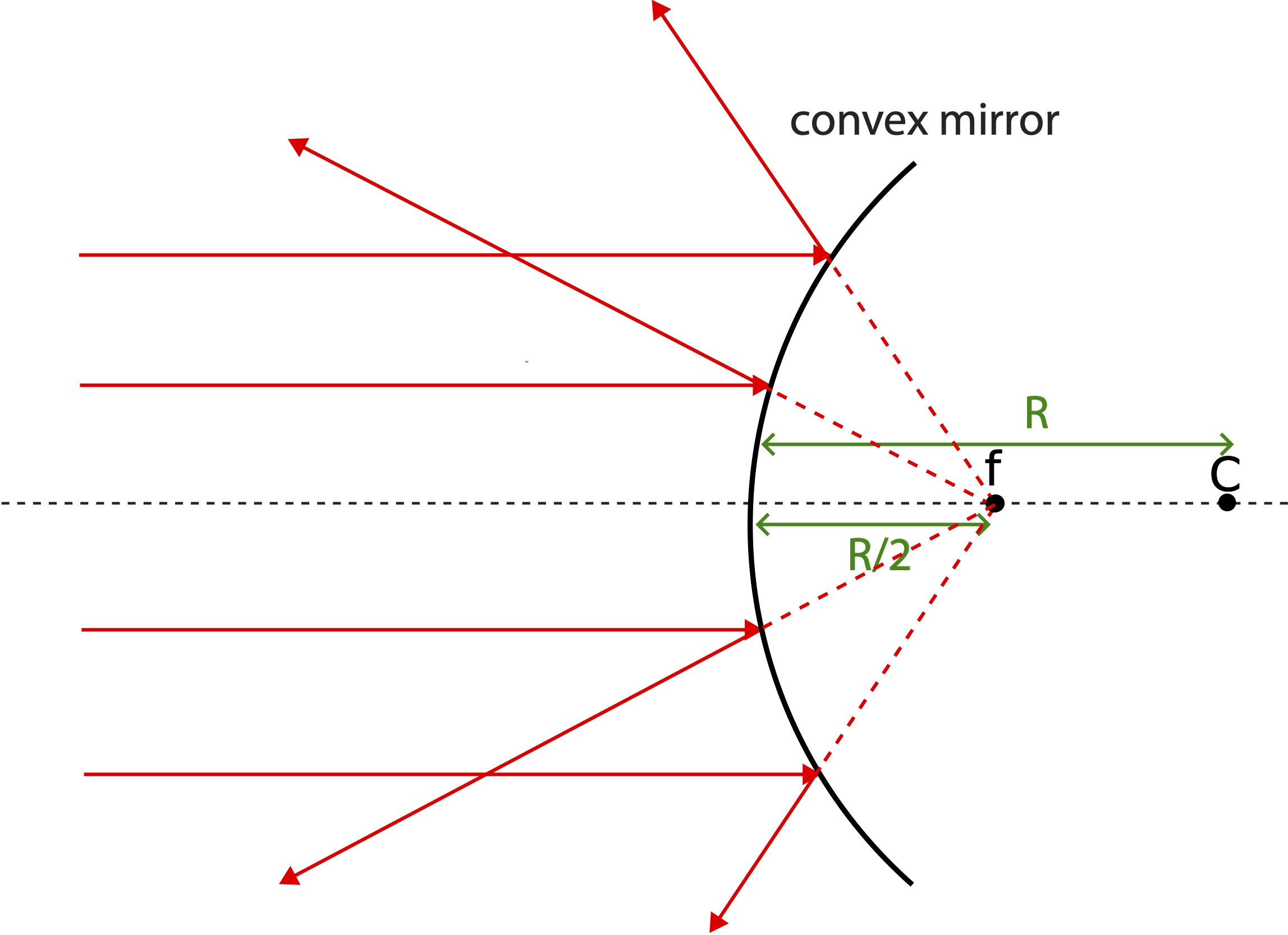
A convex mirror or diverging mirror is a curved mirror in which the reflective surface bulges towards the light source. Convex mirrors reflect light outwards, therefore they are not used to focus light. Such mirrors always form a virtual image, since the focal point (F) and the centre of curvature (2F) are both imaginary points "inside" the mirror, that cannot be reached. As a result, images formed by these mirrors cannot be projected on a screen, since the image is inside the mirror. The image is smaller than the object, but gets larger as the object approaches the mirror.
A collimated (parallel) beam of light diverges (spreads out) after reflection from a convex mirror, since the normal to the surface differs at each spot on the mirror.
Uses
The passenger-side mirror on a car is typically a convex mirror. In some countries, these are labeled with the safety warning "Objects in mirror are closer than they appear", to warn the driver of the convex mirror's distorting effects on distance perception. Convex mirrors are preferred in vehicles because they give an upright (not inverted), though diminished (smaller), image and because they provide a wider field of view as they are curved outwards.
These mirrors are often found in the hallways of various buildings (commonly known as "hallway safety mirrors"), including hospitals, hotels, schools, stores, and apartment buildings. They are usually mounted on a wall or ceiling where hallways intersect each other, or where they make sharp turns. They are useful for people to look at any obstruction they will face on the next hallway or after the next turn. They are also used on roads, driveways, and alleys to provide safety for road users where there is a lack of visibility, especially at curves and turns.
Convex mirrors are used in some automated teller machines as a simple and handy security feature, allowing the users to see what is happening behind them. Similar devices are sold to be attached to ordinary computer monitors. Convex mirrors make everything seem smaller but cover a larger area of surveillance.
Round convex mirrors called Oeil de Sorcière (French for "sorcerer's eye") were a popular luxury item from the 15th century onwards, shown in many depictions of interiors from that time. With 15th century technology, it was easier to make a regular curved mirror (from blown glass) than a perfectly flat one. They were also known as "bankers' eyes" because their wide field of vision was useful for security. Famous examples in art include the Arnolfini Portrait by Jan van Eyck and the left wing of the Werl Altarpiece by Robert Campin.
Image
The image on a convex mirror is always virtual (rays haven't actually passed through the image; their extensions do, like in a regular mirror), diminished (smaller), and upright (not inverted). As the object gets closer to the mirror, the image gets larger, until approximately the size of the object, when it touches the mirror. As the object moves away, the image diminishes in size and gets gradually closer to the focus, until it is reduced to a point in the focus when the object is at an infinite distance. These features make convex mirrors very useful: since everything appears smaller in the mirror, they cover a wider field of view than a normal plane mirror, so useful for looking at cars behind a driver's car on a road, watching a wider area for surveillance, etc.
Additional Information:
Introduction
A mirror is a smooth surface that shows images of the objects near it. Most mirrors are a sheet of glass with a shiny metallic coating on the back.
Reflection
The appearance of an image in a mirror is called a reflection. Reflection happens when light hits a surface. If the light cannot pass through the surface, it bounces off, or reflects. Most surfaces absorb some light and reflect some light. Mirrors, however, reflect almost all the light that hits them. The metallic coating on the back causes the reflection.
When you stand in front of a mirror, your body reflects patterns of light to the mirror. Those patterns of light bounce off the mirror and go back to your eyes. Your brain then interprets, or reads, the patterns of light as an image of yourself in the mirror.
Types of Mirrors
Most mirrors are flat. They are called plane mirrors. Images in a plane mirror are reversed. For example, if you raise your right hand while looking in a mirror, you will appear to raise your left hand. People use plane mirrors to check their appearance.
Other mirrors are curved. Convex mirrors curve outward, like a dome. They make objects appear reversed and smaller than their actual size. Concave mirrors curve inward, like a bowl. At a distance, they make objects appear upside down. Nearby, however, objects appear right side up and larger than their actual size.
How Mirrors Are Made
Mirrors are made in factories with special machinery. First, a sheet of glass is polished smooth and cleaned. Next, the back of the glass is covered with a thin layer of silver, aluminum, or another metal. Then the metal is covered with copper, varnish, or paint to protect it from scratches.
It appears to me that if one wants to make progress in mathematics, one should study the masters and not the pupils. - Niels Henrik Abel.
Nothing is better than reading and gaining more and more knowledge - Stephen William Hawking.
Offline
Pages: 1