Math Is Fun Forum
You are not logged in.
- Topics: Active | Unanswered
Pages: 1
#1 2026-02-04 19:43:21
- Jai Ganesh
- Administrator

- Registered: 2005-06-28
- Posts: 53,843
Hovercraft
Hovercraft
Gist
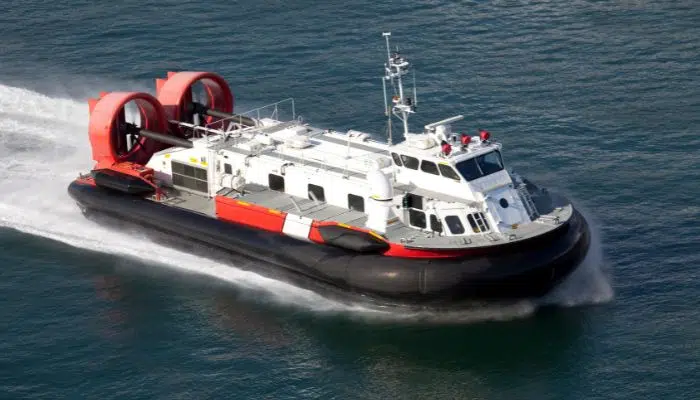
Hovercraft are used for rescue, commercial, military and paramilitary applications to transport, save and protect lives across the world's most challenging environments.
Hovercraft are actually more like planes than boats or cars, although they are more at home moving across water than flying down the runway at Birmingham! Hovercrafts use the same 'lift' physics that an aeroplane uses to fly, although you'll never really get that far off the ground to find out.
The highest recorded speed by a hovercraft is 137.4 km/h (85.38 mph), by Bob Windt (USA) at the 1995 World Hovercraft Championships on the Rio Douro River, Peso de Regua, Portugal.
Summary
A hovercraft (pl.: also hovercraft), also known as an air-cushion vehicle or ACV, is an amphibious craft capable of travelling over land, water, mud, ice, and various other surfaces.
Hovercraft use blowers to produce a large volume of air below the hull, or air cushion, that is slightly above atmospheric pressure. The pressure difference between the higher-pressure air below the hull and lower pressure ambient air above it produces lift, which causes the hull to float above the running surface. For stability reasons, the air is typically blown through slots or holes around the outside of a disk- or oval-shaped platform, giving most hovercraft a characteristic rounded-rectangle shape.
The first practical design for hovercraft was derived from a British invention in the 1950s. They are now used throughout the world as specialised transports in disaster relief, coastguard, military and survey applications, as well as for sport or passenger service. Very large versions have been used to transport hundreds of people and vehicles across the English Channel, whilst others have military applications used to transport tanks, soldiers and large equipment in hostile environments and terrain. Decline in public demand meant that as of 2025, only two year-round public hovercraft service in the world are still in operation: Hovertravel, which serves between the Isle of Wight and Southsea in the UK, and Oita Hovercraft resumed services in Oita, Japan in July 2025.
Although now a generic term for the type of craft, the name Hovercraft itself was a trademark owned by Saunders-Roe (later British Hovercraft Corporation (BHC), then Westland), hence other manufacturers' use of alternative names to describe the vehicles.
Details
One part boat, one part airplane, and one part helicopter a hovercraft is a vehicle that traps a cushion of air underneath itself and then floats along on top of it. The air cushion holds it high above waves and land obstructions, making the craft superbly amphibious (equally capable of traveling on land or water or gliding smoothly from one to the other). That's why military hovercraft, designed for swift beach landings, are often called LCACs (Landing Craft Air Cushion).
Hovercraft come in all shapes and sizes, from one-person fun machines and small beach rescue craft to giant passenger ferries capable of carrying over 400 passengers and 50 cars. Where boats are slowed by hulls that drag deep in the water, hovercraft ride fully clear, which means they use less fuel and can reach blistering speeds of up to 145kph (90mph). From ice and water to mud and sand, from floodplains and river deltas to mangrove swamps and frozen glaciers, the great advantage of a hovercraft is that it can glide with ease to places ordinary boats struggle to reach, and land people safely even where there are no harbors or landing stages.
In practice, hovercraft have four broad applications: large commercial hovercraft are mostly used as high-speed people and car ferries; slightly smaller military LCACs are used as tried-and-tested beach landing craft; smaller niche craft are used for things like oil and gas prospecting, inshore search and rescue, and scientific surveys; and small, one-person recreational craft are often raced round courses like flying go-karts!
How does a hovercraft work?
At first sight, you might think a hovercraft works in much the same way as a helicopter: it throws air down underneath itself and then simply rides along on top. But where a helicopter balances its own weight (the force of gravity pulling it down) with a massive down-draft of air (pushing it back up again), a hovercraft works in a much more subtle way that allows it to use far less air, far more efficiently, so getting by with a much smaller engine and considerably less fuel.
The basic mechanism of a hovercraft is very simple: there's an engine (diesel or gasoline) that powers both a large central fan, pointing downward, and one or more other fans pointing backward. The central fan creates the lift that holds the craft above the waves; the other fans propel the craft backward, forward, or to the side. A rubber skirt (with or without fingers) traps a cushion of air under the craft. Side-wall hovercraft have only partial skirts: with solid sides and a skirt only at the front and back, they can be powered by quieter propellers or water-jet engines, making them quieter.
Other important parts
What else do you need to make a hovercraft? A downward-pointing fan can only blow air underneath, so hovercraft typically have one or more propeller fans on top of the hull, pointing backward to propel them forward. Usually, there's a rudder positioned just behind each fan to swivel the air it produces and steer the hovercraft in the appropriate direction. An alternative method of steering is to divert some of the down-draft from the fan through air nozzles that point horizontally—and the very first hovercraft prototype, SR.N1, effectively worked this way. Although hovercraft usually have separate fans (to create the cushion) and propellers (to drive them along), the same engines typically drive both, using gearboxes and transmissions to turn the engine's power through ninety degrees. Bigger hovercraft like the US military LCACs typically use several very hefty engines, such as powerful gas turbines. Then there's the hull itself. Most large hovercraft are built from light, rustproof, and highly durable aluminum, though hobby craft are often molded from tough composite materials such as fiber glass. Finally, you need a math to keep your pilot safe and sound—and some cargo space (either enclosed, for passengers and cars, or a large "open well" deck for carrying military cargo).
Advantages and disadvantages
Hovercraft can launch and land anywhere, travel over almost any kind of surface, race along at high speeds, and efficiently carry large numbers of passengers and equipment or hefty military cargos. They compare favorably with all kinds of rival vehicles. Since they produce an air cushion more efficiently than a helicopter, they're cheaper to operate, simpler, and easier to maintain (safer too). Where boats waste energy dragging through water and waves, a hovercraft riding smoothly on top creates little in the way of either drag or wake, so it's generally more efficient (and less disruptive to the marine environment than a propeller-driven ship).
But if hovercraft are so wonderful, why aren't they used everywhere? They're expensive initially and, though cheaper than helicopters, considerably more costly to maintain than ships and boats of similar cargo capacity (because they're essentially aircraft, not boats, and mechanically more complex). Although hovercraft successfully carried tens of millions of people between Britain and France for just over 30 years, they eventually stopped operating following the opening of the Channel Tunnel and the arrival of low-cost ferry ships and fast, wave-piercing catamarans. Hovercraft are also fairly tricky to pilot: more like helicopters, in this respect, than simple-to-operate boats. They're very noisy too, which can be a problem both for passengers and people living near the ports where they operate, and is certainly a drawback for "covert" military operations.
Additional Information:
Objective
Investigate how different amounts of air in the hovercraft's balloon affect how long the hovercraft can hover.
Introduction
A hovercraft is a vehicle that glides over a smooth surface by hovering upon an air cushion. Because of this, a hovercraft is also called an Air-Cushion Vehicle, or ACV. How is the air cushion made? The hovercraft creates vents or currents of slow-moving, low-pressure air that are pushed downward against the surface below the hovercraft. Modern ACVs often have propellers on top that create the air currents. These currents are pushed beneath the vehicle with the use of fans. Surrounding the base of the ACV is a flexible skirt, also called the curtain, which traps the air currents, keeping them underneath the hovercraft. These trapped air currents can create an air cushion on any smooth surface, land or water! Since a hovercraft can travel upon the surface of water, it is also called an amphibious vehicle.
How does the air cushion beneath the hovercraft allow the vehicle to glide to freely? The key to the ease of movement is reducing friction. A simple way to think of friction is to think about how things rub together. It is easier to rollerblade on a smooth sidewalk than a gravel path because the sidewalk has less friction. The wheels of the rollerblade do not rub as much against the sidewalk as they do all the pieces of gravel on the path. Similarly, the air cushion beneath the hovercraft greatly reduces the friction of the vehicle, allowing it to glide freely upon the land or water below.
In this aerodynamics and hydrodynamics science project, you will build your own mini hovercraft using a CD or DVD, pop-top lid from a plastic drinking bottle, and a balloon. The balloon will create the air currents the hovercraft needs to work. These air currents will travel through the pop-top lid and go beneath the hovercraft. You will fill the balloon up with different amounts of air to test if more air will cause the hovercraft to travel for longer periods of time. A balloon blown up with a lot of air will provide a large volume of air, and a balloon blown up with less air will provide a smaller volume of air.
It appears to me that if one wants to make progress in mathematics, one should study the masters and not the pupils. - Niels Henrik Abel.
Nothing is better than reading and gaining more and more knowledge - Stephen William Hawking.
Offline
Pages: 1