Math Is Fun Forum
You are not logged in.
- Topics: Active | Unanswered
Pages: 1
#1 2026-02-02 16:41:05
- Jai Ganesh
- Administrator

- Registered: 2005-06-28
- Posts: 53,903
Stirrup/Stapes
Stirrup/Stapes
Gist
What is stirrup in the human body?
The stapes is the body's smallest bone! Sometimes called the stirrup, this delicate bone works with two others in the ear to send sound vibrations into the inner ear.
In medicine, "stirrup" most commonly refers to the stapes, the smallest bone in the human body, located in the middle ear, named for its resemblance to a horse's stirrup and vital for transmitting sound vibrations.
The stapes is one of three bones of the middle ear along with the malleus and incus. These three bones are collectively called auditory ossicles. They are primarily responsible for sound conduction from the tympanic membrane to the middle ear. The stapes is the smallest and the lightest bone of the human body.
Summary
The stapes is one of three bones of the middle ear along with the malleus and incus. These three bones are collectively called auditory ossicles. They are primarily responsible for sound conduction from the tympanic membrane to the middle ear.
The stapes is the smallest and the lightest bone of the human body. It is stirrup-shaped and composed of several parts including the head, neck, anterior limb, posterior limb and base.
The base of the stapes rests on the vestibular window of the inner ear, while its head articulates with the incus through the incudostapedial joint. The incudostapedial joint is a ball and socket type of synovial joint. The neck of the stapes serves as the attachment point for the stapedius muscle.
Details
The stapes or stirrup is a bone in the middle ear of humans and other tetrapods which is involved in the conduction of sound vibrations to the inner ear. This bone is connected to the oval window by its annular ligament, which allows the footplate (or base) to transmit sound energy through the oval window into the inner ear. The stapes is the smallest and lightest bone in the human body, and is so-called because of its resemblance to a stirrup (Latin: Stapes).
Structure
The stapes is the third bone of the three ossicles in the middle ear and the smallest in the human body. It measures roughly 2 to 3 mm, greater along the head-base span. It rests on the oval window, to which it is connected by an annular ligament and articulates with the incus, or anvil through the incudostapedial joint. They are connected by anterior and posterior limbs (Latin: crura).
Development
The stapes develops from the second pharyngeal arch during the sixth to eighth week of embryological development in humans. The central cavity of the stapes, the obturator foramen, is due to the presence embryologically of the stapedial artery, which usually regresses in humans during normal development.
Animals
The stapes is one of three ossicles in mammals. In non-mammalian tetrapods, the bone homologous to the stapes is usually called the columella; however, in reptiles, either term may be used. In fish, the homologous bone is called the hyomandibular, and is part of the gill arch supporting either the spiracle or the jaw, depending on the species. The equivalent term in amphibians is the pars media plectra.
Variation
The stapes appears to be relatively constant in size in different ethnic groups. In 0.01–0.02% of people, the stapedial artery does not regress, and persists in the central foramen. In this case, a pulsatile sound may be heard in the affected ear, or there may be no symptoms at all. Rarely, the stapes may be completely absent.
Function
Situated between the incus and the inner ear, the stapes transmits sound vibrations from the incus to the oval window, a membrane-covered opening to the inner ear. The stapes is also stabilized by the stapedius muscle, which is innervated by the facial nerve.
Clinical relevance
Otosclerosis is a congenital or spontaneous-onset disease characterized by abnormal bone remodeling in the inner ear. Often this causes the stapes to adhere to the oval window, which impedes its ability to conduct sound, and is a cause of conductive hearing loss. Clinical otosclerosis is found in about 1% of people, although it is more common in forms that do not cause noticeable hearing loss. Otosclerosis is more likely in young age groups, and females. Two common treatments are stapedectomy, the surgical removal of the stapes and replacement with an artificial prosthesis, and stapedotomy, the creation of a small hole in the base of the stapes followed by the insertion of an artificial prosthesis into that hole. Surgery may be complicated by a persistent stapedial artery, fibrosis-related damage to the base of the bone, or obliterative otosclerosis, resulting in obliteration of the base.
Additional Information
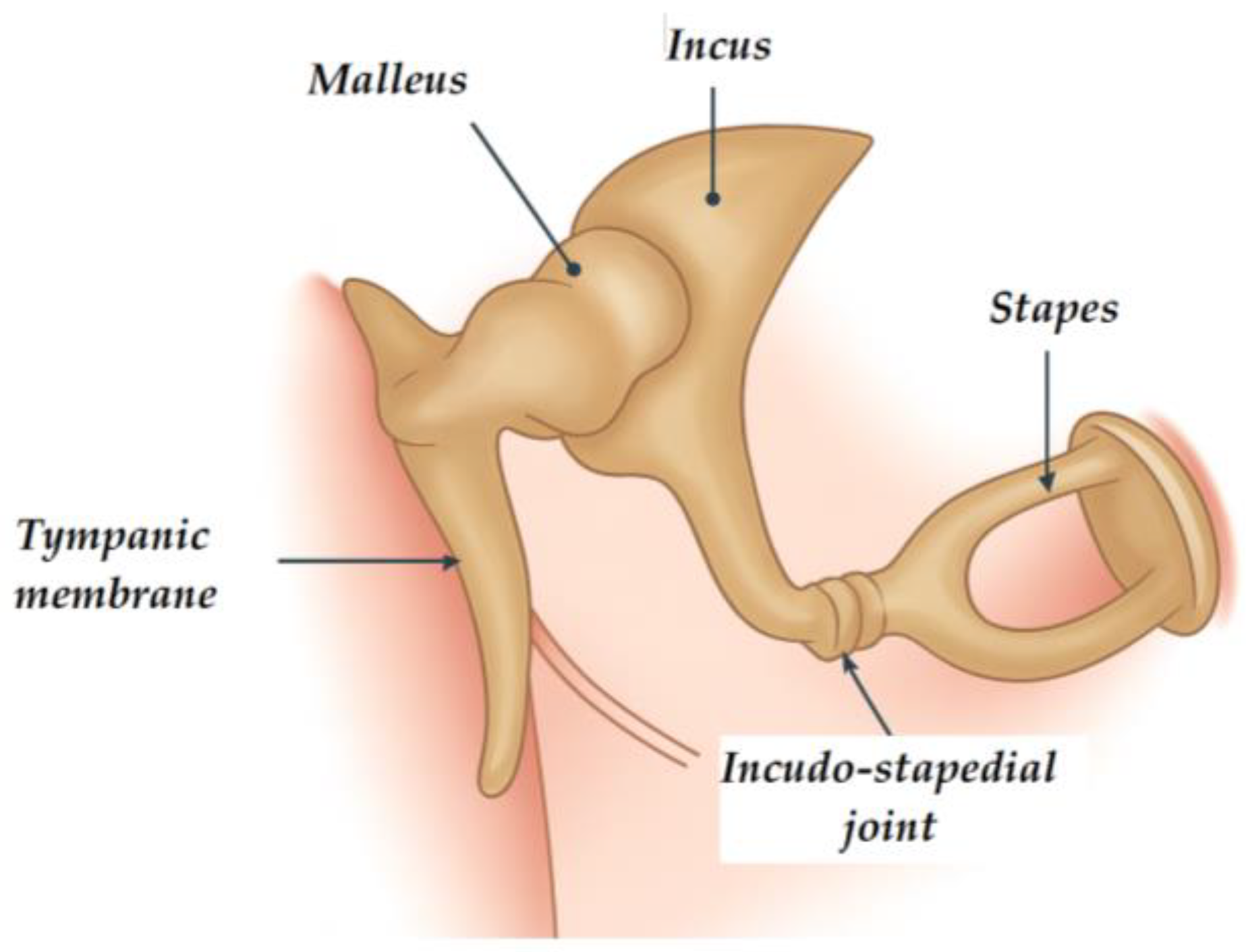
Stapes bone is the smallest bone in our body. It is the innermost bone of our auditory ossicles in the middle ear, which are responsible for transmitting sound waves from the air outside to the fluid-filled labyrinth (cochlea). Auditory ossicles are a group of three small bones that work together forming a vibrating chain. These three bones are as
follows:
* Malleus
* Incus
* Stapes
For better understanding of the anatomy of Stapes, have a look at the image below:
Related Conditions
* Otosclerosis- A disorder in which the footplate of the stapes is invaded and replaced by an abnormal bone, affecting sound transmission to the inner ear at the level of the oval window.
* Stapedectomy.
Pathological Conditions
Stapes fractures- Transverse fracture of stapes Anterior Crus, a rare fracture.
It appears to me that if one wants to make progress in mathematics, one should study the masters and not the pupils. - Niels Henrik Abel.
Nothing is better than reading and gaining more and more knowledge - Stephen William Hawking.
Offline
Pages: 1