Math Is Fun Forum
You are not logged in.
- Topics: Active | Unanswered
- Index
- » Science HQ
- » Sternum
Pages: 1
#1 2026-02-01 17:10:37
- Jai Ganesh
- Administrator

- Registered: 2005-06-28
- Posts: 53,903
Sternum
Sternum
Gist
The sternum, or breastbone, is a flat, vertical bone in the center of the chest that forms the front of the rib cage, protecting vital organs like the heart and lungs, and serving as an attachment point for ribs and muscles. It's divided into three parts—the manubrium, body, and xiphoid process—and is crucial for chest stability and breathing.
The sternum is also commonly known as the breastbone, a flat bone in the center of the chest that connects the ribs and protects vital organs like the heart and lungs. Anatomically, it's divided into three parts: the manubrium, the body (or gladiolus), and the xiphoid process.
Summary
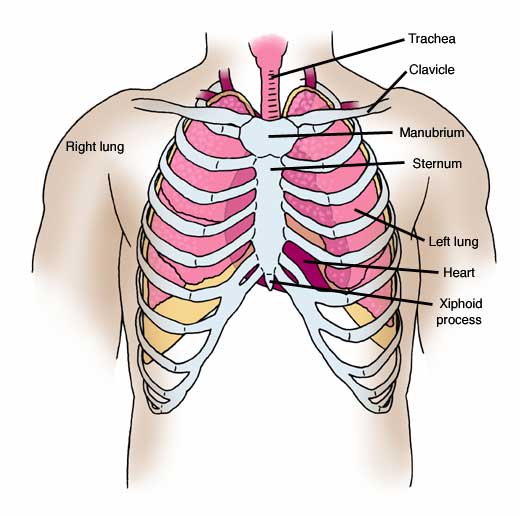
The sternum (pl.: sternums or sterna) or breastbone is a long flat bone located in the central part of the chest. It connects to the ribs via cartilage and forms the front of the rib cage, thus helping to protect the heart, lungs, and major blood vessels from injury. Shaped roughly like a necktie, it is one of the largest and longest flat bones of the body. Its three regions are the manubrium, the body, and the xiphoid process.
Structure
The sternum is a narrow, flat bone, forming the middle portion of the front of the chest. The top of the sternum supports the clavicles (collarbones) and its edges join with the costal cartilages of the first two pairs of ribs. The inner surface of the sternum is also the attachment of the sternopericardial ligaments. Its top is also connected to the sternocleidomastoid muscle. The sternum consists of three main parts, listed from the top:
* Manubrium
* Body (gladiolus)
* Xiphoid process
In its natural position, the sternum is angled obliquely, downward and forward. It is slightly convex in front and concave behind; broad above, shaped like a "T", becoming narrowed at the point where the manubrium joins the body, after which it again widens a little to below the middle of the body, and then narrows to its lower extremity. It is usually longer in the male than in the female.
Details
Your sternum, or breastbone, is a flat, vertical bone at the center of your chest that protects your organs and muscles. It connects to other bones and muscles and forms part of your ribcage, which protects your heart and lungs. Many different conditions can cause sternum pain, but most aren’t serious.
Overview:
What is the sternum?
Your sternum is a flat, T-shaped bone at the center and front of your chest. Your sternum protects the organs and muscles inside your chest from injury. It also connects to other bones and muscles with cartilage. It forms part of your ribcage, which protects your heart and lungs. Another name for your sternum bone is your breastbone.
Function:
What is the function of the sternum in the ribcage?
Your sternum (breastbone) works with your ribcage to protect the organs within your chest. This includes your:
* Stomach.
* Esophagus.
* Lungs.
* Heart.
* Blood vessels.
Your breastbone also provides support — it connects to other parts of your skeletal system, including your clavicle (collarbone) and first six sets of ribs. Other muscles in your chest and upper belly (abdomen) connect to your sternum, as well.
Your sternum doesn’t help with movement in your chest or torso. But cartilage that connects your sternum to your ribs helps with minor motions that occur every time you take a breath.
Anatomy:
Where is the sternum?
The breastbone location is at the center and front of your chest. You can find it in your upper chest in front of your thymus. It connects to your clavicles, which run horizontally (from side to side) above it.
What organ is behind your sternum?
Your thymus gland is located behind your sternum (breastbone). This gland is part of your lymphatic system. It’s in charge of training special white blood cells called T-lymphocytes (T-cells).
What are the parts of the sternum?
Your sternum anatomy consists of three bony parts. These parts include:
* Manubrium: The manubrium of the sternum is the wide, handle-like top portion of the bone. This is where your collarbone and first set of ribs attach. The bottom edge of the manubrium borders the body of your sternum, which is where your second set of ribs attach.
* Body: The body of the sternum is in the center. It’s flat, narrow and the longest part of your sternum. Your third, fourth, fifth, sixth and seventh set of ribs attach to your sternum along the body.
* Xiphoid process: The xiphoid process is the lowest part of the sternum. This pointed end piece of your sternum is made of mostly cartilage. As you age, it begins to calcify and turn to bone.
What is the tip of the sternum?
The tip of the sternum is called the xiphoid process. It’s thinner and narrower than the rest of the sternum. Its shape can vary, but it usually forms into a small point at the bottom of the sternum.
What does the sternum look like?
Your sternum measures about 6 inches long from top to bottom. You could compare the shape of your sternum to an upside-down sword. This is because the wide part at the top resembles a handle. The body of the sternum is long and flat, like the blade of a sword. And the xiphoid process at the end of the sternum looks like the tip of a sword.
Conditions and Disorders:
What does it mean when your sternum hurts?
Many issues with your sternum and its surrounding bones and muscles can cause sternum pain. In addition, you may experience substernal pain — discomfort that occurs below or behind your sternum. This type of pain is usually due to gastrointestinal conditions. Some common causes of sternum or substernal pain include:
* Costochondritis.
* Pectus carinatum.
* Sternum (sternal) fracture.
* Sternoclavicular joint injury.
* Collarbone injury.
* Muscle strain.
* Hiatal hernia.
* Acid reflux.
* Pleurisy.
* Bronchitis.
* Pneumonia.
Costochondritis
Costochondritis is a condition that causes inflammation in the cartilage that attaches your ribs to your sternum. An infection, injury or arthritis can cause the condition. Costochondritis causes sharp, stabbing rib pain and tenderness. You usually feel it in your sternal area and the first three sets of ribs, but it can spread to your arms and shoulders. You may also notice warmth and tenderness in the area.
Pectus carinatum
Pectus carinatum is a condition that causes your sternum to stick out more than it should. Other names for the condition include pigeon chest and keel chest because of how it makes your chest appear. Most people with pectus carinatum don’t have symptoms. But, you may experience chest pain when in specific positions or participating in certain activities.
Sternum (sternal) fracture
A sternal fracture occurs when you break your sternum bone, most often due to blunt force trauma. Sternum fractures commonly occur due to auto accidents. They also happen because of sports injuries and falls. There are two types of sternum fractures:
* Direct: When a direct blow to the front of your chest wall causes a break further back in your chest.
* Indirect: When your sternum is injured in such a way that a break occurs closer to the front of your chest.
Sternoclavicular joint injury
Your sternoclavicular joint is the area in your body where your clavicle connects to your sternum. Although rare, you can sometimes develop problems in this joint area due to infections, injuries or arthritis. You’ll experience pain and discomfort if you have an injury there.
Collarbone injury
Your collarbone (clavicle) connects to the top corners of your sternum. Since the two are closely connected, if you injure your collarbone, you’ll feel pain and discomfort in your sternum, as well. You can injure your collarbone through accidents, sports injuries and falls.
Muscle strain
A muscle strain, or a pulled muscle, can occur when you injure a tendon or muscle. Many tendons and muscles are connected to your sternum. Therefore, injuries to a muscle or tendon can also affect your sternum. Muscle strains occur due to overuse, playing sports and coughing too hard.
Hiatal hernia
A hiatal hernia happens when the top of your stomach moves past your diaphragm and into your chest. This affects the area behind your chest and can cause substernal pain (the area behind your sternum). Hiatal hernias are the most common type of hernia.
Acid reflux
Acid reflux occurs when stomach acid causes irritation and inflammation that wears away the lining of your esophagus. This can cause substernal pain. The condition most often affects people with gastroesophageal reflux disease (GERD).
Pleurisy
Pleurisy is a condition that causes inflammation in your pleurae — the sheets of tissue between your ribcage and lungs. Some autoimmune diseases, lung conditions, and bacterial or viral infections can cause pleurisy. This can also cause substernal pain.
Bronchitis
Bronchitis is a condition that causes inflammation in the primary airways leading to your lungs — your trachea (windpipe) and bronchi — causing substernal pain. This inflammation causes your lungs to fill with mucus, leaving you with a nagging cough that can last for weeks.
Pneumonia
Pneumonia is a condition that causes inflammation in the air sacs (alveoli) in your lungs. After the alveoli inflame, they fill with fluid, which can cause sharp chest pains. You may feel this pain behind your sternum.
Additional Information
Sternum, in the anatomy of tetrapods (four-limbed vertebrates), is an elongated bone in the centre of the chest that articulates with and provides support for the clavicles (collarbones) of the shoulder girdle and for the ribs. Its origin in evolution is unclear. A sternum appears in certain salamanders; it is present in most other tetrapods but lacking in legless lizards, snakes, and turtles (in which the shell provides needed support). In birds an enlarged keel develops, to which flight muscles are attached; the sternum of the bat is also keeled as an adaptation for flight.
In mammals the sternum is divided into three parts, from anterior to posterior: (1) the manubrium, which articulates with the clavicles and first ribs; (2) the mesosternum, often divided into a series of segments, the sternebrae, to which the remaining true ribs are attached; and (3) the posterior segment, called the xiphisternum. In humans the sternum is elongated and flat; it may be felt from the base of the neck to the pit of the abdomen. The manubrium is roughly trapezoidal, with depressions where the clavicles and the first pair of ribs join. The mesosternum, or body, consists of four sternebrae that fuse during childhood or early adulthood. The mesosternum is narrow and long, with articular facets for ribs along its sides. The xiphisternum is reduced to a small, usually cartilaginous xiphoid (“sword-shaped”) process. The sternum ossifies from several centres. The xiphoid process may ossify and fuse to the body in middle age; the joint between manubrium and mesosternum remains open until old age.
It appears to me that if one wants to make progress in mathematics, one should study the masters and not the pupils. - Niels Henrik Abel.
Nothing is better than reading and gaining more and more knowledge - Stephen William Hawking.
Offline
Pages: 1
- Index
- » Science HQ
- » Sternum