Math Is Fun Forum
You are not logged in.
- Topics: Active | Unanswered
Pages: 1
#1 2026-01-26 22:59:35
- Jai Ganesh
- Administrator

- Registered: 2005-06-28
- Posts: 53,903
Coronary Arteries
Coronary Arteries
Gist
Coronary arteries send blood to the heart muscle. All tissues in the body need oxygen-rich blood to function. The heart muscle also needs it. And oxygen-depleted blood must be carried away.
Coronary artery disease (CAD) is most commonly caused by atherosclerosis, the gradual buildup of plaque (fats, cholesterol, calcium) in the heart's arteries, leading to narrowing and reduced blood flow; key risk factors accelerating this process include smoking, high blood pressure, high cholesterol, diabetes, obesity, and lack of exercise.
Summary
A coronary artery is one of two blood vessels that branch from the aorta close to its point of departure from the heart and carry oxygen-rich blood to the heart muscle. Both arteries supply blood to the walls of both lower chambers (ventricles) and to the partition between the chambers. The right coronary artery supplies blood to the right upper chamber (atrium), while the left supplies the left atrium. Blockage of any branch of the coronary arteries causes death of a portion of the heart tissue when it is deprived of oxygen-rich blood
Details
The coronary arteries are the arterial blood vessels of coronary circulation, which transport oxygenated blood to the heart muscle. The heart requires a continuous supply of oxygen to function and survive, much like any other tissue or organ of the body.
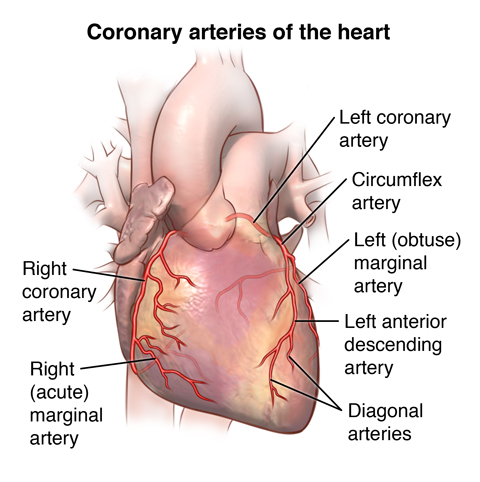
The coronary arteries wrap around the entire heart. The two main branches are the left coronary artery and right coronary artery. The arteries can additionally be categorized based on the area of the heart for which they provide circulation. These categories are called epicardial (above the epicardium, or the outermost tissue of the heart) and microvascular (close to the endocardium, or the innermost tissue of the heart).
Reduced function of the coronary arteries can lead to decreased flow of oxygen and nutrients to the heart. Not only does this affect supply to the heart muscle itself, but it also can affect the ability of the heart to pump blood throughout the body. Therefore, any disorder or disease of the coronary arteries can have a serious impact on health, possibly leading to angina, a heart attack, and even death.
Structure
The coronary arteries are mainly composed of the left and right coronary arteries, both of which give off several branches.
* Aorta
** Left coronary artery
*** Left anterior descending artery
*** Left circumflex artery
*** Posterior descending artery
*** Ramus or intermediate artery
** Right coronary artery
*** Right marginal artery
*** Posterior descending artery
The left coronary artery arises from the aorta within the left cusp of the aortic valve and feeds blood to the left side of the heart. It branches into two arteries, the left anterior descending and the left circumflex. The left anterior descending artery perfuses the interventricular septum and anterior wall of the left ventricle. The left circumflex artery perfuses the left ventricular free wall. In approximately 33% of individuals, the left coronary artery gives rise to the posterior descending artery which perfuses the posterior and inferior walls of the left ventricle. Sometimes a third branch is formed at the fork between left anterior descending and left circumflex arteries, known as a ramus or intermediate artery.
The right coronary artery (RCA) originates within the right cusp of the aortic valve. It travels down the right coronary sulcus, towards the crux of the heart. The RCA primarily branches into the right marginal arteries, and, in 67% of individuals, gives place to the posterior descending artery. The right marginal arteries perfuse the right ventricle and the posterior descending artery perfuses the left ventricular posterior and inferior walls.
There is also the conus artery, which is only present in about 45 percent of the human population, and which provides collateral blood flow to the heart when the left anterior descending artery is occluded.
Clinical significance
Narrowing of the arteries can be caused by a process known as atherosclerosis (most common), arteriosclerosis, or arteriolosclerosis. This occurs when plaques (made up of deposits of cholesterol and other substances) build up over time in the walls of the arteries. Coronary artery disease (CAD) or ischemic heart disease are the terms used to describe narrowing of the coronary arteries.
As the disease progresses, plaque buildup can partially block blood flow to the heart muscle. Without enough blood supply (ischemia), the heart is unable to work properly, especially under increased stress. Stable angina is chest pain on exertion that improves with rest. Unstable angina is chest pain that can occur at rest, feels more severe, and/or last longer than stable angina. It is caused by more severe narrowing of the arteries.
A heart attack results from a sudden plaque rupture and formation of a thrombus (blood clot) that completely blocks blood flow to a portion of the heart, leading to tissue death (infarct).
CAD can also result in heart failure or arrhythmias. Heart failure is caused by chronic oxygen deprivation due to reduced blood flow, which weakens the heart over time. Arrhythmias are caused by inadequate blood supply to the heart that interferes with the heart's electric impulse.
The coronary arteries can constrict as a response to various stimuli, mostly chemical. This is known as a coronary reflex.
There is also a rare condition known as spontaneous coronary artery dissection, in which the wall of one of the coronary arteries tears, causing severe pain. Unlike CAD, spontaneous coronary artery dissection is not due to plaque buildup in arteries, and tends to occur in younger individuals, including women who have recently given birth or men who do intense exercise.
Coronary artery dominance is described as the coronary artery that give branches to supply the right posterior descending artery and supplies the inferior wall of the heart. In 80 to 85% of the population, the right coronary artery supplies the posterior descending artery, making it right heart dominant while in 7 to 13% of the population, the left coronary artery supplies the posterior descending artery, making it left heart dominant. In 7 to 8% of the population, both right and left coronary arteries supplies the posterior descending artery, making it right and left co-dominance. Narrowing of coronary arteries is more frequent in those who are left dominant when compared to those who have right dominant or co-dominant hearts.
Additional Information:
Anatomy and Function of the Coronary Arteries
Coronary arteries send blood to the heart muscle. All tissues in the body need oxygen-rich blood to function. The heart muscle also needs it. And oxygen-depleted blood must be carried away. The coronary arteries wrap around the outside of the heart. They send oxygen-rich blood into the heart's muscle tissues.
Two coronary arteries
The two main coronary arteries are:
* Left main coronary artery. This artery sends blood to the left side of the heart muscle. This includes the left ventricle and left atrium. It divides into these branches:
** Left anterior descending artery. This smaller artery branches off the left coronary artery. It sends blood to the front of the left side of the heart. It also helps send blood to the middle (septum) of the heart.
** Left circumflex artery. This artery also branches off the left coronary artery. It circles around the heart muscle. This artery sends blood to the outer side and back of the heart.
* Right coronary artery. This artery sends blood to the right side of the heart. This includes the right ventricle, the right atrium, and the SA (sinoatrial) and AV (atrioventricular) nodes. These nodes control the heart rhythm. The right coronary artery divides into smaller branches. One is the right posterior descending artery. The other is the acute marginal artery. It also helps send blood to the middle (septum) of the heart.
Problems with the coronary arteries
Since coronary arteries send blood to the heart muscle, any coronary artery problem can cause serious health problems. It reduces the flow of oxygen and nutrients to the heart muscle. This can lead to a heart attack and possibly death. The most common cause of heart disease is atherosclerosis. This is a buildup of plaque in the inner lining of an artery. It causes the artery to become narrow or blocked, so that less blood can get to the heart tissues.
It appears to me that if one wants to make progress in mathematics, one should study the masters and not the pupils. - Niels Henrik Abel.
Nothing is better than reading and gaining more and more knowledge - Stephen William Hawking.
Offline
Pages: 1