Math Is Fun Forum
You are not logged in.
- Topics: Active | Unanswered
Pages: 1
#1 2026-01-02 22:33:05
- Jai Ganesh
- Administrator

- Registered: 2005-06-28
- Posts: 53,831
Petrology
Petrology
Gist
Petrology is the branch of geology that studies rocks, focusing on their composition, texture, structure, origin, and the conditions under which they form and transform, covering the three main types: igneous, sedimentary, and metamorphic rocks. Petrologists analyze rocks to understand Earth's history, geological processes like volcanism and mountain building, and even conditions on other planets, using field studies and lab techniques like microscopy (petrography) and experimental synthesis.
Petrology is the scientific study of rocks, delving into their origin, composition (minerals), texture, structure, occurrence, distribution, and formation processes, covering igneous, sedimentary, and metamorphic rocks to understand Earth's history and dynamic systems. It's a core part of geology, using techniques like microscopy to examine rocks and minerals to answer fundamental questions about Earth's crust, mantle, and other planetary bodies.
Summary
Petrology is the scientific study of rocks that deals with their composition, texture, and structure; their occurrence and distribution; and their origin in relation to physicochemical conditions and geologic processes. It is concerned with all three major types of rocks—igneous, metamorphic, and sedimentary. Petrology includes the subdisciplines of experimental petrology and petrography. Experimental petrology involves the laboratory synthesis of rocks for the purpose of ascertaining the physical and chemical conditions under which rock formation occurs. Petrography is the study of rocks in thin section by means of a petrographic microscope (i.e., an instrument that employs polarized light that vibrates in a single plane). Petrography is primarily concerned with the systematic classification and precise description of rocks.
Petrology relies heavily on the principles and methods of mineralogy because most rocks consist of minerals and are formed under the same conditions. Also essential to petrological research is the careful mapping and sampling of rock units, which provide data on regional gradations of rock types and on associations unavailable by other means.
Details
Petrology (from Ancient Greek (pétros) 'rock' and (-logía) 'study of') is the branch of geology that studies rocks, their mineralogy, composition, texture, structure and the conditions under which they form. Petrology has three subdivisions: igneous, metamorphic, and sedimentary petrology. Igneous and metamorphic petrology are commonly taught together because both make heavy use of chemistry, chemical methods, and phase diagrams. Sedimentary petrology is commonly taught together with stratigraphy because it deals with the processes that form sedimentary rock. Modern sedimentary petrology is making increasing use of chemistry.
Background
Lithology was once approximately synonymous with petrography, but in current usage, lithology focuses on macroscopic hand-sample or outcrop-scale description of rocks while petrography is the speciality that deals with microscopic details.
In the petroleum industry, lithology, or more specifically mud logging, is the graphic representation of geological formations being drilled through and drawn on a log called a mud log. As the cuttings are circulated out of the borehole, they are sampled, examined (typically under a 10× microscope) and tested chemically when needed.
Methodology
Petrology utilizes the fields of mineralogy, petrography, optical mineralogy, and chemical analysis to describe the composition and texture of rocks. Petrologists also include the principles of geochemistry and geophysics through the study of geochemical trends and cycles and the use of thermodynamic data and experiments in order to better understand the origins of rocks.
Branches
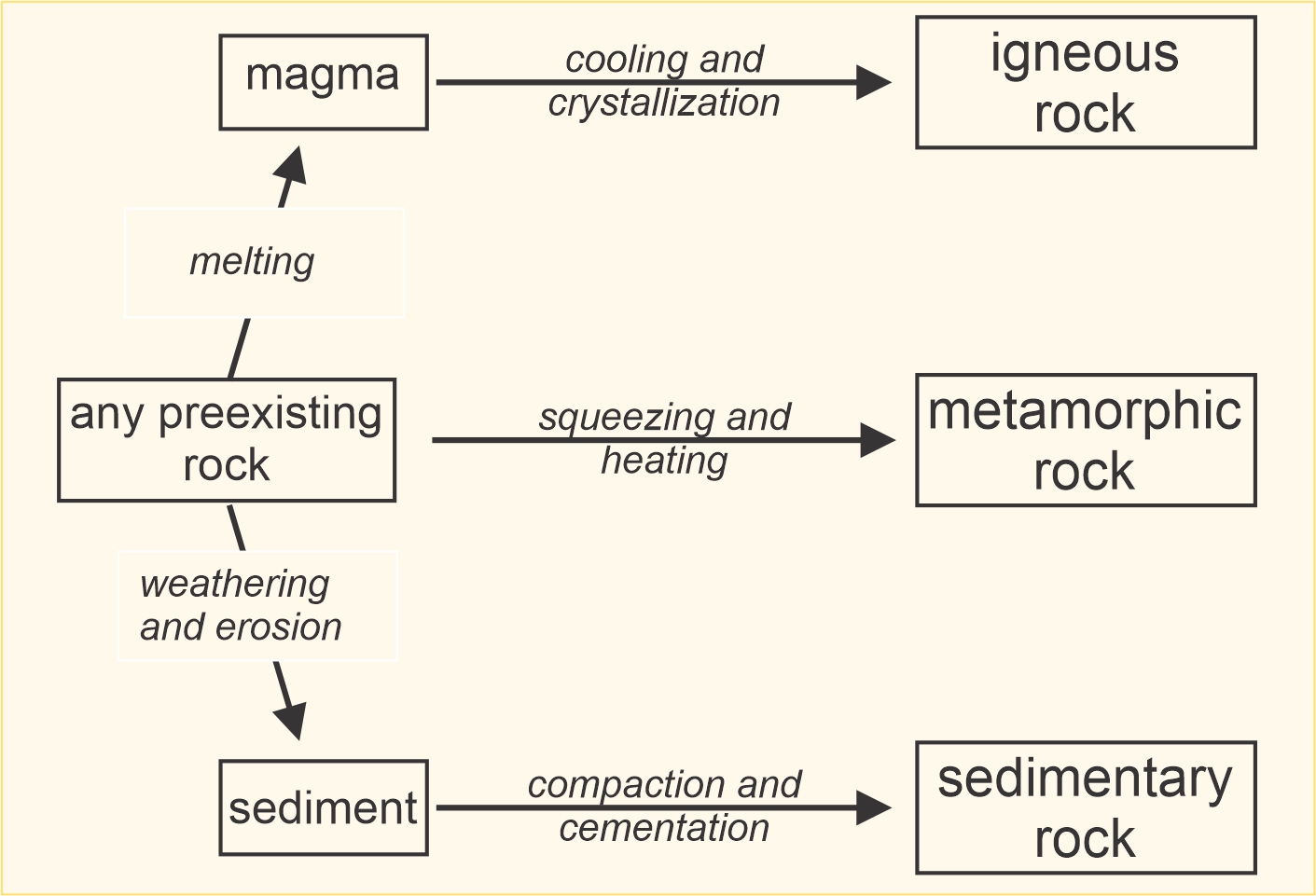
There are three branches of petrology, corresponding to the three types of rocks: igneous, metamorphic, and sedimentary, and another dealing with experimental techniques:
* Igneous petrology focuses on the composition and texture of igneous rocks (rocks such as granite or basalt which have crystallized from molten rock or magma). Igneous rocks include volcanic and plutonic rocks.
* Sedimentary petrology focuses on the composition and texture of sedimentary rocks (rocks such as sandstone, shale, or limestone which consist of pieces or particles derived from other rocks or biological or chemical deposits, and are usually bound together in a matrix of finer material).
* Metamorphic petrology focuses on the composition and texture of metamorphic rocks (rocks such as slate, marble, gneiss, or schist) which have undergone chemical, mineralogical or textural changes due to the effects of pressure, temperature, or both). The original rock, prior to change (called the protolith), may be of any sort.
* Experimental petrology employs high-pressure, high-temperature apparatus to investigate the geochemistry and phase relations of natural or synthetic materials at elevated pressures and temperatures. Experiments are particularly useful for investigating rocks of the lower crust and upper mantle that rarely survive the journey to the surface in pristine condition. They are also one of the prime sources of information about completely inaccessible rocks, such as those in the Earth's lower mantle and in the mantles of the other terrestrial planets and the Moon. The work of experimental petrologists has laid a foundation on which modern understanding of igneous and metamorphic processes has been built.
Additional Information
Petrology is the study of the macroscopic and microscopic mineralogical and chemical composition of rocks. In addition to assessing sedimentary, igneous, and metamorphic rocks that are accessible at the surface, experimental petrology aims to create high pressure and temperature conditions to investigate what rock types may exist in the Earth’s subsurface.
It appears to me that if one wants to make progress in mathematics, one should study the masters and not the pupils. - Niels Henrik Abel.
Nothing is better than reading and gaining more and more knowledge - Stephen William Hawking.
Offline
Pages: 1