Math Is Fun Forum
You are not logged in.
- Topics: Active | Unanswered
#876 Re: Maths Is Fun - Suggestions and Comments » Coefficient vs Constant » 2014-06-13 03:07:42
The way I understand it:
1) c is a coefficient in that polynomial;
2)coefficient is a constant used in a polynomial. I have not seen the term coefficient used much elsewhere.
#877 Re: Help Me ! » Geometry Problem » 2014-06-12 07:52:21
Hi harrychess
#878 Re: Dark Discussions at Cafe Infinity » Brittle math 2: Generalizing is a disease. » 2014-06-12 04:34:10
When can we expect BM3?
#879 Re: Help Me ! » Number Daisy and Proof? » 2014-06-12 03:51:50
Hi phro
Ah, I see. Missed that one. Thanks! That makes 46 largest so far.
#880 Re: Help Me ! » Number Daisy and Proof? » 2014-06-12 03:32:16
Yes, I know, but are you sure that includes that type of connectedness?
#881 Re: Help Me ! » Euclid's element (P14) » 2014-06-12 03:28:30
Then, by the same logic, you would not even need Postulate 4.
#882 Re: Help Me ! » Number Daisy and Proof? » 2014-06-12 03:26:30
Are you sure that's valid?
#883 Re: Help Me ! » Euclid's element (P14) » 2014-06-12 02:58:27
That's how I'm understanding it.
#884 Re: Help Me ! » Number Daisy and Proof? » 2014-06-12 01:41:22
Hm, I don't know, but how do you make a 21 with that one?
#885 Re: Help Me ! » Number Daisy and Proof? » 2014-06-12 00:35:30
Hi guys, wouldn't it be better if there was a 20 instead of a 19 there? You can then get up to 47.
#886 Re: Dark Discussions at Cafe Infinity » What if : The matrix is real? » 2014-06-12 00:30:15
Hi bobbym
I know, but I was trying to hint at how much worse they are compared to the first one.
#887 Re: Dark Discussions at Cafe Infinity » What if : The matrix is real? » 2014-06-12 00:24:02
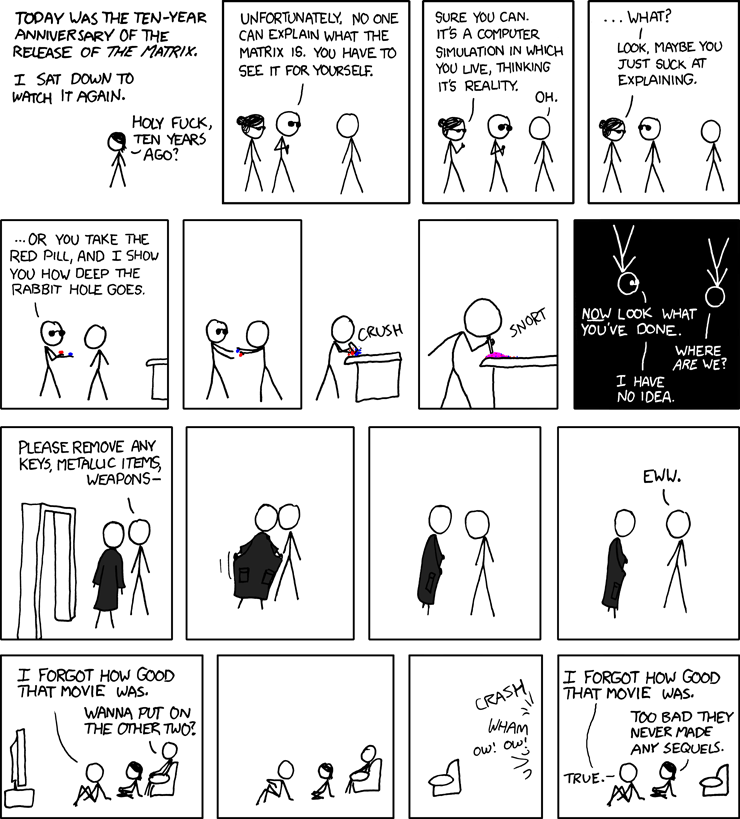
It has no sequels.
#888 Re: Help Me ! » conditions required » 2014-06-12 00:22:48
No problem. I'm glad it was clear. I tend to complicate.
#889 Re: Dark Discussions at Cafe Infinity » What if : The matrix is real? » 2014-06-12 00:21:41
Hi bobbym
There is only one movie.
#890 Re: Dark Discussions at Cafe Infinity » Brittle math 2: Generalizing is a disease. » 2014-06-11 12:55:18
Happens all the time to me. But it's usually in the form of [math][/hide].
#891 Re: Help Me ! » Euclid's element (P14) » 2014-06-11 12:31:29
Well, I'm guessing it's because without the Postulate 4, you wouldn't actually be able to use Common Notion 1, because you don't know if two right angles is equal to two right angles.
#892 Re: Dark Discussions at Cafe Infinity » Brittle math 2: Generalizing is a disease. » 2014-06-11 12:27:40
Hi phro
#893 Re: Help Me ! » conditions required » 2014-06-11 05:04:12
#894 Re: Help Me ! » Sequences » 2014-06-11 00:22:11
Well, did you open the file I posted? I do the cancellation, just on finitely many terms.
#895 Re: Maths Is Fun - Suggestions and Comments » MIF - Article Submission » 2014-06-11 00:13:20
Ah, found it.
#896 Re: Help Me ! » Sequences » 2014-06-11 00:11:14
Well, I do that too, just a bit more rigorously.
#897 Re: Help Me ! » conditions required » 2014-06-11 00:09:04
Hi nikarika_kumar
Look at the graph of a parabola which is always positive.

Notice that it cannot have any intersection with the x-axis. If it did, there would be points where it is 0 and/or negative, which we don't want.
So, this leads us to conclude that, because the parabola has no intersections with the x-axis,
.Also, another thing we need to notice is the orientation of the parabola. If it has no solutions and is upside down from the picture above, it will always be negative:

So, we need the parabola to be turned like in the first picture. That will happen when
.That's all there is to it. 
#898 Re: Help Me ! » Sequences » 2014-06-10 23:36:19
Hmm, how are they different?
#899 Re: Maths Is Fun - Suggestions and Comments » MIF - Article Submission » 2014-06-10 23:34:40
What Contribute link?
#900 Re: Help Me ! » What values of x make this expression a perfect cube? » 2014-06-10 05:43:53
That's true.
Have you seen my PM?