Math Is Fun Forum
You are not logged in.
- Topics: Active | Unanswered
#176 Re: Puzzles and Games » How Low Can You Go? » 2006-11-05 13:38:10
I tried again and got 2.5 seconds, I am the Django Reinhardt of typing.
#177 Re: Puzzles and Games » How Low Can You Go? » 2006-11-05 09:17:55
Why was the QWERTY keyboard intentionally designed to be inefficient?
I am not able to get under 3 seconds, but pretty close. My problem is that I am one of those two-finger typers. Yes, I refuse to learn how to "really" type.
#178 Re: Help Me ! » I just want a hint (Limits & Calculus) » 2006-11-03 15:11:56
Well, but I am a little bit confused, is the final result 1/2 ???
Indeed it is. 
#179 Re: Help Me ! » Find X » 2006-11-03 08:42:54
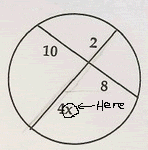
This is the solution
#180 Re: Help Me ! » binomial? » 2006-10-28 14:19:07
txjulie wrote:Please tell me how to solve
y^2 - y =4160
Thanks a million!!
y^2 - y - 4160 = 0
Solve using quadratic formula.
You insane factoring types may also solve it by recognizing it as (y - 65)(y + 64). 
#181 Re: Help Me ! » Finding the Anti-Derivative » 2006-10-28 14:16:47
I never really thought about solving this integral before, so I wrote out a solution for it to see if i could do anything. I use integration by parts and get it as an infinite sum:
where c is our constant of integration (don't forget that ) and (2n - 1)!! is a double factorial, which means the product (2n - 1)(2n - 3)(2n - 5)...5 × 3 × 1. Note that (-1)!! = 0!! = 1.
#182 Re: Euler Avenue » Interesting proofs » 2006-10-17 21:09:58
Theorem:
There are infinitely many primes.
Proof:
Define a topology on the set of integers by using the arithmetic progressions (from -∞ to ∞) as a basis. It is easy to verify that this yields a topological space. For each prime p let A[sub]p[/sub] consist of all multiples of p. A[sub]p[/sub] is closed since its complement is the union of all the other arithmetic progressions with difference p. Now let A be the union of the progressions A[sub]p[/sub]. If the number of primes is finite, then A is a finite union of closed sets, hence closed. But all integers except -1 and 1 are multiples of some prime, so the complement of A is {-1, 1} which is obviously not open. This shows A is not a finite union and there are infinitely many primes.
#183 Euler Avenue » Proofs of selected inequalities from the Formulas thread. » 2006-10-17 20:53:22
- Zhylliolom
- Replies: 1
Upon request, I have supplied proofs to some of the inequalities in the Inequalities thread in the Formulas section. I have selected those inequalities which seem less known, so feel free to request some other proofs.
Bernoulli's Inequality
For x > -1, x ≠ 0, and integers n > 1,
Proof
Use induction. The base case is n = 2, which gives (1 + x)² > 1 + 2x, which is certainly true upon expanding the left hand side. Now assume the inequality holds for some n ≥ 2. Then since x > -1, 1 + x > 0 and we can write
which again is certainly true upon expanding the left hand side. Thus the proof is complete.
Jensen's Inequality
For 0 < p ≤ q and positive a[sub]k[/sub],
Proof
Restate the inequality as follows:
Let {x[sub]i[/sub]}[sub]i = 1[/sub][sup]n[/sup] be a fixed set of n positive numbers and p > 0. The function f(p) defined on (0, ∞) by
is positive decreasing function, and therefore if 0 < p[sub]1[/sub] ≤ p[sub]2[/sub], we have the inequality
Since f(p) is positive, write
so that x[sup]p[sub]2[/sub][/sup] = ∑[sub]i = 1[/sub][sup]n[/sup] x[sub]i[/sub][sup]p[sub]2[/sub][/sup]. This implies that x[sub]i[/sub][sup]p[sub]2[/sub][/sup] ≤ x[sup]p[sub]2[/sub][/sup] and thus x[sub]i[/sub] ≤ x for each i. Since p[sub]2[/sub] ≥ p[sub]1[/sub] > 0, it follows that
From the above analysis, the left hand side of this inequality is simply 1, so we now have
which immediately gives
which is the desired result.
Hadamard's Inequality
Let A be an n × n matrix with entries a[sub]ij[/sub] and transpose A[sup]T[/sup]. Then
Proof
Apply the Gram determinant(Gramian), defined as follows:
In other words, the Gramian is the determinant of the matrix with ij-entry equal to the inner product of the ith and jth vector argument of G. Now a theorem(whose proof is excluded at least in this discussion) on Gramians states that if {x[sub]1[/sub],..., x[sub]k[/sub]} are k vectors in E[sup]n[/sup] then G(x[sub]1[/sub],..., x[sub]k[/sub]) is the square of the k-dimensional measure of the k-parallelotope determined by the vectors, or in other words, G(x[sub]1[/sub],..., x[sub]k[/sub]) is the square of the determinant of the k × k minor consisting of the i[sub]1[/sub], i[sub]2[/sub],..., i[sub]k[/sub] rows. Then given n vectors in E[sup]n[/sup], G(x[sub]1[/sub],..., x[sub]n[/sub]) = D². Then it follows that
Since the determinant of the transpose is also D, the indices i and j may be interchanged and the inequality is the same.
There are a few proofs for now, it is time for me to go. Perhaps later more will be added.
#184 Re: Help Me ! » help with a polynomial » 2006-09-03 08:40:09
No problem. Congratulations on becoming a Full Member.
#185 Re: Help Me ! » help with a polynomial » 2006-09-03 07:13:13
If you have forgotten your password, go here:
http://www.mathsisfun.com/forum/login.php?action=forget
Hopefully you still have the email that you registered your forum account with.
#186 Re: Help Me ! » help with a polynomial » 2006-09-03 06:53:03
You can get the answer a and b by doing it this way:
Now the keen and experienced eye factors this instantly as (x - a)(x - b) = 0, which gives the answer a and b . But most people wouldn't notice this since they're used to factoring with numbers, not letters, so let's use the quadratic formula:
Then we have
and
Thus the roots(zeroplaces ) are a and b.
#187 Re: This is Cool » Death by Quicksand - Is It Possible? » 2006-09-01 19:02:24
Tell us more, justlookingforthemoment.
#189 Re: Puzzles and Games » Treasure Map » 2006-09-01 06:46:23
n villages, where n can be any strictly positive integer. I wouldn't call it an unknown in this problem. The problem is asking for a proof that no matter how many villages there are and no matter what order you go towards them in (following the map's instructions but possibly interchanging B, C, etc.), if you follow the map's instructions then you will still be lead to the same place.
#190 Re: Puzzles and Games » Einstein's problem: how many solutions can you find? » 2006-08-31 11:06:11
#191 Puzzles and Games » Treasure Map » 2006-08-30 14:03:45
- Zhylliolom
- Replies: 5
Here's a cute little thing I noticed. Maybe someone will get the nice geometric significance once they solve it:
A treasure map has n villages marked on it, and it contains the following instructions: Start at village A, go 1/2 of the way to village B, 1/3 of the way to village C, 1/4 of the way to village D, and so forth. The treasure is buried at the last stop. Problem: You lose the instructions, and don't know in what order to select the villages. Prove that the order you select the villages in doesn't matter.
#192 Re: Help Me ! » Trig » 2006-08-30 09:00:59
Yes. For example, if our angle is y and the opposite side is 1 and the hypotenuse is 2, then sin y = 1/2 and y = sin-¹(1/2) = 30°. You might need a table of values for inverse trigonometric ratios or a calculator. After a while you'll start to memorize some of the values though  .
.
#193 Re: Help Me ! » Trig » 2006-08-30 08:36:52
Since sin x = opposite/hypotenuse, you can figure out the angle as x = sin-¹(opposite/hypotenuse).
Do you know about sin-¹?
This page may be helpful with some trigonometry, if you forget what each trigonometric ratio is:
#194 Re: Jokes » Religious Joke » 2006-08-30 07:17:33
Haha, owned.
#195 Re: Help Me ! » confused..... » 2006-08-29 09:18:46
Hey confused94, just making sure you don't forget about the Integration by Substitution thread I made the other day in response to this post. Hopefully you can go to this thread and benefit from the practice on the problems.
Here is the link again:
#196 Re: Guestbook » Home and away!! » 2006-08-29 09:12:56
Yeah Ricky! I'm glad someone knows about the glory of Dom Joly. My good friend and I used to build giant cell phones and wear spy outfits and perform our own little pranks, usually at school during lunchtime. My goodness, those were the times of my life.
#197 Re: Jokes » Jokes » 2006-08-28 16:56:29
What a sassy woman! She just went there.
#198 Re: Guestbook » Home and away!! » 2006-08-28 16:47:42
I've never heard of it. Trigger Happy TV is my thing though.
#199 Re: Exercises » Integration by Substitution » 2006-08-27 16:32:21
substitution*
Monumental effort, Ricky, and your solution is indeed correct. However, you are right in noticing that you didn't ever use any substitution. The solution takes much less work with the proper cleverness of substitution and manipulation and the right knowledge.
#200 Re: Exercises » Integration by Substitution » 2006-08-27 15:27:02
Good work Ricky, but as you must know, no credit is given for stating only the answer and not the solution method.