Math Is Fun Forum
You are not logged in.
- Topics: Active | Unanswered
#101 Re: Dark Discussions at Cafe Infinity » Linux » 2007-03-05 11:27:58
Well for one thing, Windows XP is a lot easier to shut down. You're just sitting there using the computer, and boom, it shuts down. No hassle of saving important documents or anything.
Hahaha, I totally did not catch the sarcasm the first time I read that a few days ago. But now I get it. 
I use Linux for programming purposes and Windows for everyday "normal" computer activities.
#102 Re: Introductions » sup » 2007-03-05 09:39:30
Also note that I find it completely odd that you managed to post around 100 times in a day. Even I don't have that much free time. (O.o)
It doesn't take much time to post 1-3 word replies to threads which add nothing to the discussion, such as "cool", "ok", "lol that's funny", and so on.
#103 Re: Introductions » sup » 2007-03-05 06:41:01
please let me be a moderator please please PLEASE!!!!!
I would imagine the behavior you are displaying here in this thread is not something that is impressing any of the moderators...
#104 Re: Introductions » sup » 2007-03-04 08:39:08
Why does post count matter so much to you people?
#105 Re: Introductions » Introducing myself » 2007-03-03 13:25:42
You haven't told us about your favorite areas of mathematics!!
#106 Re: Dark Discussions at Cafe Infinity » Pi Day 2007 » 2007-03-03 11:41:49
22/7 is Pi Approximation Day! Funny that 3.14 is an approximation as well, yet it still is considered the "official" pi day...
#107 Re: This is Cool » Robot Walks Like Us » 2007-03-03 05:55:18
As far as I can tell they are urban legends, it is really had to tell if it really did happen since there are so many schools around the world. But if I were a teacher I would definitely appreciate a witty answer on such questions. "Why?" is kind of an asinine question and I wouldn't be expecting students to do much with it... it might be put on as a random question which has no real answer or weight on your grade. But in a philosophy course, who knows what to expect as an answer. "What is courage?" is much more answerable and I might be looking for an actual answer to it. If a student handed me the answer "This is" to "What is courage?" I'd hand it back with "No, that's stupidity" and a big "0" written on it in red ink, just to be a jerk. 
#108 Re: This is Cool » Robot Walks Like Us » 2007-03-03 05:17:11
I heard someone took philosophy, and on his final exam, got one question, and several pages of lines. The question was 'why?'.
Ugh. I do not want to do philosophy for my VCE!
The answer is "Why not?"
#109 Re: This is Cool » INFINITE 0.9 <> 1 PROOF : COMPLETE : By,Anthony.R.Brown,15/02/07 » 2007-03-03 04:43:10
Quote:
" C = A/B×B = A = 1
0.999... = 1
D = A-C = A-A/B×B = A-A = 0 "A.R.B
C = ( A/B ) = ( Infinite 1.111...) x ( 0.9 ) = ( Infinite 0.999...)
0.999... <> 1 Because of an Infinite Difference of ( 0.001... )
D = 1 - ( Infinite 0.999...) = Infinite Difference of ( 0.001... )
proof credited.
Last edited by Anthony.R.Brown (Today.. )
Using the assumption that 0.999... ≠ 1 to prove that 0.999... ≠ 1 is faulty logic... I'm sure you can realize the problem here without too much difficulty. The algebra which you have quoted is correct, why would A/B × B ≠ A? Please explain why this would happen. Until you can somehow convince everyone that basic algebra is incorrect, proof discredited. 
#110 Re: This is Cool » Permanent Moon Base » 2007-03-02 12:40:09
I miss the dinosaurs 
#111 Re: This is Cool » Ramanujan's "Mock Theta Functions" solved » 2007-02-27 12:31:09
Ramanujan is my favorite mathematician second to Euler. His works are unbelievable, the man was pure talent. I'm going to try to find the 3 papers mentioned in that article. I'll post them here if I can.
#112 Re: Dark Discussions at Cafe Infinity » I Guess I can post this here since its to do with anime and animation. » 2007-02-26 10:17:58
Bigger is better, enlarge the banner please
#113 Re: Guestbook » Maths » 2007-02-26 09:12:30
I love your name, kung fu kats.
#114 Re: This is Cool » 0.9999....(recurring) = 1? » 2007-02-25 21:27:49
Yes, it can be considered an effect of the completeness property of the reals: every nonempty set of real numbers with an upper bound has a supremum in R. The set S I used is bounded above since every element is less than or equal to 1 (don't think I am implying that 1 must be in the set here, although I did prove it, this is just the definition of an upper bound: for any s in S, s ≤ 1, the ≤ is in the definition. In general the upper bound is not necessarily an element of the set), and in fact the supremum is 1. A property of the supremum is that for any r > 0, there is an s[sub]r[/sub] ∈ S such that sup S - r < s[sub]r[/sub]. Since sup S is 1 in our case, we have that 1 - r < s[sub]r[/sub] ≤ 1. This means s[sub]r[/sub] ∈ B(1, r) = (1 - r, 1 + r). In case you need this defined, an accumulation point (also called a limit point) of a set A is a point x such that every open ball B(x, r) contains a point in A distinct from x for any radius r. We see from the argument several sentences ago that 1 is by definition an accumulation point of S. There is another theorem of point set topology that states a closed set contains all of its accumulation points. This is why it follows that 1 ∈ S. If you need any of the theorems I am referencing explicitly stated and proven, just ask.
#115 Re: This is Cool » 0.9999....(recurring) = 1? » 2007-02-25 20:27:20
S is closed because its complement is an open set. An open set is a set whose points are all interior points. An interior point to a set A is a point in A such that the all the points in the open ball centered at that point are also in A. In the one-dimensional case we are considering, an open ball is simply an open interval. Also in this one-dimensional case, all open intervals are open sets. There is a theorem which states that the union of any collection of open sets is open. This is why S is closed in my proof.
I did not define any number as an infinite set, but instead I defined a number as an element of an infinite set. Is there something wrong with this? Every real number is an element of an infinite set... Every integer is an element of an infinite set... How is this any different?
#116 Re: This is Cool » 0.9999....(recurring) = 1? » 2007-02-25 19:51:00
I can see why someone might argue that 0.9 + 0.09 + 0.009 + ... only approaches 1. But with basic point set topology, we can easily prove that it actually is 1.
Theorem: Let S = {0.9, 0.99, 0.999, ...}. Then 1 ∈ S.
Proof: First, note that S is closed, since its complement R\S = (-∞, 0.9) U (0.99, 0.999) U ... is a union of open sets, and thus open. Also, 1 is an accumulation point (limit point) of S, since any open ball B(1, r) contains some point in S that is not equal to 1 (I have not seen anyone dispute that 0.9 + 0.09 + 0.009 + ... approaches 1, and this is basically what this sentence says). But S is closed, and thus contains all of its accumulation points. Then 1 ∈ S.
It should be clear that 0.999... is the element of S that is equal to 1.
#117 Re: Help Me ! » Some math comp. problems » 2007-02-24 09:51:17
BD is not the diameter of the circle! It is somewhat longer. This is your problem.
If you do the problem correctly you will get pi as your answer. Although technically none of those are correct, as it says "in centimeters" and area would be in square centimeters... owned.
#118 Re: Guestbook » i dont love cats » 2007-02-24 09:09:16
The main reason that I don't like cats is that the one I had at a very young age gave me several injuries and made me endure a lot of pain.
One time when I was a young boy my cat went insane and jumped on my head, tearing up my scalp for a good while. I still love cats though . Cats are so nice to have hang out with you when they just sit on your lap or bed and relax.
#119 Re: This is Cool » Four Colour Theorem : Formula Challenge » 2007-02-23 06:07:58
A map on an orientable surface of genus g needs a maximum of γ colors, where γ is given by
#120 Re: This is Cool » 0.9999....(recurring) = 1? » 2007-02-23 05:49:19
1 is a number, however 0.999... is not.
Then what is 0.999...? How about 0.333...? Is pi not a number? Define a number in such a way that 0.999... is not a number but all our notions of what a number is remain intact.
All you did were embeding infinite digits(a self-contradictory concept) into your defination of r-somes and claiming you need it. Do you call that valid? Can a 1/10[sup]∞[/sup] or r[sub]∞[/sub] exist?
In my proof it is clear that the n appearing in 1/10[sup]n[/sup] and r[sub]n[/sub] is a natural number. I'm sure you know that ∞ is not a natural number, much less a reach number. Then there is no 1/10[sup]∞[/sup] or r[sub]∞[/sub]. n just increases indefinitely, is it so wrong to count 1, 2, 3, 4... forever? You'll always be saying a natural number.
I can rewrite my proof to give another infinite decimal representation for a real number, a representation you wouldn't argue against. This proof is equally as valid as the original; it merely gives another decimal representation for a real number, the "standard" decimal representation.
Theorem. Assume x ≥ 0. Then for every integer n ≥ 1 there is a finite decimal r[sub]n[/sub] = a[sub]0[/sub].a[sub]1[/sub]a[sub]2[/sub]...a[sub]n[/sub] such that r[sub]n[/sub] ≤ x < r[sub]n[/sub] + 1/10[sup]n[/sup].
Proof. Let S be the set of all nonnegative integers less than x. Then S is nonempty, since 0 ∈ S, and S is bounded above by x. Then by the Completeness Axiom of the real numbers, S has a supremum, which we denote a[sub]0[/sub] = sup S. a[sub]0[/sub] ∈ S, so that a[sub]0[/sub] is a nonnegative integer. a[sub]0[/sub] is then the greatest integer in x, [x]. Clearly, a[sub]0[/sub] ≤ x < a[sub]0[/sub] + 1. Now let a[sub]1[/sub] = [10x - 10a[sub]0[/sub]], the greatest integer in 10x - 10a[sub]0[/sub]. Since 0 ≤ 10x - 10a[sub]0[/sub] = 10(x - a[sub]0[/sub]) < 10, we have that 0 ≤ a[sub]1[/sub] ≤ 9 and a[sub]1[/sub] ≤ 10x - 10a[sub]0[/sub] < a[sub]1[/sub] + 1. Then a[sub]1[/sub] is the largest integer satisfying a[sub]0[/sub] + a[sub]1[/sub]/10 ≤ x < a[sub]0[/sub] + (a[sub]1[/sub] + 1)/10. More generally, having chosen a[sub]1[/sub],..., a[sub]n-1[/sub] with 0 ≤ a[sub]i[/sub] ≤ 9, let a[sub]n[/sub] be the greatest integer satisfying a[sub]0[/sub] + a[sub]1[/sub]/10 + ... + a[sub]n[/sub]/10[sup]n[/sup] ≤ x < a[sub]0[/sub] + a[sub]1[/sub]/10 + ... + (a[sub]n[/sub] + 1)/10[sup]n[/sup]. Then 0 ≤ a[sub]n[/sub] ≤ 9 and we have r[sub]n[/sub] ≤ x < r[sub]n[/sub] + 1/10[sup]n[/sup], where r[sub]n[/sub] = a[sub]0[/sub].a[sub]1[/sub]a[sub]2[/sub]...a[sub]n[/sub]. This completes the proof.
It is easy to see from this theorem that we can define an infinite decimal representation of x. For x = 1, we see that a[sub]0[/sub] = 0, and a[sub]n[/sub] = 0 for all n > 1. Then 1 = 1.000....
Since these proofs are virtually identical, you can see that saying 0.999... ≠ 1 is basically the same as saying 1.000... ≠ 1.
#121 Re: Introductions » Deleted » 2007-02-22 19:47:16
...a ring whose set was the set of all functions, and whereby function composition was the additive operation...
In a ring (R, +, ·), (R, +) is an Abelian group. However, function composition is in general not commutative. (Even if (R, +, ·) were a semiring, (R, +) would be a commutative monoid; we cannot escape the commutativity.)
#122 Re: This is Cool » Mapping with only four colors-proof by Li, Ming and me » 2007-02-22 11:17:37
Yes he admits the donut will be different. But he states that a sphere is more or less the same as a plane with infinite streches-you can assume the four infinite corners picked together as the other pole of the sphere. Projective Geometry, he argues.
Yes, the sphere is the one-point compactification of the plane; this doesn't change the coloring. A map on the surface of a torus may sufficiently be colored with 7 different colors. I can discuss how one determines the number of colors required for a map on a given closed surface, it is related to the genus of the surface (which is why the sphere and the plane have the same sufficient number of colors, but a torus is different), if you wish (this is a generalization of the four color theorem to any closed surface, not just the plane). Interestingly, the Klein bottle is the one exception to the rule: it is sufficiently colored with 6 colors, although in theory this should be 7 colors.
#123 Re: Introductions » Deleted » 2007-02-22 11:03:55
I'd like to note that "Problem 1" on your website, although very slightly different than my statement, was introduced to Delta by me, which in turn was presented to me by a colleague. I just thought I'd tell you this since you state that you "feel obliged to ask" before posting problems.
Here is the thread:
http://www.mathsisfun.com/forum/viewtopic.php?id=5833
Also, if you haven't solved it yet, you probably never will unless in a hallucinogenic state or if intense insight strikes. I only know one other person who has solved it.
#124 Re: This is Cool » 0.9999....(recurring) = 1? » 2007-02-21 06:34:57
Me and one of my friends somehow started talking about this a few days ago.
I said that 0.999... = 1, and told him about the proof that involves taking x away from 10x to give 9, meaning x is 9/9 which is 1. He didn't believe me, and said that that couldn't be true on the grounds that 1 is a natural number. If 0.999... = 1, then 0.999... should be a natural number as well. It clearly isn't though, because its decimal form has things other than a bunch of zeroes after the point.
That isn't enough to convince me that 0.999... <> 1, but at the same time, I'm not entirely sure why that argument isn't valid.
Thoughts?
But it is a natural number. Since 0.999... = 1, it is a positive integer and thus a natural number. Just because it doesn't look like it is doesn't mean it isn't. One big reason people have trouble accepting the fact that 0.999... = 1 is that they just don't look the same. But in reality it is just the same as saying 5(3n + 6)/(15n + 30) = 1, they clearly don't look the same, but you'd never say that they aren't equal.
Theorem. Assume x ≥ 0. Then for every integer n ≥ 1 there is a finite decimal r[sub]n[/sub] = a[sub]0[/sub].a[sub]1[/sub]a[sub]2[/sub]...a[sub]n[/sub] such that r[sub]n[/sub] < x ≤ r[sub]n[/sub] + 1/10[sup]n[/sup].
Proof. Let S be the set of all nonnegative integers less than x. Then S is nonempty, since 0 ∈ S, and S is bounded above by x. Then by the Completeness Axiom of the real numbers, S has a supremum, which we denote a[sub]0[/sub] = sup S. a[sub]0[/sub] ∈ S, so that a[sub]0[/sub] is a nonnegative integer. a[sub]0[/sub] is then the greatest integer in x minus one, [x] - 1. Clearly, a[sub]0[/sub] < x ≤ a[sub]0[/sub] + 1. Now let a[sub]1[/sub] = [10x - 10a[sub]0[/sub]] - 1, the greatest integer in 10x - 10a[sub]0[/sub] minus one. Since 0 < 10x - 10a[sub]0[/sub] = 10(x - a[sub]0[/sub]) ≤ 10, we have that 0 ≤ a[sub]1[/sub] ≤ 9 and a[sub]1[/sub] < 10x - 10a[sub]0[/sub] ≤ a[sub]1[/sub] + 1. Then a[sub]1[/sub] is the largest integer satisfying a[sub]0[/sub] + a[sub]1[/sub]/10 < x ≤ a[sub]0[/sub] + (a[sub]1[/sub] + 1)/10. More generally, having chosen a[sub]1[/sub],..., a[sub]n-1[/sub] with 0 ≤ a[sub]i[/sub] ≤ 9, let a[sub]n[/sub] be the greatest integer satisfying a[sub]0[/sub] + a[sub]1[/sub]/10 + ... + a[sub]n[/sub]/10[sup]n[/sup] < x ≤ a[sub]0[/sub] + a[sub]1[/sub]/10 + ... + (a[sub]n[/sub] + 1)/10[sup]n[/sup]. Then 0 ≤ a[sub]n[/sub] ≤ 9 and we have r[sub]n[/sub] < x ≤ r[sub]n[/sub] + 1/10[sup]n[/sup], where r[sub]n[/sub] = a[sub]0[/sub].a[sub]1[/sub]a[sub]2[/sub]...a[sub]n[/sub]. This completes the proof.
It is easy to see from this theorem that we can define an infinite decimal representation of x. For x = 1, we see that a[sub]0[/sub] = 0, and a[sub]n[/sub] = 9 for all n > 1. Then 1 = 0.999....
#125 Re: Help Me ! » The Conway Polynomial » 2007-02-20 20:42:54
I realize the poster is probably long gone by now, but I am in a knot theory class currently and might as well post some content in this thread. I can try to give more knot theory formulas if there is any request (it doesn't seem like a hugely popular field, however).
The Conway Polynomial
The Conway polynomial is a polynomial invariant of knots and links described by the following three axioms:
Axiom 1: For each oriented knot or link K there is an associated polynomial ∇[sub]K[/sub](z) ∈ Z[z] (Z[z] is the ring of polynomials in z with integer coefficients). If one knot K is ambient isotopic to another knot K' ( K ~ K'), then ∇[sub]K[/sub] = ∇[sub]K'[/sub].
Axiom 2: If K is ambient isotopic to the unknot (K ~ O), then ∇[sub]K[/sub] = 1.
Axiom 3: Suppose that three knots or links K[sub]+[/sub], K[sub]-[/sub], and L differ at one crossing in the manner shown below:
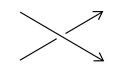 K[sub]+[/sub]
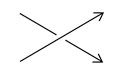 K[sub]-[/sub]
 L
L
Then ∇[sub]K+[/sub] - ∇[sub]K-[/sub] = z∇[sub]L[/sub].
Axiom 1 tells us that for any knot or link there exists a Conway polynomial; Axioms 2 and 3 give us a way to find it. Tomorrow I shall post an example of how to use these axioms to find the Conway polynomial of a knot (using a specific example, most likely the trefoil, but maybe some others), and perhaps I shall also describe the Jones polynomial, the HOMFLY polynomial, the chromatic polynomial, and more.
Edit: Wow, sorry about that, I could have sworn this topic had been replied to very recently, and I didn't realize it had been moved from the formulas section.