Math Is Fun Forum
You are not logged in.
- Topics: Active | Unanswered
#351 Re: Maths Teaching Resources » for a challenge » 2006-07-12 16:14:45
Hopefully we all know Euler's formula:
For this problem, let 0 ≤ θ ≤ 2π. Now ask yourself, for what value of θ will e[sup]iθ[/sup] = i? Why yes, it's π/2!
So now we know that e[sup]iπ/2[/sup] = i. Now let's take it to the next level:
Now if we remove the restriction 0 ≤ θ ≤ 2π, then we get the general solution
where n ∈ Z. I'm not sure why you have just n and not 2n, Ricky. Odd values of n in your solution would give
Now take a simple case of some 0 ≤ θ ≤ 2π that could give e[sup]iθ[/sup] = -i. 3π/2 is our value. Then
So, given the same interval 0 ≤ θ ≤ 2π, (-i)[sup]i[/sup] ≠ i[sup]i[/sup], so I will conclude that your n should be 2n.
#352 Re: Maths Teaching Resources » for a challenge » 2006-07-12 12:16:22
You could always use my historical proof that i[sup]i[/sup] = e[sup]-π/2[/sup] ∈ R. I did it for a talent show and won, so I guess it could be used as good mathematical magic. It was a great day for mathematics. If you would like me to write out the problem, just ask.
#353 Euler Avenue » ζ(2n). » 2006-07-12 12:06:19
- Zhylliolom
- Replies: 20
For a time I wondered how one could possibly obtain exact values for various zeta functions, such as ζ(2) = π[sup]2[/sup]/6 and ζ(4) = π[sup]4[/sup]/90. Then, one fateful day, by luck or extreme insight, I realized that Fourier series could possibly do the job. Upon testing, I was pleasantly led the to correct answer. Due to the nature of the method, only values for ζ(2n) are obtainable. Of course, as far as I know, ζ(2n + 1) (odd values, basically) always appears unable to be expressed in terms of known constants. Anyway, let us move on to the method.
We begin by writing the Fourier series for a 2π-periodic function f(x) = x[sup]2n[/sup] defined on (0, 2π). For this example, we use the case n = 1, but this can easily be extended to any value of n.
I'll start by defining the Fourier series for anyone who is interested in this but has not seen it before:
For this problem, we will have f(x) = x[sup]2[/sup] and L = 2π.
Then
and
The the Fourier series expansion for f(x) is
Now when x = 0, the series becomes
Now, for the convergence of Fourier series, there are 3 conditions called the Dirichlet conditions:
1. f(x) is defined, expect for possibly at a finite number of points in (0, 2L).
2. f(x) is 2L-periodic outside (0, 2L).
3, f(x) and f'(x) are piecewise continuous in (0, 2L).
Now, our function is definitely defined all throughout (0, 2L). We defined f(x) as being 2L periodic, so it is a parabola from x = 0 to x = 2π, and this is repeated periodically(so f(x + 2π) = f(x)). On (0, 2L), f(x) is a continuous parabola and f'(x) is a continuous straight line. So the Dirichlet conditions are satisfied.
Now that the Dirichlet conditions are known to be satisfied, what does that do for us? It does something very good. It tells us that the Fourier series for f(x) will converge to
Now let us return to the problem at hand. We had just let x = 0. This means we can find what the Fourier series will converge to when x = 0, thanks to the Dirichlet conditions:
Now we may write the Fourier series at x = 0 as
Now we may easily solve the equation for ζ(2):
And so it is done. In general, to find ζ(2n), write the Fourier series for a 2π-periodic function f(x) = x[sup]2n[/sup] defined on (0, 2π) and work out the problem as I have above.
Does anyone else have methods for finding exact values of infinite series?
#354 Re: Guestbook » What would you prefer? » 2006-07-12 00:58:12
Right. So, do you say you're allergic to things you don't want to eat, or just for no particular reason?
Both, but I really don't like cake or ice cream all that much, so they fall under the "don't want to eat" category.
#355 Re: Guestbook » What would you prefer? » 2006-07-11 21:42:32
Are you allergic to dairy?
No, I'm a compulsive liar. I say I'm allergic to things all the time when it really isn't true. Vanilla ice cream does make me feel funny though.
#356 Re: Dark Discussions at Cafe Infinity » Principia Mathmatica » 2006-07-11 09:33:15
If you'd like more than just information and would like the experience the text firsthand, just visit the bookstore. As All_Is_Number mentioned, Stephen Hawking's text contains the material and it shouldn't be too hard to find at a bookstore. I've encountered it a few times myself. My bookstore also has some edition of the Principia itself, so maybe you could find that too.
#357 Re: Guestbook » hannah » 2006-07-11 09:25:15
This calls for a math-off. *rolls out the blackboards and gets the stopwatch*
#358 Re: Guestbook » What would you prefer? » 2006-07-11 09:16:21
ice-cream or cake?
Neither, I'm allergic to them.
a pet dog or cat?
A cat, of course.
the computer or telivision?
I need the computer.
a theam park or tropical island?
A tropical island.
a hot dog or a hamburger?
A hamburger.
red or green?
I don't like to discriminate against colors. It's all about context. Red for love, green for go...
a hotel or resort?
A resort.
dasie or dandiline?
Maybe a rose curve.
to be hot or cold?
I like it hot.
art or english?
Art I suppose.
music or reading?
Music.
#359 Re: Help Me ! » Probability » 2006-07-11 09:00:31
I think the solution has something to do with that thing with four legs that you eat on. What's that word again?

What does my wife have to do with this problem? And how did you know that I do this with her?
#360 Re: Help Me ! » Help » 2006-07-09 16:51:59
Using basic statistics, we realize that we need to write out the formula for the Guassian distribution:
Then to find the probability that the tire will wear out before 54,000 miles, we simply integrate:
Then out of 2,000 tires,
are likely to wear out before 54,000 miles. Note that a 46th tire begins to wear out halfway but doesn't completely make the transformation to a worthless tire.
#361 Re: Help Me ! » Trigonometry » 2006-06-24 15:19:31
Yes, it is the quadratic formula. If we let x = cos θ, then
which may be solved by means of the quadratic formula.
#362 Re: Help Me ! » Trigonometry » 2006-06-24 13:35:08
#363 Re: Help Me ! » calculating normal vector from equation for a shape » 2006-06-23 20:53:16
If by "tangent space" you mean the tangent plane to the surface at a given point, that is just as easy to determine.
The rectangular form of the plane is given by
Edit: Hey, it looks better!
#364 Re: Help Me ! » calculating normal vector from equation for a shape » 2006-06-23 20:24:55
what does the |(a,b,c) notation actually mean? Ive never seen it before
It tells the reader to evaluate the preceding expression given that (x, y, z) = (a, b, c), where a, b, c are arbitrary points. For example:
Basically, in this situation, the notation tells you to evaluate the expression at the point indicated in the subscript.
I see the notation a lot with derivatives. Suppose y = x². Then
#365 Re: Help Me ! » calculating normal vector from equation for a shape » 2006-06-23 19:24:44
A lot of the work is cleared away if the surface requires no parametric definition. In fact, if F(x, y, z) = 0 is the equation of the surface, then the normal to the surface is
where (a, b, c) is the arbitrary point of the surface which we wish to find the normal and the operator
is defined by is called the gradient of F.So, for the surface you defined and found the first order partial derivatives for in your previous post,
#366 Re: Help Me ! » calculating normal vector from equation for a shape » 2006-06-23 15:10:57
Sorry for taking a little while to respond to this, but I take forever to type up LaTeX and I had to head out for the day yesterday while I was typing it up. Anyway, here's my simple calculus/vector analysis method for doing it.
For a torus:
Since you mentioned a torus first, I'll use it for the first example. The parametric expression for a torus is
where c is the distance from the center to the inner boundary of the torus and a is the radius of the torus "tube."
Now, first we want to find the tangent vectors to the "curves" of the torus. To do this, we calculate the partial derivatives:
Since the magnitude of the vectors is irrevelant (unless the magnitude is 0, then that's no fun), we can simplify the partial derivatives by dividing through by a in f[sub]u[/sub] and (c + a cos u) in f[sub]v[/sub]:
Now we may simply put our parameter values u and v in for our point of interest. We have two partial derivatives here, so for our arbitrary parameter values, we will get two tangent vectors. This is a good thing, since from basic vector analysis, we know how to find a vector mutually perpendicular to two given vectors in R[sup]3[/sup]: the cross product. So now what we merely need to do is take the cross product of the two tangent vectors obtained:
This process can be used for other surfaces, such as a sphere (parametrically defined in R[sup]3[/sup] by [r cos u sin v, r sin u sin v, r cos v]).
I leave you with the following note:
Edits: It seems that the forum is thinner than the preview space... and I can't get some of the spacing right still. Oh well.
#367 Re: This is Cool » The Golden Ratio by Mario Livio. Anybody read it? » 2006-06-19 13:28:03
is i ever usefull?
i has many applications outside of pure mathematics. In special relativity, time is treated as imaginary in Minkowski space in order to make it symmetric to space: the fourth dimension, time, is given as x[sub]4[/sub] = ict. Quantum mechanics is littered with imaginary numbers. The example of i from quantum mechanics which springs to my mind instantly is Schrödinger's equation:
I know imaginary numbers play a role in electrical engineering as well, but sadly I do not have as much experience as I wish to in that area.
#368 Re: This is Cool » The Golden Ratio by Mario Livio. Anybody read it? » 2006-06-18 19:01:44
I suppose the "noteworthy sum" for i can be used to simplify the third expression. I don't know why I didn't notice this before. Perhaps I liked the more complex formula and didn't want to change it. Anyway:
On second thought, this formula is more beautiful due to the compactness compared to its other form. Also, I prefer the relation of φ with constants not including itself, at least in this case.
On the topic of the book, I have not read it. I am becoming more interested in φ though, and I see this book everytime I go to buy more math textbooks, so perhaps I will give in a purchase it in the future.
Edit: A period was not where it needed to be. I can't handle mistakes like those!
#369 Re: This is Cool » The Golden Ratio by Mario Livio. Anybody read it? » 2006-06-18 16:21:53
This post has inspired me to work out some expressions for φ. Being a fan of infinite series representations of special constants, I chose to focus on that area:
In the process of deriving the third equation above, I came across a noteworthy sum:
I'll spend some more time finding expressions for φ and other constants later.
Edit: For some reason I had put the negative in formula two outside of the first sum. Interestingly enough, this made it an expression for -1/φ.
#370 Re: This is Cool » The Golden Ratio by Mario Livio. Anybody read it? » 2006-06-18 11:23:05
Don't mess with that number! It is the Devil's constant!
#371 Re: Help Me ! » M2 QUESTION - HELP Exam on Monday! » 2006-06-17 17:25:40
In a frictionless enviornment, applying a constant positive force will constantly accelerate an object. Thus, if the force is always acting on the marble, the marble will be at a different velocity at any point in time. So asking the speed is meaningless.
The marble is undergoing uniform circular motion, so the force is centripetal and thus the resulting velocity change is only directional. The magnitude of the velocity vector (the speed), which the problem asks for, remains constant.
#372 Re: Help Me ! » M2 QUESTION - HELP Exam on Monday! » 2006-06-17 10:06:13
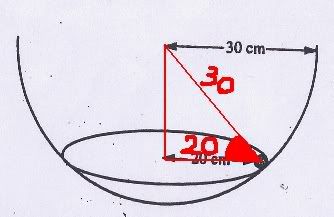
If you wish to find the indicated angle in this diagram, it is arccos(20/30). The hypotenuse is 30 because the problem tells us that the bowl is a hemisphere, so the distance from the center to any point on the surface of the bowl is simply the radius, 30. Hopefully this is the mentioned angle you needed to solve the problem, if you need more pieces of the puzzle, just ask.
#373 Re: Help Me ! » Row reduced echelon form » 2006-06-13 22:35:08
To reduce to echelon form, apply Gaussian elimination. To do this you take m = -a[sub]i1[/sub]/a[sub]11[/sub] times the i[sup]th[/sup] row and add the 1st row to it. This will sound a lot better when you see the example worked out:
is our matrix. Let row 1 = L[sub]1[/sub], row 2 = L[sub]2[/sub], and row 3 = L[sub]3[/sub].For row 2, m = -1. So replace row 2 with -L[sub]1[/sub] + L[sub]2[/sub] and get
For row 3, m = -1. So replace row 3 with -L[sub]1[/sub] + L[sub]3[/sub] and get
Now we must apply the algorithm again, using a[sub]22[/sub] = 1 as a pivot.
m = 3 this time (-3/-1), so replace row 3 with -L[sub]2[/sub] + L[sub]3[/sub] and get
At this point, the matrix is in echelon form, which is what I believe you asked for. If you happened to mean row canonical form, I'll make a post for that. Please ask any questions, as I am unsure how clearly I explained this algorithm for you.
#374 Re: Help Me ! » Parametric Differentiation » 2006-06-13 15:33:32
Silly me! He's right, I checked a web page about it.
dy/dx is (dy/dt) / (dx/dt).
Oh well. I think Zhyl is using the quotient rule, but I can't remember it, square in denominator and some combinations subtracted in numerator?
Yes, the quotient rule was used to determine dy/dt and dx/dt, but dy/dx was determined by simply putting dy/dt over dx/dt and simplifying. Just to spark your memory,
Somewhat pointless edit: Assuming v ≠ 0.
#375 Re: Help Me ! » Parametric Differentiation » 2006-06-13 14:14:28
For parametric functions,
To solve your specific problem, we find both dy/dt and dx/dt, and then simply put them in the numerator and denominator, respectively.
Then