Math Is Fun Forum
You are not logged in.
- Topics: Active | Unanswered
#301 Re: This is Cool » The First Hard Drive from 50 Years Ago » 2006-07-30 23:46:05
"So how many songs can this thing play?"
"Well... it only has space for one. And you can't really hear it over the noise of the hard drive."
He could put it on wheels and have his own primitive one-song iPod with him everywhere he goes (provided it fits where he goes).
#302 Re: Jokes » Lawyers » 2006-07-30 23:43:23
I have used RealEstateBroker's "Lawyer at a Funeral" joke with friends. Thanks for providing me with such an enjoyable joke to share with the community.
I'll submit some:
-If you are stranded on a desert island with Adolph Hitler, Atilla the Hun, and a lawyer, and you have a gun with only two bullets, what do you do?
-Shoot the lawyer twice.
-How can you tell when a lawyer is lying?
-His lips are moving.
-What's the difference between a lawyer and a herd of buffalo?
-The lawyer charges more.
#303 Re: Guestbook » Compliments » 2006-07-30 23:31:28
Hey guys, I have to say that I enjoy this forum a great deal, and spend a substantial amount of free time browsing it. I'm glad it exists.
As for math itself, I couldn't live without it! It's my life. It's my number one use of both free time and work time. Hmm, this makes me sound like a lonely deranged man... but be sure, that such a thing is not true.
#304 Re: This is Cool » The First Hard Drive from 50 Years Ago » 2006-07-30 23:14:19
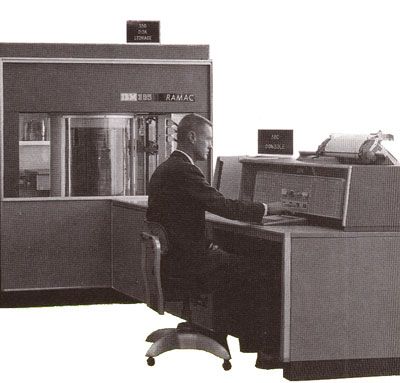
I found the description of it hilarious. Just imagine how a 1956 man's head would spin if he were transported to 2006 and saw how small and powerful hard drives have become.
Here's the 1956 man working with the pinnacle of his day's technology:
#305 Re: This is Cool » I pwn! » 2006-07-30 23:06:06
Placement tests like the one you described don't sound like the best tool really. As you said, the test didn't really even probe your true talents, and you say you didn't even get to calculus-level questions? From the posts I have seen by you, you sure do know calculus and deserve to move on to a higher level, but from the sound of this test, it's like they'll just throw you in calculus I if they can't stump you on enough of the problems. But I'm certain that you deserve a higher placement than that. Perhaps you should consult the math department and ask to take some sort of challenge test? A test that would evaluate your knowledge of more advanced concepts (primarily calculus I & II) and could determine placement in a much more appropriate way for an individual as motivated and talented as you. By the way, it sounds like you are finally done with the placement test; did they assign you to a math course yet?
#306 Re: Help Me ! » Riemann hypothesis » 2006-07-30 20:30:22
se7en, (Edit: Ricky didn't leave it out in his post, I just didn't see it. And yes, any real number a is a complex number with Im(a) = 0. By the way, I just want to be friendly and correct another statement of yours, to save you some confusion: you said 89 = 90 + i², which is true, but no, you cannot say Re(89) = 90 and Im(89) = i, because by definition a complex number is expressed in the form z = a + bi, where a and b are real numbers, and Re(z) = a and Im(z) = b. Since a and b are real you cannot let b = i. This, along with the previous statement about how Re(z) and Im(z) must be real numbers, explains why Re(89) ≠ 25 and Im(89) ≠ 64i in your other problem (even though following your logic Im(89) should have been -64i, I assume it was just a simple mistake on your part with forgetting the subtraction though)) (refer to my post at the top of this page if you wish for another statement of the hypothesis). The thing is, it is conjectured that Re(s) = 1/2 for all non-trivial zeros s. As my post explained, ζ(s) = 0 for every negative even integer, and thus those zeros are considered trival.
In regard to the generalized Riemann hypothesis, no, it does not say that ζ(s) = 0 (or L(χ, s) = 0, since you mentioned the Dirichlet L-series and this series is really what makes this different than the plain old Riemann hypothesis) if Re(s) ≤ 1/2. What it is saying is that if ζ(s) = 0 or L(χ, s) = 0, then Re(s) ≤ 1/2 (basically it's the other way around from what you said). Proof of the Riemann hypothesis would help this hypothesis as the mathematical world knows that the trivial zeros of ζ(s) have the property Re(s) ≤ 1/2 since they are all negative even integers, and if one proves that all other zeros of ζ(s) (the non-trivial zeros) have the property Re(s) = 1/2, then all the bases are covered, we would be certain that Re(s) is either 1/2 or a negative even integer if ζ(s) = 0. Now L-functions are very similar to Riemann's zeta function (for example, L(χ, s) = ∑χ(n)/n[sup]s[/sup], and for χ(n) = 1, L(χ, s) = ζ(s)), and thus properties may easily be compared between the two, but this is only a fraction of the power of the Riemann hypothesis.
So, using the previous paragraph this question can be answered:
...is it possible, for example, for there to be a zero when the real part equals 1/4 but there's no zero when the real part equals 1/8?
No, the conjecture says that it is only possible for a zero s to have the property Re(s) = 1/2 or s = -2, -4, -6... It cannot be 1/4, or 1/8 or anything other than a complex number with real part 1/2 or a negative even integer.
#307 Re: Help Me ! » partial order » 2006-07-30 15:24:34
If A, B, and C are real numbers, isn't it required that they be comparable by trichotomy and transitivity? Or am I wrong? Does trichotomy only say that there exists a definite relation between two real numbers, but says that it is not necessarily able to be found? If so, can you give an example?
#308 Re: Help Me ! » Riemann hypothesis » 2006-07-30 15:15:26
Correct, it remains to be proved.
#309 Re: Help Me ! » Riemann hypothesis » 2006-07-30 15:01:26
Ricky laid it out on the first page, but I'll write it out for you (I like to use LaTeX):
From this you can say that the non-trivial zeros of ζ(s) lie on the "critical line" σ = ½ + it. ζ(s) has zeros at all negative even integers, so the zeros s = -2, -4, -6 are referred to as the trivial zeros of ζ(s).
I'm not sure what you know about the zeta function so I'll write a few things extra for you.
For integral n,
For real x,
For complex z,
One last note:
Γ(x) is the gamma function, defined by
Γ(n) is related to the factorial for integral n by
and may be considered a continuous extension of the factorial.
#310 Re: Help Me ! » Riemann hypothesis » 2006-07-30 09:15:28
Wow, this thread grew substantially overnight.
Ok se7en, this here isn't a question as to whether or not your thesis works, so I hope you may choose to reply to it: when do you think your algorithm will be sufficiently used by you so you'd feel comfortable publishing some proofs and thus releasing it to the mathematical community? Are you going to wait until you're done with Riemann, or do a few more problems, or wait until you actually present your master's thesis?
I found it interesting that Ricky brought up the Poincaré conjecture... I came here just to ask if you could do that, but I guess it's already been talked about.
#311 Re: This is Cool » Pi to a Million Decimal Places! » 2006-07-29 20:00:50
It was set last summer apparently, so the sites with the 42,000 digit figure are just out of date i'm guessing.
#312 Re: This is Cool » Pi to a Million Decimal Places! » 2006-07-29 19:05:48
Ok, I was assuming pretty darn good recitations of pi, like this one:
"Gaurav on Monday recited 10,980 digits, breaking the North American and U.S. record of 10,625, which had stood for 27 years. During an after-school session, he recited about two numbers per second for one hour, 14 minutes and 28 seconds."
That's what made me say hours  . I guess I was imagining the musical idea as being a significant aid such that someone could set a record with it.
Haha, there's a man who recited 83,431 digits. It took nearly 24 hours. Great stamina there.
#313 Re: Exercises » Completing The Square » 2006-07-29 14:06:33
3. x² -10x + 16.
4. 2x² - 3x + 4.
Bonus:
5. Complete the square for both x and y, to find the standard equation for this circle:
x² - 6x + y² - 4y + 9 = 0.
#314 Re: Help Me ! » gcd and lcm » 2006-07-29 13:56:58
Alright, captain. Consider the set of all primes that divide a and/or b:
Then for some suitable nonnegative exponents
we have
Now p[sup]q[/sup] divides p[sup]r[/sup] if and only if q ≤ r, so
But we can also tell that for ab ≠ 0,
Now consider the product
Also, consider the product
Because of the fact that
we have
Thus we can conclude that the two products are equal, so
Is that good enough?
#315 Re: Help Me ! » Riemann hypothesis » 2006-07-29 09:23:02
I have to say that I don't believe a word you say, but I eagerly await that day.
Eagerly await the day there's no open questions in mathematics? What? I don't know if that's what you're referring to, but I wouldn't like a world like that. I don't think it's very possible either, so I guess I don't have anything to worry about. It would be a sad day when us mathematicians are left with nothing to prove. If I can't get a job in 10 years after going through college for math because R-66Y can not only calculate faster than me but prove anything and do it without asking for a salary, I'll be pretty upset.
...topology, manifold theory, Lie algebras, differential forms, exterior algebra, Clifford algebra...
I love it when you talk dirty  . But you're right, this thing would have to be more than insanely good to be able to solve ANY problem in ANY mathematical field. It's already impossible enough that it could solve 3 of the greatest problems in history related to number theory.
#316 Re: This is Cool » Pi to a Million Decimal Places! » 2006-07-29 08:58:53
Well... seeing that there are 10 possible digits (0-9) and thus 10 notes/chords you would need to use, it'd be hard to create something remotely diatonic. Sure, you could maybe put in secondary dominants or something for the 3 extra notes... possibly even make them the tonic, supertonic, and mediant an octave higher, but with the way the digits go the music would be rather random and hard to memorize. Another negative aspect of using music is that once you get to a respectable amount of digits, it'll take several hours to recite them all, so you'd need to remember a pretty long piece. Maybe some guy who is a professial orchestral musician with an interest in mathematics could pull it off, who knows.
#317 Re: Help Me ! » How do I cure carelessness? » 2006-07-29 08:49:26
By the way, is this a written test or oral(like where you race to buzz in with an answer against others, like a math bowl)?
#318 Re: Help Me ! » How do I cure carelessness? » 2006-07-28 20:31:37
I'm not too sure what to say to help you other than calm down. Quickly check over your work to make sure you don't do something foolish. It's not worth submitting that answer faster if it's not the right answer.
#319 Re: Help Me ! » 2+2 = 3.99 recurring?? » 2006-07-28 17:45:31
I'd imagine that the expression you posted is undefined, George.
On a slightly related note to this thread (I didn't want to start a new one... I don't know if it would be worth it), here's an article I was reading where 0.999... comes up as something that makes the real numbers contradictory and flawed (as well as trichotomy, pure blasphemy!). Anyway, here is the article if you want to read the ideas of a deranged mathematician:
#320 Re: Dark Discussions at Cafe Infinity » Probability Paradox » 2006-07-28 12:55:29
I think you're thinking that his signature is his answer?
#321 Re: Help Me ! » Riemann hypothesis » 2006-07-28 12:19:20
Fermat's Last Theorem: For n ≥ 2, x[sup]n[/sup] + y[sup]n[/sup] = z[sup]n[/sup] has no solutions for nonzero integers x, y, and z. Looks simple, but it's extremely tricky to prove. I'll include a copy of the only proof currently in existence. It'll make your head spin.
The Wiles paper: http://math.stanford.edu/~lekheng/flt/wiles.pdf
Goldbach Conjecture: Every even integer greater than 2 can be written as the sum of two primes. Once again, a very simple and easily understood statement, but to this day nobody has supplied a correct proof.
That would be incredible if someone solved the Four Color Theorem in such a concise manner. I was actually reading up on it today, and I have the following facts to offer: the first proof of the theorem was a proof by exhaustion with 1,936 cases. Today the lowest is 633 cases.
Edit: Sure, I've also derived results independently from my studies of mathematics only to later discover that somebody else had already established such discoveries many years before me, but these problems are on a completely different level. Mathematicians have been struggling with them for hundreds of years. It is highly unlikely that these problems would be solvable on a high school level, and even less likely that the same process could be used to prove all three of these legendary problems. But there's nothing we can really do yet; until we see the proofs we have no idea whether the algorithm or its application to these problems is correct, so for now all we're doing is assuming the most reasonable case. Anything is possible, but distinct events are on varying levels of possibility.
#322 Re: Dark Discussions at Cafe Infinity » Music; what's your song? » 2006-07-28 11:58:26
Hmm...
Types of music: Classical compositions, instrumental shred, classic rock, grunge.
A few favorite musicians/bands: Beethoven, Steve Vai, Joe Satriani, Pink Floyd, Led Zeppelin, Alice in Chains, Soundgarden, Pearl Jam.
Favorite Song: For the Love of God, by Steve Vai. This song controls my life.
#323 Re: Help Me ! » Riemann hypothesis » 2006-07-28 10:17:16
I was hoping you'd make it this morning, I was waiting in the shadows ever since I saw you at 989 a day or two ago, and I saw you were at 995 thi morning too.
I'm a lowly high schooler too, and I have the same feelings you do, Ricky. They don't emphasize proof at all here. Even in mathematics competitions they're real light, I can do a terrible "proof" (sometimes I don't even feel like it shows anything at all, but I have to submit something) and they're perfectly fine with it. Then when I started reading up on vector spaces and topology and the like, I wasn't breezing through, as there aren't as many "exercises and problems" in these topics as there are "prove theorem 6.2.7". It's a lot different from calculus or "high school math", where you mainly solve exercises but rarely prove anything (I don't think I've ever had to do a real proof for any math assignment). Anyway, I guess the idea here is that if se7en is a high school student, it is unlikely that he has much experience with proofs unless he has unique or special math classes, or he does them in his private studies.
Just a brief semi-off-topic question while I still have it in my head: does anyone know of a good book that is a good aid in constructing proofs? Kind of like a guide to proving theorems. I've never been formally taught this kind of stuff and I find it pretty essential. I think I'll go look up some stuff on Wikipedia and see what I need to learn.
#324 Re: Help Me ! » Riemann hypothesis » 2006-07-28 09:44:28
He may not want to show the proof of Fermat's Last Theorem because he says his algorithm can solve all of these problems. So if someone sees the algorithm in the proof he posts for Fermat, they could take it and adapt it to the Goldbach Conjecture, Riemann Hypothesis, and other big problems.
I'm sorry, but I'm very reluctant to believe all of this. If you have such an algorithm, it must be extremely creative and original to be on a high school level (I assume it's there because you ask for the Riemann hypothesis to be explained in "terms a high school student can understand") and not have ever been caught by the countless mathematicians who have lived ever since our "high school level" mathematics have been around. I mean, just imagine how many mathematicians there have been who have tried to find a simple proof to Fermat's Last Theorem. If you've really managed to prove these great problems, big congratulations to you. I've been working on them this summer but I haven't gotten too far. I was hoping to solve mabye one, many moons from now... maybe if they do get solved, I can still prove them in another way. Man, if this is all true, I guess my chances for mathematical fame in this lifetime are gone, everyone in this era would instantly be downsized, and the greatest problems will have already been solved, so what could I do after that!?
Is Ricky's explaination good for you? He laid out the basic hypothesis for you, but we don't know how much you need to know for you to be able to use this algorithm.
(Hey Ricky, congratulations on post 1000)
Edit: He has 7 posts too, this is pretty insane. April 1st was a while ago though.
#325 Re: Help Me ! » Here is another cache that stumps me, but may not be about math??? » 2006-07-28 01:52:14
Yeah, maybe it's just me but I feel like they emphasized the fact that it was an indefinite integral. They could have just said "rotten integral" and gotten the same log answer.
Edit: Haha, I was thinking of pi too at first. Man, I love math.