Math Is Fun Forum
You are not logged in.
- Topics: Active | Unanswered
#151 Re: Help Me ! » How to do this integral? » 2008-03-29 17:06:22
lol! has everyone gone nuts? Double integrals?
Let u = ln(x + 1)
let dv = x dx
its easy as pi! 
#152 Re: Maths Is Fun - Suggestions and Comments » Chess » 2008-03-21 11:31:42
did you write the AI mathsisfun?
#153 Re: Help Me ! » newtons second law for a system of particles » 2008-03-19 08:51:14
whoops! Sorry Jane, I forgot about this thread.
The acceleration is in 2 dimensions and therefore has two componants. The book gives the answer as (2.35)i - (1.57)j
You gave the acceleration of the boxes, they want the acceleration of the center of mass. 
Anyway, the reason i asked about summing individual forces, is this. Yes, canceling forces are a waste of time, but that still takes care of them. So I can basically just note that cancelling forces can be ignored. However, i believe canceling forces do not necessarily mean the force is internal. Know what I mean?
In otherwords, I'm hoping if i'm unclear about what are internal or external, i can just sum all the individual forces to find Fnet and internal forces will be taken care of. However, I still think i need to be able to identify an internal force.
Right now I'm thinking maybe its two parts of the system acting directly against eachother, rather than a force on one part of the system thats acting on one part, and eventually acting on another part after its been altered.
#154 Re: Help Me ! » newtons second law for a system of particles » 2008-03-16 14:20:05
Maybe....
What i'm thinking right now is..
Jane, would it work just to sum all the parts of the system, internal and external? Because internal forces should cancel out anyway, right?
#155 Re: Help Me ! » newtons second law for a system of particles » 2008-03-15 13:13:57
Right! And all of what you say makes sense! But doesn't this defy the books statement? I mean we are talking about newtons second law for a system of particles, and we are told that the total mass, times the acceleration of the center of mass of the entire system is equal to the sum of the net external forces (with internal forces ignored). If the force of the rope is internal for the entire rope-block system, then wouldn't that imply, as i explained earlier, that the acceleration of the center of mass is zero in the horizontal direction?
In otherwords, you said the force would be internal for the entire rope block system. Is that not the system we are considering? Isn't newtons second law for a system of particles used when you want to consider the entire system rather than the individual parts?
#156 Re: Help Me ! » newtons second law for a system of particles » 2008-03-15 09:54:21
Okay, it seems the login is working again.
#157 Re: Help Me ! » need help understanding work (physics) » 2008-02-27 09:23:30
WHEW! thanks for clearying that up for me, Jane! It was annoying me to no end! Now it makes perfect sense and doesn't annoy me. HUZZAH! The thrill of comprehension!
#158 Re: Coder's Corner » variable swapping puzzle » 2008-02-27 09:19:26
I'd be wary of using that one line solution, since it can be interpretted two different ways by the compiler. If it evaluates right to left then it will set x = y first, then subtract that from x + y, which is now y + y, and you'll end up with y = y and x = y. Of course, I realize that you aren't suggesting actually using such code, but I thought that should be pointed out.
I suppose it might be interpreted different ways by different compilers, but my understanding of parenthesis is that inner most parens are always evaluated first, thats why i have doubled parens around x + y. So I'm PRETTY sure this would work on any correct compiler.
#159 Re: Coder's Corner » variable swapping puzzle » 2008-02-26 11:15:08
the purpose of this puzzle is by no means to save memory or time, its just a puzzle for fun.
However, what I like about TheDude's method is you could use it in assembly to swap the values in two registers without having to use an extra one. Pretty cool!
Does anyone else have any fun code wielding challenges? post them here!
#160 Help Me ! » need help understanding work (physics) » 2008-02-26 11:04:49
- mikau
- Replies: 2
I'm getting kind of frusterated because I can't really see the logic in the idea of work in physics.
My book defines work, as "energy transferred to or from an object by means of a force acting on the object."
thats fine, but in order for that to make sense, you need to define some interval of time or distance during which that change occurs. Distance, it appears, is what they choose.
Now here's where I'm getting annoyed, the book claims that when a force transfers energy to or from an object, you say that work is being done on the object by the force. Thats also fine, but it again leaves out the detail of what kind of interval this change takes place in.
But the biggest annoyance with this definition is the following, consider a 100kg block that is dragged 5 meters across the floor by a force of 10 newtons as shown.
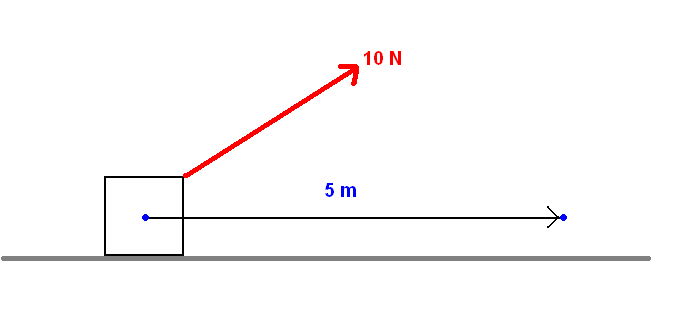
what bothers me greatly, is even though the object has no vertical component of velocity (and so has no vertical component of work) there is still a vertical component of force. In the absence of gravity, the object would accelerate upward and therefore, I strongly believe that energy is being transferred into the object by the force, but the force of gravity is transferring an equal amount of energy from the object. I put that in bold face because my entire understanding of the matter hinges on that.
But if the vertical component of force is causing energy to be transferred to the object, then definitely the vertical component of the force should contribute to the work done on the object by the force. However, sample problems in the book clearly show that this quantity must be treated as zero.
THEREFORE! I have concluded that the work done on an object by a force as it moves from point 1 to point 2 is NOT defined as the energy transferred to the object by the force, it is DEFINED to be the energy transfered to the object by the component of force in the direction of the displacement, only! It must be this by definition, and not as a result of some earlier definition. If it were only energy transferred, then the vertical component should effect the work done, even if this energy is canceled out by another force.
I have just now tried my absolute hardest to explain my understanding of the topic, my assumptions, and conclusions from them. I now hope, having exposed every bit of my understanding, someone can point out if I am correct, or in error.
#161 Re: Coder's Corner » variable swapping puzzle » 2008-02-26 10:06:52
hehehe!
Well here's for how to do it in one line.
#162 Re: Coder's Corner » variable swapping puzzle » 2008-02-26 05:43:55
that was quick! good job, thedude!
Now, can you do it in one line of code?
#163 Coder's Corner » variable swapping puzzle » 2008-02-26 05:35:45
- mikau
- Replies: 9
here's something i thought of today at school
suppose you have two integer values a and b stored in two int variables x and y
int x = a;
int y = b;
normally, if we want to swap the values in these two variables, we need to instantiate a temporary variable to save one of the values during the swap
int temp = x;
x = y;
y = temp;
BUT can YOU think of a way, in Java or C++, to swap the two int values without creating an additional variable?
You may use as many lines of code as you wish but you may not use loops or if statements or the like. You may not call any predefined functions of course. You may use boolean, arrithmetic or logical operators if you wish.
I have tested my solution in both C++ and java to make sure they worked.
#164 Re: Help Me ! » friction and weight » 2008-02-16 06:46:18
thanks, Jane! though all i really needed was the last line. I just wasn't sure what they wanted.
#165 Help Me ! » friction and weight » 2008-02-15 18:49:10
- mikau
- Replies: 4
this is weird.
an initially stationary box of sand is to be pulled across a floor by means of a cable in which the tension should not exceed 1100N. The coefficient of static friction between the box and the floor is 0.35. (a) what should be the angle between the cable and the horizontal in order to pull the greatest possible amount of sand, and (b) what is the weight of the sand and box in that situation?
(a) is easy, about 19 degrees and the book agrees with my answer. But (b) makes little sense. Clearly we determined the angle which maximizes the pulling power independent of weight, because the mass of the object was not given. What do they mean by weight in that situation? I thought perhaps they meant the normal force on the box from the floor, but also seems impossible to determine.
My book claims the answer to (b) is about 3.3 kilonewtons. No idea where they got this.
#166 Re: Coder's Corner » C++: pointers, references and memory leaks » 2008-02-14 03:05:11
Yeah, but in first.cpp it declares 'external int' without the 'extern' keyword. But, because of its name, I pressume it also is external.
So does the 'extern int externalInt' declaration in second.ccp create a new variable or does it refer to the same thing as the external int in first.cpp?
#167 Re: Coder's Corner » C++: pointers, references and memory leaks » 2008-02-13 19:47:10
Todays subject: internal and external linkage!
I'm just reading about namespaces in my C++ book for the first time. It began by introducing the subject of linkage, but its description is rather unclear.
here's my books description:
Linkage
Names can have internal and external linkage. These two terms refer to the use or availability of a name across multiple translation units or within a single translation unit. Any name having internal linkage can only be referred to within the translation unit in which it is defined. Names having external linkage are available to other translation units.
okay, but they don't explain what a 'translation unit' is. Immediatley after it uses the following listings to demonstrate internal and external linkage
first.cpp
int externalInt = 5;
const int j = 10;
int main()
{
  return 0;
}
second.cpp
extern int externalInt;
int anExternalInt = 10;
const int j = 10;
after this it says the externalInt variable defined in line 1 of first.cpp has external linkage.
I don't follow. First, this is the first time i have ever seen the 'extern' keyword. So i'm not sure what the first line in second.cpp means, and how many instances of externalInt there are.
Usually my book explains things better than this. Can anyone explain to me whats happening between these two .cpp files?
#168 Re: Help Me ! » force and motion » 2008-02-09 13:09:07
mikau wrote:Jane, perhaps i didn't make it clear, the idea is that the man is pulling on the rope such that the total tension in the rope is 1000N. So the idea is he IS standing on the beam, but there IS movement. He's pulling his platform upward.
Well then
I suppose. (Although if Mathsy is right it could be 0 instead.)

I am not really interested in the particular values, my question is how we derive them. How are the forces acting on each other? 
#169 Re: Help Me ! » force and motion » 2008-02-09 06:41:31
Jane, perhaps i didn't make it clear, the idea is that the man is pulling on the rope such that the total tension in the rope is 1000N. So the idea is he IS standing on the beam, but there IS movement. He's pulling his platform upward.
#170 Re: Help Me ! » force and motion » 2008-02-09 05:27:04
what do you mean a stable system? you mean you can treat the man and the beam as a single 75kg object?
#171 Help Me ! » force and motion » 2008-02-09 05:18:45
- mikau
- Replies: 9
how would you go about solving the following problem
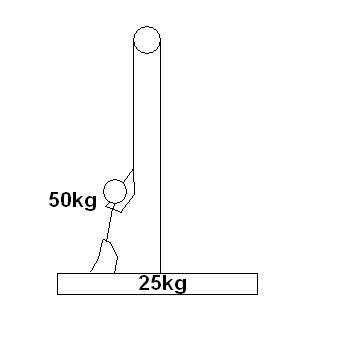
suppose the total tension on the rope is... say 1000N. How do we calculate the acceleration of the man/beam?
what puzzles me is that the man is standing on the beam, and thus the beam is pushing up on the man, but the man is also pulling on the rope which lessens his weight. So i'm not sure how to write the equations of force on each object.
(edit) whoops, i got the masses backwards in the pic. Fixed.
#172 Re: Help Me ! » physics progam wrong? » 2008-02-09 04:52:43
yeah, luca. Those are the same answers i got initially. It would seem the program is in fact wrong.
#173 Re: Help Me ! » physics progam wrong? » 2008-02-08 15:15:16
We use WileyPlus. So far its been pretty good. This is the first thing i've found so far.
#174 Re: Help Me ! » physics progam wrong? » 2008-02-08 14:15:20
well I just discovered that it accepts the angle of the position vector at t = 0.7 as the correct answer. Thats not the direction of travel, is it?
#175 Help Me ! » physics progam wrong? » 2008-02-08 13:56:09
- mikau
- Replies: 5
grrr...
in my physics course we have to do weekly homework assignments through a special online program. The program gives questions from the book with a few of the values changed, and you have to enter the answers in the provided textfields.
You get as many tries as you want, and it tells you when you've got the right answer. But this one problem appears to not accept the correct answer:
A 0.28 kg particle moves in an xy plane according to x(t) = - 15 + 3 t - 5 t^3 and y(t) = 26 + 7 t - 9 t^2, with x and y in meters and t in seconds. At t = 0.7 s, what are (a) the magnitude and (b) the angle (relative to the positive direction of the x axis) of the net force on the particle, and (c) what is the angle of the particle's direction of travel?
okay, this is an easy problem but for some reason its not working out. (a) worked fine, but for B it wouldn't accept my answer as correct. I eventually discovered it accepts 139.4 as the correct answer (which i'm pretty certain is absolutely wrong). For (c) I'm certain the answer is -127.84° (or 232.16°) but it says incorrect.
Its also worth mentioning that i did the books version of the problem and i got all three answers correct easy.
Should i email my professor or did I make a mistake somewhere.