Math Is Fun Forum
You are not logged in.
- Topics: Active | Unanswered
#1551 Re: Help Me ! » tough problem » 2005-12-01 18:44:30
Aha! I just did the problem and it worked out fine. Yeah the derivitive of the confusion ;-) was simply that I thought a and b were variables and not constants. So I gave them a derivative of 1 instead of zero. Thanks for your help ryos! You RYOCK! hehehe! :-P
You know when you get stuck on something like this for an ENTIRE DAY, its a pain in the neck but once you find out where your error was, you never forget the mistake you made and rarely make it again.
#1552 Re: Help Me ! » tough problem » 2005-12-01 18:32:42
The stuff you come up with, I swear...
The stuff I come up with? Or are you talking to yourself like all mathematicians do! Anyways I didn't invent that problem if thats what your thinking.
#1553 Re: Help Me ! » tough problem » 2005-12-01 17:21:29
Well I guess we must assume a and b are constants. I don't think we can differentiate with more then two variables.
So I guess it would have to be with respect to the independant variable. But if they are constants then their derivatives are zero. That makes a differance. I just hope its not a false assumption.
in this case if we have to find the derivative of u = bx we have to multiply b by the derivitive of x which is 1. And x * the derivitive of b. But if b is a constant then its slope is 0.
Ok I'll try messing with that to see if I can rearrange it into the desired form. But how am I supposed to know b and a were constants?
#1554 Re: Help Me ! » tough problem » 2005-12-01 16:58:06
And btw something thats also confusing me. If we differentiate:
u = bx
we get
du = b + x right? but does this mean b+ x is dx, bx? Both? Neither? I'm confused. x_x
#1555 Re: Help Me ! » tough problem » 2005-12-01 16:34:52
Hmm... I'll have to review the chain rule. But isn't that what I did? The derivative of bx is b * the derivitive of x (which is 1) + x * the derivitive of b (which is also 1) so it should be e^u (x + b) right?
Thats not the answer. My book wants the answer only in terms of a and constants. You can't use x. The answer to the problem is: a^2 / (a-1)
Wierd huh?
#1556 Help Me ! » tough problem » 2005-12-01 14:56:26
- mikau
- Replies: 8
I just can't get this one to work.
Let f(x) = e^bx and g(x) = e^ax. Find the value of b in terms of a such that [f(x)/g(x)]' = f'(x)/g'(x)
f'(x) = e^bx * (b+x) g'(x) = e^ax * (a+x) Correct? Did I do that right?
So f'(x)/g'(x) = e^(bx - ax) * (b+x)/(a+x) Correct again?
To find the deriviave of f(x)/g(x) I'll divide them first. e^bx/e^ax = e^(bx - ax) Right?
Now we'll find the derivitive:
e^(bx - ax) * ( b + x - ( a + x) ) which simplifies to e^(bx-ax) * (b - a) Correct?
So we found the quotient of the derivitives, and the derivative of the quotient. (thats fun to say! :-D ) If they are equal:
e^(bx - ax) * (b+x)/(a+x) = e^(bx-ax) * (b - a)
Fortunatly the e^(bx - ax) appears on both sides. So we can divide both sides by e^(bx -ax) to get:
(b+x)/(a+x) = b - a
We can now solve for b in terms of a and x, but the book has the answer only in terms of the variable x. If I could replace x with an expression involving a that would do it but I don't know where to find one. :-(
#1557 Re: Help Me ! » multiple differentials » 2005-12-01 14:40:06
[Sh]e's right! Technically we should say the slope of e^x when x equals two.
I think I see where the confusion is now, irspow, thanks.
#1558 Help Me ! » multiple differentials » 2005-12-01 12:57:07
- mikau
- Replies: 4
one thing thats bothering me. Sometimes it seems the rules for differentiating are not always true. For instance:
e^2
we know the differential of e^x = e^x dx so the slope of the line at 2 is e^2
But what if we used the fact that the derivative of x^n = nx^(n-1) ?
by this definition the derivative of e^2 should be ne^1 or 2e^1 but this is different then e^2!
So what if you took the derivitive of n^2 and n just happens to equal e or close to it? Would the derivative be wrong?
This is disturbing.
#1559 Help Me ! » differantiating products and quotients of trig functions » 2005-11-30 13:38:50
- mikau
- Replies: 2
Differentiating the products and quotients of trig functions tend to create a monster, since the product and quotient rule for differentials tend to produce expressions that are a bit on the long side. This tends to lead to a trigonometric identity nightmare! What I'm wondering is, is it ok to rearrange the function, before you differentiate?
This is the problem I had.
sin(2t)/cos^2 t
If you first replace sin(2t) with 2sin t cos t you have:
2 sin t cos t / cos^2 t
you can cancel out cos t and get
2 sin t/ cos t
But sin t /cos t = tan t so we can rewrite it as
2 tan t
differentiate and we get:
2 sec^2 t
Now thats easy as pi and it was the correct answer to the problem. But would rearranging before differentiating ever produce an ambigous answer?
Of course, the form of the original function must always be taken into acount, we cannot use values of t that would result in division by zero or the square root of negative numbers in the original function, even if those values work fine in the deriviate of the function.
Anyways, the question is, is rearranging before differentiating ever a bad idea?
#1560 Re: This is Cool » Philosophy of math » 2005-11-30 04:31:43
:-)
Heres another one!
What is math?
Math is fun! :-D
#1561 Re: This is Cool » Philosophy of math » 2005-11-29 18:24:02
"Math is the intelligence and order of the mind of God. This order enforced upon the world holds the physical word together. Without it, nothing could exist. God created the world, but first he created math, and built the world upon it." - Mikau
And btw, the idea of this thread is just to list lots of interesting philosophies about math. Not start a religious debate. If you do not believe in God, just ignore it, I'm not trying to preach or prove anything.
#1562 This is Cool » Philosophy of math » 2005-11-29 18:17:38
- mikau
- Replies: 36
What is math?
"Math is natures way of communicating with us" - Charlie Eps, Numb3rs
"Math is a gigantic can of whoopass in disguise" - Mikau
Whats your philosophy? What is math?
#1563 Re: This is Cool » My 3D engine: reinventing the wheel » 2005-11-27 08:13:14
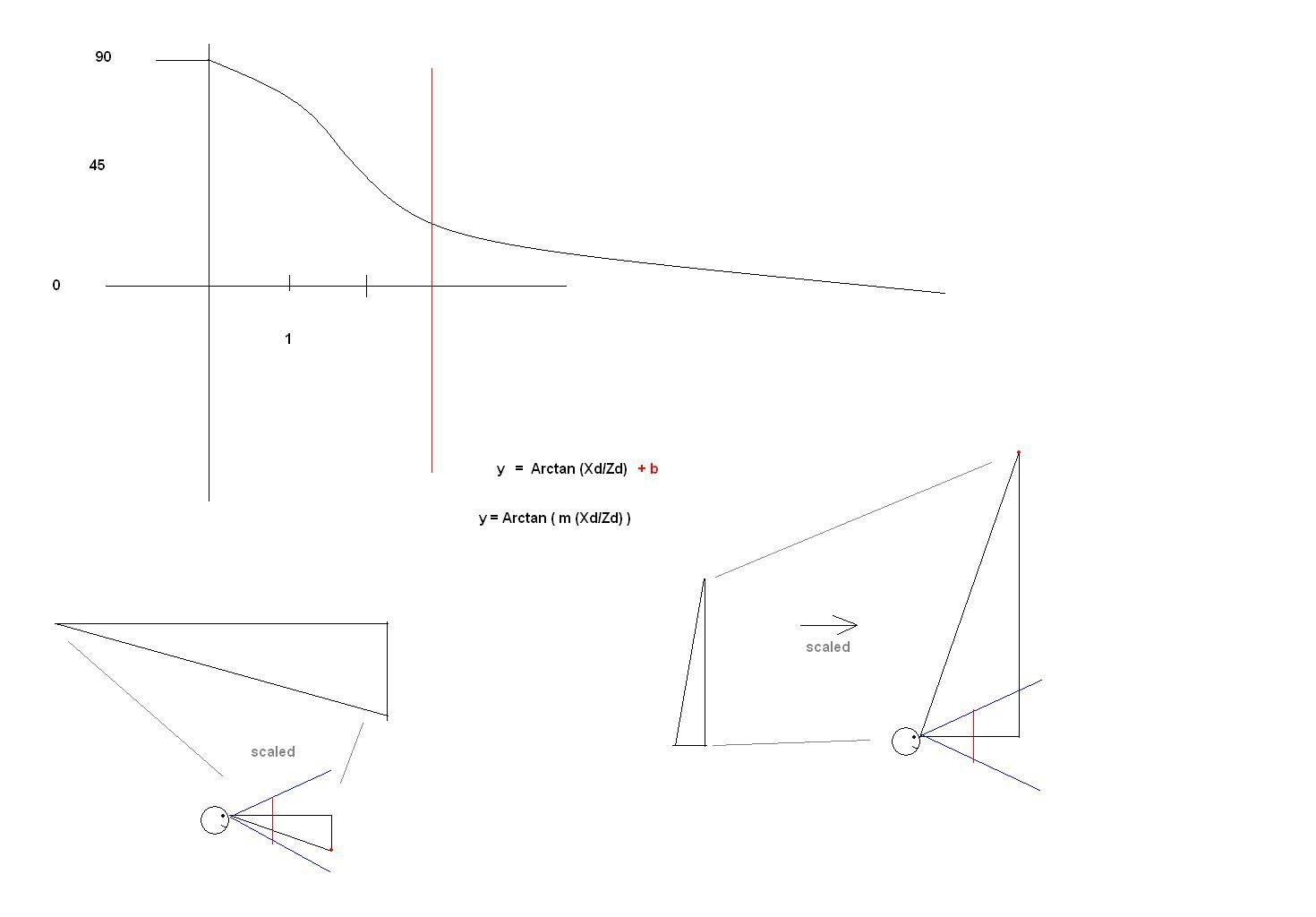
Ok heres the idea. As an object gets closer and closer, the angle from the viewer to the point gets closer and closer to 90 degree's. When its far away, changes of the distance and location of the object effect the angle at which the viewer see's it very little. This is the same reason why the sun or moon appears to follow you when your driving. Its so far away that proportionally small changes to your location hardly effect the angle at which you see it at all. As a point gets closer, the angle at which you see it begins to accelerate. Again, when your driving, it often appears nearby objects like telephone poles are moving a lot faster then the buildings far behind them. You know what I mean.
Anways, that acceleration is what makes objects go off screen when you get close or go past them. The angle to the object begins to accelerate towards 90 degrees and beyond. The viewing cone is 60 degree's wide at most so that disapears off screen.
Now when objects are far away, they vanish slower because the angles are not as abrupt. You can see the basic shape of the functions graph below. The angle to the object gets closer and closer to 90 degree's and accelerates towards it as it gets close. It slows down a bit as it gets close but its already off screen at that point.
Anyways, when I first measured the Z distance to a point and added the constant B to it, this was indirectly shifting the graph b units to the left. The red line I drew is where the y axis would be in that case. This shows why that worked to shorten the vanishing points. The curve is much slower and flater there. But it also shows why objects did not go off the screen when they were behind you. They had to go much farther back before the angles would hit 90 degree's and accelerate off the edge of the screen.
Then I had an inspiration. All I need to do to lessen the steepness of the curve is multiply (Zd/Xd) by a positive constant. Since the slope is negative, if we multiply Xd/Zd by say... 2, then the curve will be half as steep in every place. I created a constant m which would indirectly multiply the curve by 2 or whatever constant I wanted, to lessen the steapness of the curve. I tried it and it worked. Everything vanished slower. But there was a problem. It was doing what it was supposed to, no glitches, but since objects vanished slower, objects that weren't so far away weren't much smaller, and thus, they were bigger and dissapeared off the screen pretty quickly. Therefore you could not see much onscreen unless they were pretty far away, which is equivilent to just having a more narrow viewing cone. Dang.
At this point I'm not sure what else to do. Every possible adjustment I thought would be usefull I've figured out how to make, they all worked in differant ways, but none that allowed at least a 60 degree viewing cone without distortions. I can think of no other adjustments to the perspective that are not self contradictory. Objects need to both vanish slower and faster.
My design thus far would work fine for third person games, but for a first person game, you would have to have a very narrow viewing cone. 30 or maybe 40 degree's at most. I've often noticed first person video games seem to have a pretty narrow view but I doubt its as little as 30 degree's. But I could be wrong. It may be a natural consequence that a 3d illusion on a 2d plane must be limited to a narrow viewing angle to work properly.
Of course there is the possibility that certain adjustments must be made to compensate for the fact that we do not percieve a screen as a window to another world. If it were so, the objects are all in the exact locations they should be. (where we would see them through the glass) but since close and far objects are all on the same 2d plane (the screen) its more then a bit differant then just a glass window. So perhaps, adjustments must be made which in reality would be incorrect but tricks the brain into thinking it looks right. :-)
#1564 Re: This is Cool » The TV show Numb3rs and probability » 2005-11-22 15:07:24
Thats confusing! x_x
#1565 Re: This is Cool » The TV show Numb3rs and probability » 2005-11-22 11:21:42
No problem. I don't believe in interplanetary discrimination.
#1566 Re: This is Cool » The TV show Numb3rs and probability » 2005-11-22 11:09:12
I knew it! Am I a smart earthling or what?
But anyways, don't feel bad. Good job with the program, its cool that you gave us a very accurate demonstration for this thread.
#1567 Re: This is Cool » The TV show Numb3rs and probability » 2005-11-22 10:47:18
it will make a differance al right. that will happen about 1/3 of the time, and when it does, the point will go to the switcher. So that 1/3 of the points that are missing, all go to the switcher. That brings the odds up to 2/3.
Think clearly! :-D
#1568 Re: This is Cool » The TV show Numb3rs and probability » 2005-11-22 10:36:13
I know some basic C++ but I don't know much about arrays or static whatevers. lol. So I only half understand how that program works. But 1/3 of the answers are missing so somethings not right. If you flip a coin 100,000 million times, it should come up heads about 50 million times, and tails about 50 million times. If you end up with 33 million heads and 33 million tails then someone forgot to mark something down. (about 33 million times! :-O)
It cannot be denied, if the rules of the game are followed, if you do not pic a goat on the first time, you will win if you switch. The odds of picking a goat are 2/3. So there you have it.
#1569 Re: This is Cool » The TV show Numb3rs and probability » 2005-11-22 10:27:19
Why did you not get a total of 100 million? Instead your total is roughly 2/3 of 100 million. 1/3 of 100 million worked, 1/3 of 100 million did not work, what about the other third? If it goes to the switch then numb3rs WAS right.
What did you mean by "Makes sure the one reveiled was not the answer, if it was, the whole thing is discarded." Discarded? I'm not sure what you mean but just to make sure, after (for instance) door A is picked. The program should check to see whats behind door B, if its a goat, then reveal it and switch the choice to door C. If you picked door A and door B has a car behind it, then B cannot be revealed so you reveal door C and switch your choice WHICH WILL WIN YOU THE CAR! If you simply quite the game if theres a car behind the door you want to reveal, then about 1/3 of the answers should be missing, and that third should go to the switch method.
#1570 Re: This is Cool » The TV show Numb3rs and probability » 2005-11-22 04:39:44
Sorry all you people who think this works. IT DOESN'T!!
Proof
The past will never ever ever determine a greater probability for one posibility. The fact that you made a decision before does not change the probability that you have 2 options, "swap" or "stay" and two posibilities "car" or "goat". The chance is 50/50 (FULLSTOP).
Imagine that you dont choose one to begin with!! Lets play this out. options A B C. They tell you to pick one (BUT YOU DONT). Knowing that they will not pick the "car" they show you that C is a goat. Then they tell you to "stay" or "swap". You dont have a orginal choice. SO WHATS THE PROBABILITY!!! You have to choose A or B. 1 is right, 1is wrong! The probability is 50:50. The same as if they never had a C in the first place.
If You still dont belive me then believe me when I say that Im a computer Scientist and I simulated the whole process in a computer and run the simulation ONE HUNDRED MILLION TIMES!!!!! The simulation showed that it swapping worked 50% of the times.
CONCLUSION:
NUMB3RS WAS WRONG!!
Something doesn't sound right there. You eliminated the selection. In your example, you said we will not make an official selection and reveal goat C every time. Am I correct? Pardon me if I'm not but If I am, what if you were to pick goat C when actually playing the game? The rules of the game state that when you pick one, one of the goats will be revealed, not the car, and not the one you picked. So if you pick a a door, and he flips over a goat. Now there are three possibilities at this point. You picked goat A so he has to reveal goat B. Or you picked goat B so he has to reveal got A. Or you picked the Car and he randomly flipped over one of the goats. In the first two situations, switching your choice would win you the car since its always more likely he is revealing a remaining goat. In the third situation, if you picked the car on the first try, switching would loose you the car. So in 2 out of 3 situations, switching will win you the car.
I think its because no matter which card you pick, there will always be one remaining goat that is not the door you picked (since there are two goats). So the revelation does not improve your chances at all. So if you pick door B and he reveals door C. It is most likely he revealed door C rather then door A because door A contains the car. Its not that the previous chances count, its that your chances have not improved because there will always be a remaining goat to reveal, and that will always be the one revealed. So your chances have not improved, which means they haven't changed which means they are now what they were then.
I read about computer simulations that proved this concept. Did you program it to make the selection, reveal a remaining goat that is NOT the one you picked, switch the choice, and check whats inside? Thats the only proper way to do it.
#1571 Re: Help Me ! » proof of the sum of squares » 2005-11-21 13:07:04
Induction? I'd like a proof. It appears my mathbook assumes I know it. Must have been an updated version of a previous book I didn't know about.
#1572 Help Me ! » proof of the sum of squares » 2005-11-21 04:57:02
- mikau
- Replies: 12
I was reading proofs for the exact area under a curve, (as the number of rectangles increases without bound) and right out of no where they replaced a sum of n squared integers into a differant expression and simply said "since 1^2 + 2^2 + 3^2 +... + n^2 = n(n + 1)(2n + 1)/6." Uh... it does? I'm certain they never told me that before. I'd remember something that cool. I thought maybe they'd explain it later when I learn about definite integrals, but they just mentioned it as if I already knew it. Never heard it before.
Does anyone know the proof for this formula? Or do I need to know more about calculus before I can understand it?
#1573 Re: Help Me ! » a history of mathematics » 2005-11-21 04:48:51
Calculus is a kidney stone?
Ok, I never thought I'd say this but KIDNEY STONES ROXXOR TEH BIG ONEZ!!!111
#1574 Re: Help Me ! » differentiating » 2005-11-21 04:45:22
Take your distance/rate. No hurry here.
Also differentiating by "u" substituion ROXXORS T3H BIG ONEZ!!11
#1575 Re: Help Me ! » differentiating » 2005-11-20 15:17:58
So you going to pick it apart, MathIsFun or did I just do it for you?