Math Is Fun Forum
You are not logged in.
- Topics: Active | Unanswered
#1501 Re: This is Cool » Nerd clothes: where to buy? » 2005-12-24 14:30:48
Should be, yeah. But aren't. I think people all have different talents and different... what shall I call it... antitalents? Things that you just aren't good at.
Take me for example. As much as I hate to admit it, I have no athelic skill. No matter how much I practice, they just don't come natural to me. Other people would pick it up and get good in no time. Frusterating. I have poor speechcraft and can't socialize even when I desperately want to. In fact, untill a year ago, I felt I had no talents or special skills at all. It was really depressing.
And then I discovered math. Turns out I am good at something after all. One year ago I could not have solved a simple first degree equation, and now, I'm halfway through calculus and still going strong.
Yeah, every man should be good at everything, but I think not one of us can help being horrible at one thing or another. But what we lack in some area's, are compensated for in others.
Perhaps everyone has the same level of talent, just different distributions of it into different area's.
If thats true, I bet Einstein couldn't tie his shoes!
#1502 Re: Help Me ! » Help with maximization problem » 2005-12-22 17:09:35
maximization is killing everyone today! 
#1503 Re: Help Me ! » maximization problem. » 2005-12-22 13:44:00
Thats good to know.
I hereby proclaim myself superior to the writers of my mathbook and everyone involved in making it.
#1504 Help Me ! » maximization problem. » 2005-12-22 12:49:41
- mikau
- Replies: 4
Carmen has 340 meters of fencing that she can use to enclose two seperate fields. Let x be the width of a rectangular field that must be twice as long as it is wide and have an area of at least 800 square meters. Let y be the length of a side of a square field that must contain at least 100 square meters.
a. Find the minimum and maximum values of x. (hint: no calculus is necessary)
b. Express the sum of the areas of the two fields in terms of x.
c. Find the maximum area that Carmen can enclose in the two fields.
a. You can figure this out yourself. I got x is greater then 20 and less then 50 this was the same answer the book gave.
b. I calculated Area = (17/4)x^2 -225x + 7225 this is the same answer the book gave.
c. We have found that x cannot be less then 20 or greater then 50. We have expressed the area of the fields in terms of x, thus the maximum area possible (for the conditions of the problem to be met) is the maximum value of the graph of (17/4)x^2 -225x + 7225 (The area) on the interval [20, 50]
Now the critical number theorem states that if f(x) is continous on an interval [a,b] then the the maximum or minimum values on the interval are either at f(a), f(b) or a critical number of the function.
Lets check to see if there are any turning points on the graph of (17/4)x^2 -225x + 7225 between 20 and 50
(17/2)x - 225 = 0
Solved: x = 450/17
This is about 26 and thus is between 20 and 50.
So lets compare. Lets let f(x) = (17/4)x^2 -225x + 7225 which is the area. I'm using synthetic division to evaluate it quickly.
f(20) = 4425
f(450/17) = 4247.058824
f(50) = 6600
Thus the maximum area of the fields should be 6600 square meters.
But my book givea an answer of 5100 square meters.
What could I have done wrong? Fortunatly, I know I'm on the right interval since the book did say x is greater then 20 and less then 50 was the maximum and minimum values for x. So I don't think I messed up there.
I know I got the equation of area correct as well. The books answer matched mine.
Perhaps I messed up finding the critical numbers. The area was expressed as (17/4)x^2 -225x + 7225, this is the graph of a parabolla. The lead coefficient (17/4) is positive and thus the parabolla opens upward. The critical number of a parabolla is at the vertex.
I'll try differentiating again:
A = (17/4)x^2 -225x + 7225
dA = (17/2)x dx - 225 dx
dA/dx = (17/2) x - 225
Set dA/dx equal to zero:
0 = (17/2) x - 225
225 = (17/2)x
(2*225)/17 = x
x = 450/17
I'll try evaluating the function at x = 450/17 again using synthetic division:
Ok I got 4247.058824 again.
The graph of y = (17/4)x^2 -225x + 7225 is a parabolla that opens upward right?
We found the critcal number x = 450/17 thus the point (450/17, 4247.058824) should be the vertex of the parabolla. The parabolla opens upward and thus 4247.058824 should be the lowest point on the graph. This is consistant with the evaluations of x = 20 and x = 50 being 4425 and 6600 respectively. The vertex is roughly at x = 26 so values of x greater then or less then 26 should result in larger values of y. Now 26 is relatively close to 20 so f(20) should be greater then, but relatively close to f(26). f(20) is 4425 and f(26) is 4247.058824 so this is consistant. f(50) on the otherhand should be greater then f(26), much greater. And it is. f(50) = 6600. This should be the high point of the graph since x = 50 is the maximum legal value of x in this problem.
Lets do one last test. If 450/17 is the critical number of this parabolla, then it is the x coordinate of the vertex. A parabolla will always be symetric about the x coordinate of the vertex. So if the graph is symetric about x = 450/17, then f(450/17 + b) and f(450/17 - b) should be equal. I'll use a value of 17/17 for b.
Now I'll use synthetic divison to evaluate:
f(467/17) = 4251.308824
(433/17) = 4251.308824
Yep! Its the vertex allright.
So was 5100 square meters a misprint? Or am I doing something idiotic?
#1505 Re: Help Me ! » Is there any way to solve this algebraically? » 2005-12-22 07:12:08
brilliant work, guys!
Logarithms rock!
#1506 Re: Guestbook » Harry Potter » 2005-12-21 14:13:24

#1507 Re: Help Me ! » Is there any way to solve this algebraically? » 2005-12-21 09:41:55
One thing I noted is if x^n = n, then x is then x is the nth root of n. (you can prove this by raising both sides to the 1/nth power. But I don't think that will help here.
#1508 Re: Help Me ! » Is there any way to solve this algebraically? » 2005-12-21 09:38:40
Wierd. The answer is obviously x = 2 but I can't seem to solve it using logarithms or anything like that.
#1509 Re: Guestbook » Harry Potter » 2005-12-21 09:31:34
This thread needs something. Its needs.....something to do with math!
y = arcsin (ax/b)
dy/dx = a/sqrt( b - a^2 x^2 )
y = arctan (ax/b)
dy/dx = ab/(a^2 x^2 + b^2)
YAY!
(stands back to look at the thread) Much better!
#1510 Re: This is Cool » Nerd clothes: where to buy? » 2005-12-21 08:27:43
I've definitly got to get a pi shirt.
The "acute girl" and "cutie pi" shirts are genius, but A, I think a girl would think they'e too nerdy (thats the point, cupcake!) and B how many of us geeks have girlfriends anyways? :-(
#1511 This is Cool » Nerd clothes: where to buy? » 2005-12-21 07:56:23
- mikau
- Replies: 4
On a recent episode of Numb3rs, Charlie was wearing a blue shirt with a pi symbol on it. I WANT ONE!
Doing a quick google shirt, I found all this GREAT STUFF!
CHECK IT OUT!
http://www.computergear.com/spaceandtechnology.html
#1512 Re: Help Me ! » 5-Con Triangles? » 2005-12-20 22:25:37
Or it would be a straight line.
#1513 Re: Help Me ! » tricky problem » 2005-12-20 22:23:14
I was already there for quite a while. Must have spent and hour on the problem. lol.
#1514 Re: This is Cool » Polynomial division, and more » 2005-12-20 21:54:01
Ok, only one more thing to write about:
Rational roots theorem:
the coefficient of the term with the highest power in a polynomail is the leading coefficient.
ax^2 + bx + c
a is the leading coefficient.
5x^5 + 3x^2 + 9x^3 + 2
5 is the leading coefficient.
There will also always be a constant term in a polynomial. In the polynomial I just mentioned the constant was 2. In some cases there is no constant you could say the constant has a value of zero.
Anyways, I'll try to get right to the point. If a polynomial is written in the form of the equation, then the roots of the equation are those values for which the polynomial equals zero. Hence, you could use synthetic division of the polynomial, placing different values in the little box. If the remainder comes to zero, then you've found a value of x for which the expression has a value of zero, and you've found a root of the polynomial.
The rational roots theorem states, that if a polynomial has any rational roots (values of x that are integers or integer fractions that make the expression have a value of zero) these values can b found by looking at the leading coefficient (the coefficient of the highest degree term) and the constant at the end of the expression. They will give you clues.
The numerator of a root, will be an integral factor of the constant. The denominator of a root will be an integral factor of the leading coefficient.
Its best just to observe:
6x^3 + 2x + 5 = 0
Lets find at the integral factors of the constant 5:
5, 1, -5, -1
Lets find the integral factors of the leading coefficient:
6, 1, -6, -1, 3, 2, -3, -2
If this polynomail has any rational roots, then the root(s) is a/b where a is one of the factors of 5 (the constant) and b is one of the factors of 6 (the leading coefficient)
So if the polynomial has any rational roots then the roots are one or more of these:
1/6, -1/6, 1, -1, 5/6, -5/6, 1/3, -1/3, 1/2, -1/2
We don't know which of these, IF ANY are roots to the polynomail but we could use synthetic division with these values to quickly evaluate the polynomial at one of those values, and maybe get lucky and find one.
#1515 Re: This is Cool » Polynomial division, and more » 2005-12-20 21:16:50
Hopefully I'll be able to do this without drawing lots of pictures.
The remaindor theorem.
Lets talk about remainders for a sec. Suppose you had 13 cookies and four kids. Being the wise parent that you are, you know one kid getting one extra cookie then the rest would start World War III. So you want each kid to get an equal number of cookies. But 13 will not divide evenly into 4. You consider cutting the remainders into 4th's with a knife, but they are crunchy cookies and would probably just crumbe. You could try to break them in fourths by hand but if they don't break 100% evenly, the war will start anyway. You decide to eat the remainder(s) yourself. If we use integer division which we all learned a gazillion years ago, finding how many cookies you get to eat is easy! 13/4, the answer is 3 with a remaindor of 1. (aw... you only get one cookie! >:-( ).
Now lets look at this again. What does this remainder represent? Well, if we separate the cookies into 4 groups of 3, 1 will be left The remainder. We had a 13 cookies in all and thus its obvious that 3 * 4 + 1 = 13.
But lets look at this yet again. We divided 13 by 4, got an answer of 3 with a remainder of 1.
13/4 = 3, Remainder: 1
Thus quotient * divisor + remaindor = dividend.
I use the term quotient loosely here. Technically its not a real quotient. Its an integer quotient.
When we learned fractions, we learned to put the remainder on top of the divisor to get an exact answer with no remainders. For situations when an object can be divided into parts of the whole.
Notice, with synthetic division we do the same thing. In the previous example, we got a remainder of 133. We wanted an exact answer so we placed 133 over (x + 2) to get an exact answer.
In algebra, we learned more clearly the direct connection between multiplication and division.
if x/y = 5 then x = 5 * y
Likewise, if:
(5x^4 - 6x^3 + 2x + 9)/ (x + 2) = 5x^3 - 16x^2 + 32x -62 + 133/(x+2)
then: (5x^4 - 6x^3 + 2x + 9) = (x + 2) (5x^3 - 16x^2 + 32x -62 + 133/(x+2))
But the expression on the left is the original polynomial thus we have rewritten the polynomail with a factor of (x + 2)
Remember how I said 133 was the remainder? We cut divided it by (x +2) to even it out, but what if we didn't?
If divide 13/4 and put the remainder over the divisor we get a remaindor of 1/4. But what if we didn't?
Remember earlier? 13/4 = 3 remainder 1. Thus 3 * 4 + 1 = 13.
Likewise (5x^4 - 6x^3 + 2x + 9)/ (x + 2) = 5x^3 - 16x^2 + 32x -62 Remainder 133
Thus (5x^3 - 16x^2 + 32x -62 )(x + 2) + 133 = (5x^4 - 6x^3 + 2x + 9).
But the expression on the left is the original expression. Therefore we've just rewritten it in a different form.
But lets take a look now, if we have the expression, (5x^3 - 16x^2 + 32x -62 )(x + 2) + 133, what value would it have if x = -2? well this would bring the the (x +2) factor to zero, and the whole expression in the parenthesis would have a coefficient of zero, and thus a value of zero. So what would be left? 133. The remainder.
Now lets think about what just happened. We divided the original expression by x + b using synthetic division and hence put -b in the box. The synthetic division allowed us to rewrite the expression into a form with x + b as a factor, and a remainder. (x+b)m + remainder = original expression.
When x has a value of -b, m has a coefficient of zero and no value and thus the expression has the value of the remainder.
Thefore, if we use synthetic division to devide a polynomail by x + b, then if we use -b as a value for x, the expression will have a value of the remaindor of synthetic division. But when we use synthetic division to divide by x + b, we put -b in the box.
THEREFORE! If you use synthetic division to divide a polynomial by placing b in the little box, the remaindor will be the value of the expression evaluated at b! This is the remaindor theorem.
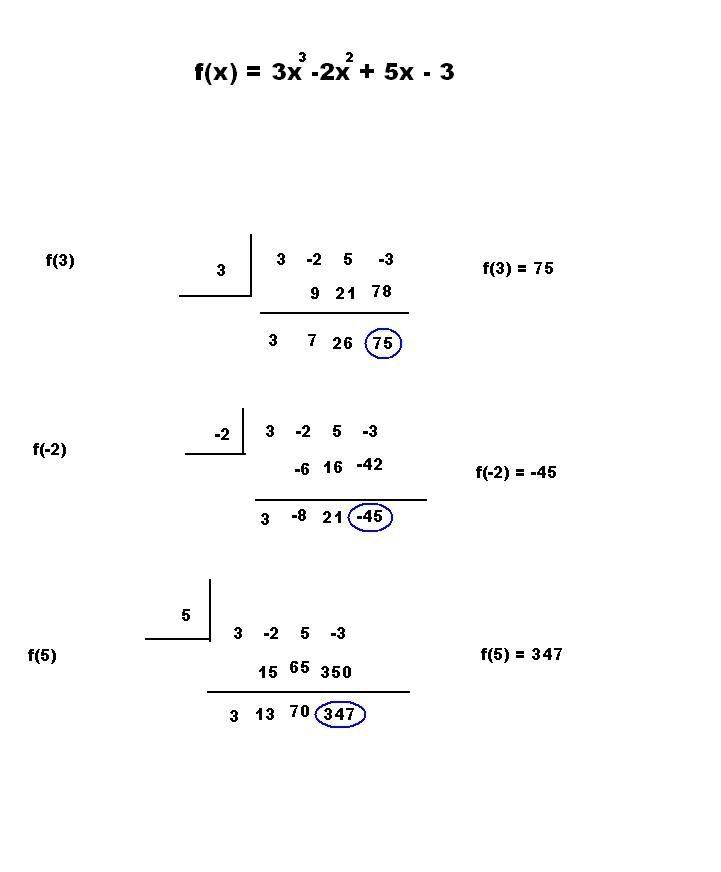
I drew up a quick diagram to illustrate using synthetic division to quickly evaluate f(x) at x values of 3, -2, and 5.
#1516 Re: This is Cool » Polynomial division, and more » 2005-12-20 19:59:55
Ok now here's synthetic division.
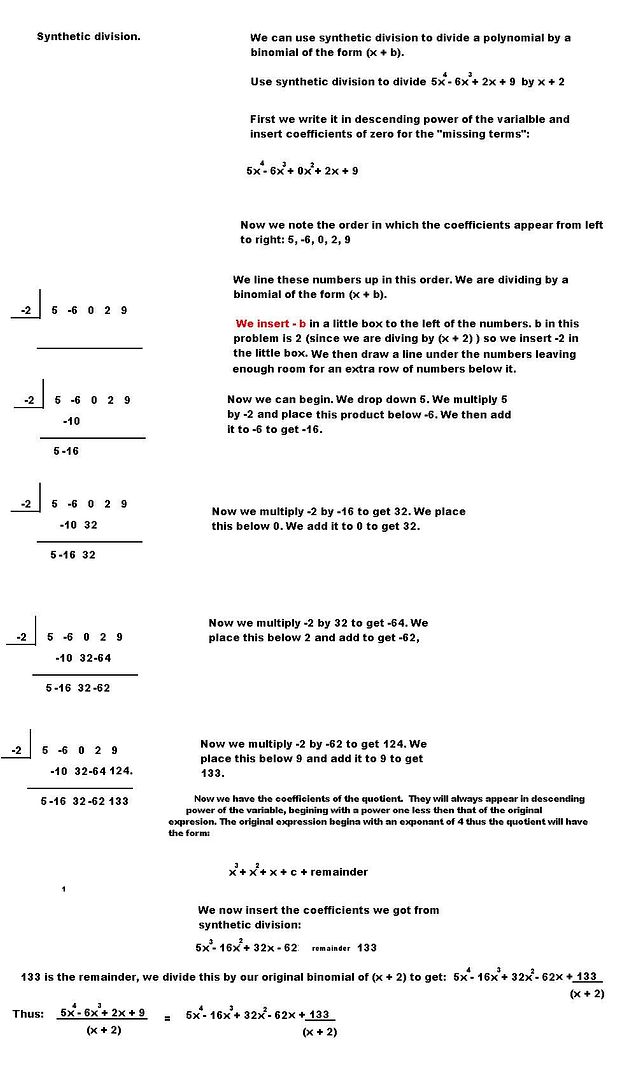
The most important thing about synthetic division is to use -b in the box when you are dividing by (x + b) and + b in the box when you are dividing by x - b. Basicly when you are dividing by x - b you use b. So if you have x + b, you can rewrite it as x - (-b) and thus (-b) would go in the box.
So to divide by x + 3 use -3 in the box. To divide by x - 1 use 1 in the box. To divide by x - 8 use 8 in the box. To divide by x + 5 use 5 in the box and so on.
Sometimes some of the coefficients of synthetic division will come to zero. This is fine, just eliminate them when your done. It's still correct.
I'll get started on the remaindor theorem in a sec.
#1517 This is Cool » Polynomial division, and more » 2005-12-20 18:53:48
- mikau
- Replies: 9
John E franklin wanted to know about synthetic division, and the rational roots theorem. These are relatively simple so I thought I'd write up some explanations for all to see.
To divide a polynomial such as 2x^3 - 3x^2 + 5x - 7 by x + b, (where b is a constant) we can use traditional polynomial division. For those who don't know/remember how this works I wrote the following tutorial. Heres what we would do if we wanted to divide (2x^3 - 3x^2 + 5x - 7) by (x - 2):
Note! Close your "favorites" menu if you can't see the whole image"
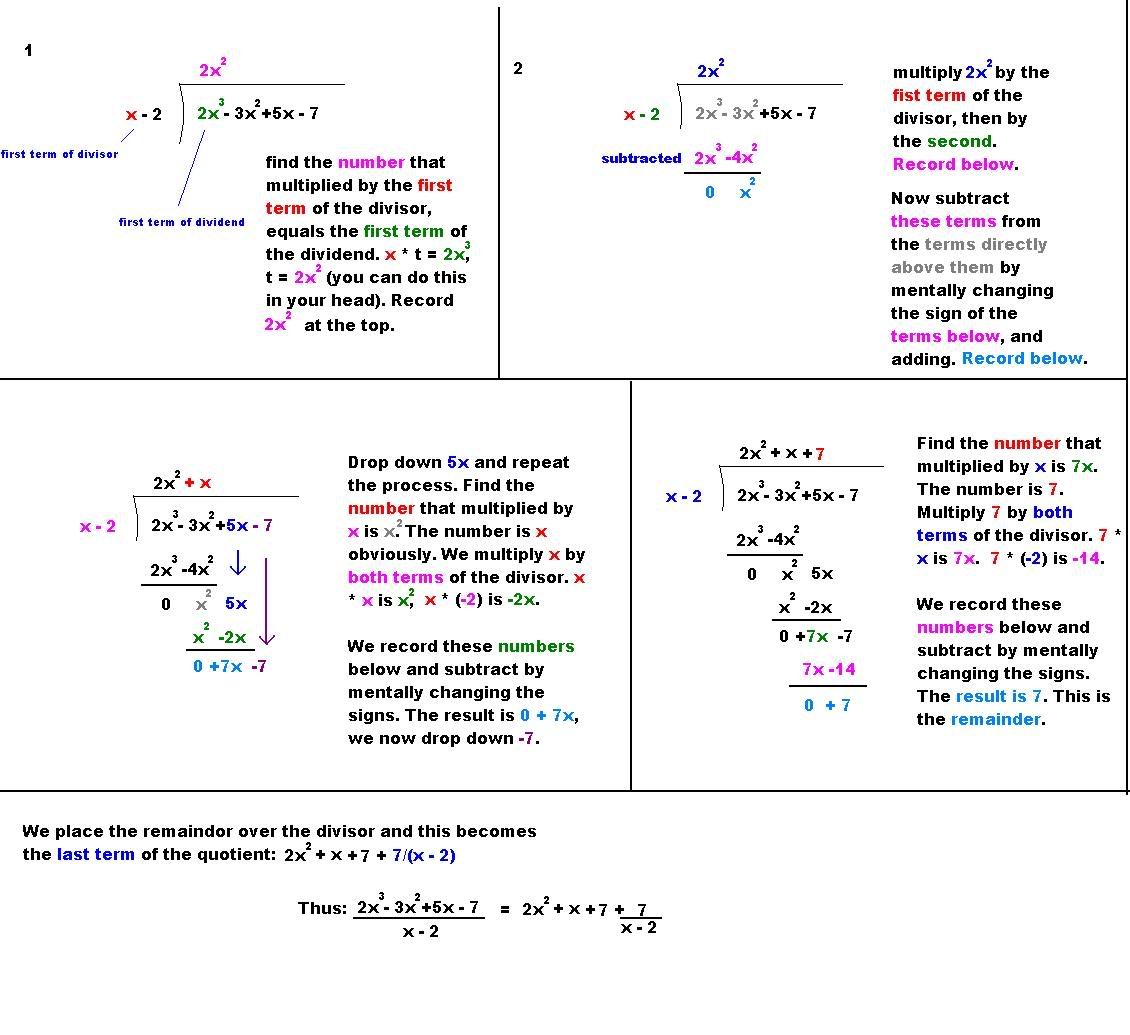
Hope that helped. One thing I really should emphasize is both the divisor and the dividend MUST be written descending power of the variable!
For those who don't remember, this means terms containing variables come first, and those with the greatest exponents come first. The constant comes last. Thus 5x^3 -2x + 6x^5 +6 + 9x^4 - x^2 would be 6x^5 + 9x^4 + 5x^3 - x^2 - 2x + 6 when written in "descending power of the variable". This MUST be done first.
The other thing I should mention is if you wanted to divide a term like x^4 + 2x^2 + 3 by (x + 3). The dividend is already in descending power of the variable, but for polynomial division, it is necessary to to rewrite this as: x^4 + 0x^3 + 2x^2 + 0x + 3 and put this in the box. If you do the problem you will imediatly see why.
You may ask, what if I wanted to divide a polynomial such as (6x^5 + 9x^4 + 5x^3 - x^2 - 2x + 6 ) by binomial containing another variable, such as (x + y) or what if I wanted to divide by a trinomial, such as (x^2 + 3x - 5)? Well I have learned some more complicated polynomial division algorithms, but for this thread, I'm only going to discuss division by a binomial of the form (x + b).
I'll explain Synthetic division shortly. A symplified quicker version of polynomial division which is much faster. Then I will explain the remainder theorem, and the rational roots theorem. :-)
#1518 Re: Help Me ! » tricky problem » 2005-12-20 14:14:46
Synthetic division is teh UBER roxxor! And very easy. I just got in from the cold and I can barely type. Later on when I'm comfy I'll write an explanation.
#1519 Re: Help Me ! » tricky problem » 2005-12-19 18:20:30
Yep yep. But like I said, it is not imediatly apparent that it can be factored into that form. If it was, then we could solve the problem right away. It leaves no remainder and thus is a zero of the expression or function when the factor equals 0.
#1520 Re: Help Me ! » tricky problem » 2005-12-19 15:04:18
I guess its just a genuine badass problem. I'll give it another shot.
(runs in the cage to take on the problem, and the ref shuts the door)
POW!
"ooooh... THAT ONE hurt him!" (mikau is carried out on a stretcher)
"NEXT!"
#1521 Help Me ! » tricky problem » 2005-12-19 12:27:50
- mikau
- Replies: 13
Let f be the function defined by f(x) = x^3 - x^2 -4x + 4. The point (a,b) is on the graph of f, and the line tangent to the graph at (a,b) passes through the point (0, -8), which is not on the graph of f. Find a and b.
Ok, the line tangent to the graph of f is the derivaitve of f.
f(x) = x^3 - x^2 -4x + 4
f'(x) = 3x^2 -2x - 4
f'(x) is merely the slope of the line. The equation of the line tangent to f is:
y = (3x^2 - 2x - 4)x + b
NOTE! b is the y intercept, not the variable b in the problem. We were told that the line tangent to f at the point (a,b) passes through (0,-8). We have not found precisly what the slope is, but no matter what it is, it will have a value of zero at this point. Therefore:
-8 = (3(0^3) - 2(0) - 4)0 + b
thus b equals -8
So we have:
y = (3x^2 - 2x -4)x - 8
what this eqation represents is somewhat abstract. The graph of this equation and the graph of f will intersect at (a,b).
Therefore:
f(x) = (3x^2 - 2x -4)x - 8
x^3 - x^2 -4x + 4 = 3x^3 - 2x^2 -4x - 8
-2x^3 + x^2 + 12 = 0
2x^3 - x^2 - 12 = 0
as far as I can tell this can be simplified no further.
Sure you can solve this using the rational roots theorem and or synthetic division. Or with a graphing calcuator. And the answer it yields is correct. x = 2, so a =2 and b = 0. But this was a somewhat inelligent method of solving the problem I think. I think there must be a simple way to solve it, one that does not end up in a third degree polynomial that cannot be reduced. I've never seen a problem in my mathbook that required the solving of a third degree polynomial and didn't say "use a graphing calculator as an aid for solving the problem".
So, any idea's?
#1522 Re: Help Me ! » i find maths impossible,literally » 2005-12-18 12:22:37
Well thats interesting. Yeah understanding the concept and reasoning is most important, but now and then the logic behind a new concept seems difficult to grasp at first. So you just observe the steps to solve the problem, and follow them. After some practice it suddenly dawns on you, what it is your doing and why. I don't know why, but it happens all the time. To me at least. And it seems it happens to other people too.
#1523 Re: This is Cool » Maclaurin Polynomials » 2005-12-17 10:47:50
Hmmm... solids of rotation? My book teaches that. Disks, washers, shells. I haven't gotten to any yet but I think I'll be learning them within a week.
#1524 Re: Help Me ! » i find maths impossible,literally » 2005-12-17 08:34:57
Right on, Rickyswallowhead....whatever your name is.
Usually understanding of a concept comes after you are familiar with it and have worked with it for a while. You been to see the logic and reasoning behind it.
And Hippogriff, this is the philosophy of the author of my mathbook:
math is not difficult, math is differant, and that people often call things that are unfamiliar to them, difficult, and things that are familiar easy. Time and practice is required for things that are differant to become things that are familiar and thus, easy.
This really is true. Also, the author of my mathbook claims he is not particularly fond of math. But he likes what math has allowed him to do. Engineering, computer sciense, etc. Math in and of itself is completely worthless, but when applied to something, its like wielding a magic wand!
#1525 Re: This is Cool » Maclaurin Polynomials » 2005-12-17 08:23:11
Calculus III? w00t! :-D Talk about t3h r0xx0r! Too bad Saxon books only go up to calculus one.
In my oppinion computer science is something every mathematician should take. It allows you to truely harness its power!
Ah the power of math!
Uh oh... I feel it coming again..... ugh.... hold on... keep it together man... keep it to-....oh no!
wigout();
OH MY FREAKIN GOSH! MATH ROXXORS T3H B1G ONEZ!1111111