Math Is Fun Forum
You are not logged in.
- Topics: Active | Unanswered
#76 Re: Puzzles and Games » One or two Cryptic Crossword Clues etc » 2010-05-27 19:01:59
...from more than one direction.
#6
It's all the same to me if you cut off my head and my tail, because I'll still be all the same (7).
#77 Re: Puzzles and Games » One or two Cryptic Crossword Clues etc » 2010-05-27 02:15:44
Here's another:
#5
Story of a horse that never lived to tell the tale (5).
Regarding #1 in post #1 above, fill in the first letters of the three words, c,w,c. The answer is now staring you in the face...
#78 Re: Puzzles and Games » Word Game #44 » 2010-05-27 00:03:35
UPDATED RESULTS
post: #2 #3 #4 #6 #8 #9
valid: 1 0 0 0 0 0
#81 Re: Puzzles and Games » Word Game #44 » 2010-05-26 00:11:24
UPDATED RESULTS
post: #2 #3 #4 #6
valid: 1 0 0 0
#82 Re: Puzzles and Games » Janes cryptic crossword clues » 2010-05-25 20:58:26
o binga banga bonga... I no wanna dance de conga
#84 Euler Avenue » Gurth's Fractals » 2010-05-25 00:35:51
- gurthbruins
- Replies: 8
In the years 1989 -2004 I spent many hours computing fractal pictures.
Inspired originally by the exceedingly beautiful pictures of the Mandelbrot Set in The Golden Age of Mathematics.
The following picture represents my final achievement, and the furthest I could get from and beyond the Mandelbrot set.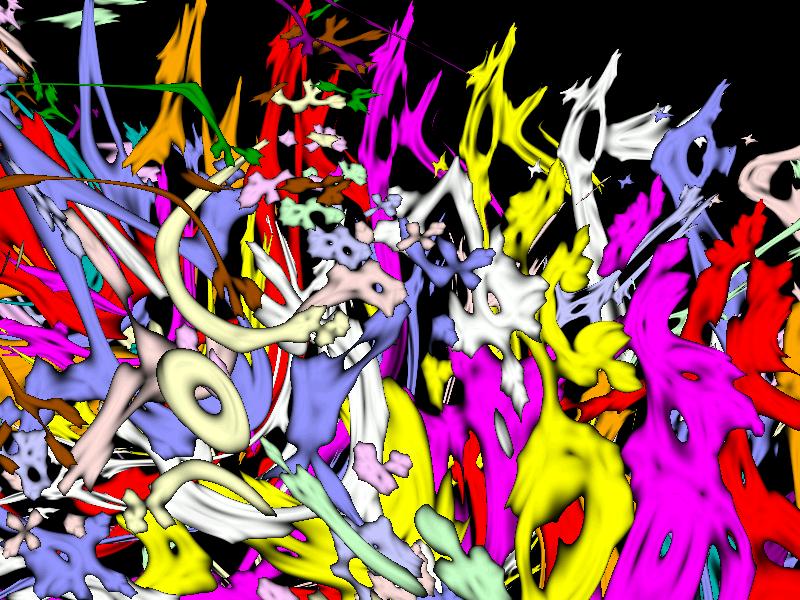
Comments: This is what I call a Solid Fractal. Meaning:
Whereas the MS and most other fractals can be considered to be functions of points on a plane, a "Solid Fractal" represents a function of the points in 3-dimensional space.
The MS treats the points on the plane as complex numbers, then repeats a Process which produces output numbers from input numbers until the value explodes. The number of repetitions required to do this (R) is the function of the starting point, and is usually portrayed by selecting various colours according to various values of R.
I deviated from using complex numbers, I took points in (x,y) format, and used some Process (differing for each fractal picture) to compute fresh points (x,y), repeating the process until the value of x or y exploded. Here again, the number of repetitions required is then used to compute the colour of the pixel on the screen at each coordinate point (x,y).
For Solid Fractals, I simply added another dimension, taking points in space in (x,y,z) format, processing the points to produce new points until explosion, to arrive at a function for each point.
Actually depicting the solid object on the screen, I used sectional views to enable the viewer to see beneath the surface to some extent.
If anyone is interested, I can furnish the computer code by which this and other of my fractals were produced.
#85 Re: Puzzles and Games » Word Game #44 » 2010-05-24 19:52:12
UPDATED RESULTS
post: #2 #3 #4
valid: 1 0 0
Up to two lists per player will be accepted up to noon GMT Wednesday 26th.
As this game is a bit more difficult than #57, you are given that words in this game are valid or invalid regardless of external circumstances, such as date, name, post # etc. There is no twist as in that game, no twist at all. Proper names are also acceptable.
#86 Re: Puzzles and Games » Word Game #57 » 2010-05-24 19:25:50
Yup, p, mathsy earned his point...
#87 Puzzles and Games » Word Game #44 » 2010-05-24 07:55:40
- gurthbruins
- Replies: 32
Word Game #44
In this game, there is a hidden rule which defines valid and invalid words.
Post a list of ten words before Noon GMT Wednesday 26 May. After that, no more than one list per player per day.
There is no scoring of points. Every list will be checked by me and I will state, by referring to the post #, how many valid words it contains, but not which.
The winner will be the first player to post a list of 10 valid words, which will also end the game. No word may be used more than once.
#88 Re: Puzzles and Games » Word Game #57 » 2010-05-24 07:44:57
Ok, mathsyperson, next game coming right up! But this game is over. Your list in post #12 would have scored 0 points, because your name doesn't start with p.
#89 Re: Puzzles and Games » Word Game #57 » 2010-05-24 03:22:30
Ha! ha! - the game's over.... well done, p!!!
#90 Re: Puzzles and Games » Word Game #57 » 2010-05-23 23:03:31
UPDATED RESULTS
post: #2 #3 #5 #7
valid: 0 1 2 1
Come to think of it, you don't really need any opponents in this game, it's just as much fun without... something like 20 Questions.
#91 Re: Puzzles and Games » Probability of a Boy » 2010-05-22 18:47:21
FURTHER CONSIDERATIONS
To restate the problem:
"Consider a pair of siblings. Given that at least one is a boy, what is the probability that both are boys?"
This "given that" is too glib. We need to ask HOW this CAN be given, or KNOWN.
Let's consider a city with a million pairs of siblings. We know that the ratio of boys:boy-girl:girls
will approximate 1:2:1. This means that if we take any pair AT RANDOM, (not a SELECTED pair) then we
can say the chances of boys:boy-girl:boys are 1:2:1.
Now we are confronted with a single pair and told that at least one is a boy. This implies that the
pair has NOT been taken at random but SELECTED from the million pairs in the city. Therefore the
chances 1:2:1 are no longer applicable. We are not informed by what process the pair has been
selected.
We are entitled to consider the possibility that the pair may have been SELECTED by some PERSON. This
person may have SELECTED a pair of boys, in which case the probability of 2 boys is 1 in 1. Or he may
have SELECTED a boy-girl pair, in which case the probability of two boys is 0 in 1.
We are entirely in the dark about how the pair has been SELECTED. We cannot do any better than confess
our complete ignorance of the probabilities.
#93 Re: Puzzles and Games » Probability of a Boy » 2010-05-22 02:09:53
No, bobby, you miss my point entirely. The possibilities BB BG GB GG are only equally likely if you know nothing. Once you know something, they no longer apply. Your reasoning is the old reasoning, which I also accepted before I thought about it more deeply.
#94 Re: Puzzles and Games » Probability of a Boy » 2010-05-22 01:47:04
What a lot of baloney! If you have two children, and you tell me at least one is a boy, this can in no way influence what the other is. That is not only intuitive, it is obviously true. Regardless of whether the mentioned boy is one born on a Tuesday, having blue eyes, being a runt or anything else, the properties of the boy have no bearing on the fact that it is a boy.
So any reasoning to the contrary must be fallacious. In fact all Devlin's reasoning contains numerous non-sequiturs (unwarranted assumptions).
The tree is also fallacious, since it assumes cases to be equally probably which are no longer equally probable. The tree, however, does highlight the inaccuracy of the 1 in 3 assumption.
In all cases, the other child is equally likely to be boy or girl, there is no information given which can affect this.
_____________________________________________________________________________________________
I posted the above before, then deleted it thinking it mistaken, so I have thought a lot before coming to the following rather earth-shaking conclusions.
The set of probabilities BB BG GB GG can only be considered valid or applicable if we have no information about the possibility of any one of these 4 possibilities. As far as we know, they are all equally possible.
The moment it is stated that one or two are boys, the applicability of the set is destroyed. We cannot simply delete the possibility GG and keep the other three, because the whole set DEPENDS on GG being a possibility.
Therefore we'll have to look at the problem afresh, and only apply probabilities to uncertain facts. We can't mix certain and uncertain data in one equation.
So we can say: there is at least one boy; that is a certainty. So we put one boy in a cage. That leaves one other child about whom we know absolutely nothing. Therefore the chances are equal that the second child will be B or G.----------------QED.
The second problem is exactly the same: the probability that the boy was born on a Tuesday is immaterial, because it is no longer a probability but a certainty.
______________________________________________________________________________
#95 Re: Puzzles and Games » Gurth's Suggestions for Posting Solutions to Problems » 2010-05-22 01:18:08
Ok, let's forget about it now. I will desist about the past. 
#96 Re: Puzzles and Games » Gurth's Suggestions for Posting Solutions to Problems » 2010-05-22 01:03:39
The moderator was the one who introduced the concept of fractional house numbers: as far as I recall, it was you yourself. I referred to your behaviour as "a boorish lack of a cooperative spirit".
I made my point a week ago. MIF is the one who has reopened this subject after a delay of one week. If moderators step out of line, I won't hesitate to rap them over the knuckles. Just grin and bear it
I don't continue to hold any grudge against those I have already punished.
#97 Re: Puzzles and Games » Gurth's Suggestions for Posting Solutions to Problems » 2010-05-22 00:45:04
You are making a distinction between "people" and "moderators." Certainly the people don't deserve to be aggravated, the moderators do. Who is to moderate the moderators? Have you complained to them about their rudeness?
I should perhaps have entitled my thread "Gurth's Suggestions to Moderators for Posting Solutions to Problems:"
#98 Re: Puzzles and Games » Word Game #57 » 2010-05-22 00:29:32
UPDATED RESULTS
post: #2 #3 #5
valid: 0 1 2
#99 Re: Puzzles and Games » Janes cryptic crossword clues » 2010-05-21 20:06:14
Yes, I didn't like it myself. I'll file it away in my head, one day the answer might occur to me. Meanwhile it can remain a mystery to me.
#100 Re: Puzzles and Games » Word Game #66 » 2010-05-21 05:25:15
Thanks for the suggestion, phrontister. I agree on the merit of having an easily-accessible authority.
But I do not wish my games to become a test of word knowledge, but rather a test of intuition and logic.
For that reason I would favour the smallest dictionary possible.
I would rather that players restricted their words to commonly used words. There will always be more than enough of such words to enable my games to be played properly. These games do not at all require a great vocabulary of arcane words, as scrabble does.
And I would like to keep it that way. Hoping you will understand.